

Social unrest grips Lebanon after pound plunges

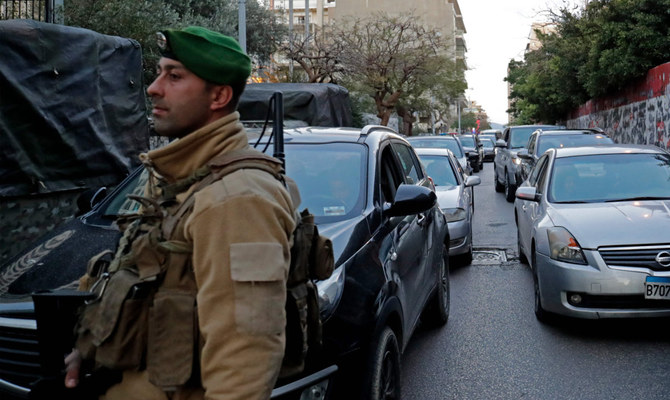
Drivers wait as traffic is brought to a hault in front of the interior ministry and the central bank on February 15, 2023, by a sit in staged by taxi drivers to show discontent due to the rising cost of living and the continuing devaluation of the Lebanese Lira. (AFP)
Short Url
Updated 15 February 2023
Follow

Social unrest grips Lebanon after pound plunges

  • Gunmen in Tripoli force shops to close, roads blocked in Beirut and rural areas

BEIRUT: A sudden fall in the value of Lebanese pound has sparked confusion in the markets, widespread anger on the street and warnings that people “can no longer afford to buy anything.” 

The exchange rate in the parallel market reached 77,000 pounds to the dollar on Wednesday, less than 24 hours after it fell to 68,000 per dollar, creating a huge discrepancy between purchase and sale prices.

Gas station owners refused to sell fuel, while government officials tried to head off protest attempts for fear of unprecedented chaos on the street.

The threat of civil unrest was highlighted by General Labor Union President Bechara Al-Asmar, who said that the union “has received information about the possibility of rioters entering the line of action.”

His comments came after gunmen in Tripoli fired in the air to force shops to close, while protesters took to the streets in Beirut and rural areas, blocking roads in anger at the alarming deterioration in their living conditions.

“What happened today in Tripoli as a result of people taking to the streets is something that makes one cry,” Al-Asmar told Arab News.

“The same happened in Beirut and Al-Awzai area at the southern entrance to Beirut, which foretells a social explosion.”

He added: “There are hidden hands that are deepening the collapse. What is the justification for the 100 percent collapse of the (Lebanese) pound today? Nothing has changed in the economic reality to cause this collapse at a tremendous pace.”

Khaled, an activist involved in the protests, said that the latest currency plunge meant people “can no longer buy anything.”

He added: “We will study the next steps of the protests. Today, all exchange shops in the city were closed and all illegal roving money changers were expelled.”

Gas stations stopped selling petrol due to the instability of the exchange rate.

The Syndicate of Gas Station Owners in Lebanon called on caretaker Energy Minister Walid Fayyad to “issue a price-fixing table for the dollar for a limited period until the situation stabilizes, as it is in the interest of citizens and owners of gas stations alike.”

George Brax, a member of the Syndicate of Gas Station Owners, said that the daily price-fixing table for fuel prices issued by the Ministry of Energy “no longer corresponds to reality.”

The fall in the value of the pound will affect not only fuel prices, but also other consumer goods, he said.

“Our lives need dollars, as we are a country that depends on imports,” he said.

After meeting station owners at noon, Fayyad confirmed that “the ministry is working on a platform to issue more than two tables per day, in line with the fluctuation of the exchange rate.”

He added: “But we will not price gasoline in dollars and we will not violate the law. According to the consumer protection law, the fuel must reach citizens in Lebanese pounds.”

British Ambassador to Lebanon, Hamish Cowell, on Wednesday warned of the fallout from the cost-of-living crisis “if all the parties in Lebanon do not agree on electing a president and starting the reform process.”

The British diplomat said that “Lebanon is an important country for Britain and the whole world, and preserving its security and stability is necessary because it represents a model for the coexistence of religions and sects.”


Turkiye blocks aid convoy to Syria’s Kobani: NGOs

Updated 5 sec ago
Follow

Turkiye blocks aid convoy to Syria’s Kobani: NGOs

  • They said the aid was blocked before it reached the Turkiye-Syria border
  • “Blocking humanitarian aid trucks carrying basic necessities is unacceptable,” said the platform

ANKARA: Turkish authorities have blocked a convoy carrying aid to Kobani, a predominantly Kurdish town in northern Syria encircled by the Syrian army, NGOs and a Turkish MP said on Saturday.
They said the aid was blocked before it reached the Turkiye-Syria border, despite an agreement announced on Friday between the Syrian government and the country’s Kurdish minority to gradually integrate the Kurds’ military and civilian institutions into the state.
Twenty-five lorries containing water, milk, baby formula and blankets collected in Diyarbakir, the main city in Turkiye’s predominantly Kurdish southeast, “were prevented from crossing the border,” said the Diyarbakir Solidarity and Protection Platform, which organized the aid campaign.
“Blocking humanitarian aid trucks carrying basic necessities is unacceptable, both from the point of view of humanitarian law and from the point of view of moral responsibility,” said the platform, which brings together several NGOs.
Earlier this week, residents of Kobani told AFP they were running out of food, water and electricity because the city was overwhelmed with people fleeing the advance of the Syrian army.
Kurdish forces accused the Syrian army of imposing a siege on Kobani, also known as Ain Al-Arab in Arabic.
“The trucks are still waiting in a depot on the highway,” said Adalet Kaya, an MP from Turkiye’s pro-Kurdish DEM party who was accompanying the convoy.
“We will continue negotiations today. We hope they will be able to cross at the Mursitpinar border post,” he told AFP.
Mursitpinar is located on the Turkish side of the border, across from Kobani.
Turkish authorities have kept the border crossing closed since 2016, while occasionally opening it briefly to allow humanitarian aid to pass through.
DEM and Turkiye’s main opposition CHP called this week for Mursitpinar to be opened “to avoid a humanitarian tragedy.”
Turkish authorities said aid convoys should use the Oncupinar border crossing, 180 kilometers (110 miles) away.
“It’s not just a question of distance. We want to be sure the aid reaches Kobani and is not redirected elsewhere by Damascus, which has imposed a siege,” said Kaya.
After months of deadlock and fighting, Damascus and the Syrian Kurds announced an agreement on Friday that would see the forces and administration of Syria’s Kurdish autonomous region gradually integrated into the Syrian state.
Kobani is around 200 kilometers from the Kurds’ stronghold in Syria’s far northeast.
Kurdish forces liberated the city from a lengthy siege by the Daesh group in 2015 and it took on symbolic value as their first major victory against the militants.
Kobani is hemmed in by the Turkish border to the north and government forces on all sides, pending the entry into the force of Friday’s agreement.