ISTANBUL: An Israeli emergency relief organization said Sunday it had suspended its earthquake rescue operation in Turkiye and returned home because of a “significant” security threat to its staff.
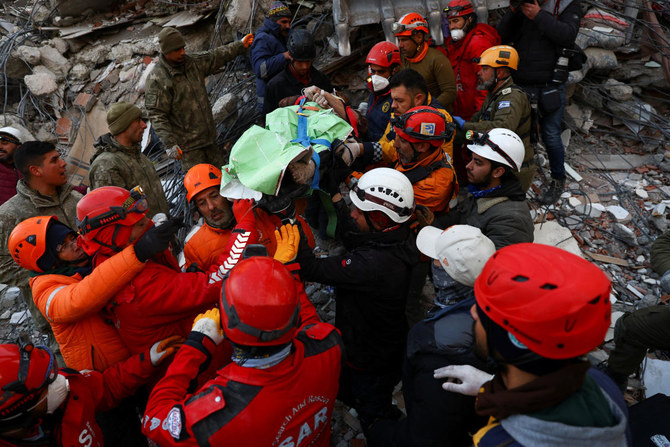
The United Hatzalah group posted images on Twitter of its team assisting Turkish Red Crescent personnel rescue a person from the rubble near the quake’s epicenter in Kahramanmaras on Saturday.
But on Sunday the group said it had taken an emergency flight back to Israel due to a “verified security threat.”
“We knew that there was a certain level of risk in sending our team to this area of Turkiye, which is close to the Syrian border,” the group’s vice president of operations Dov Maisel said.
“Unfortunately, we have just received intelligence of a concrete and immediate threat on the Israeli delegation and we have to put the security of our personnel first.”
United Hatzalah sent more than two dozen medical personnel to help deal with the impact of Monday’s 7.8-magnitude tremor.
The quake has killed nearly 30,000 people in southeastern Turkiye and more than 3,500 in Syria.
Turkish security officials have arrested dozens of people on suspicions of looting and other crimes.
The Israeli group’s announcement follows a decision by both the Austrian army and German rescue workers to suspend operations Saturday due to security fears.
The German group ISAR cited “reports of clashes between different factions” along the Syrian border and of shots being fired.


Israeli rescue team leaves Turkiye over security fears
https://arab.news/9ptek
Israeli rescue team leaves Turkiye over security fears

- United Hatzalah group posted images on Twitter of its team assisting Turkish Red Crescent personnel rescue a person from the rubble in Kahramanmaras on Saturday
- But on Sunday the group said it had taken an emergency flight back to Israel due to a “verified security threat”

Trump plans to announce Gaza funding plan, troops at first Board of Peace meeting, US officials say
- Deployment of the International Stabilization Force is a key part of the next phase of Trump’s Gaza plan, announced in September
- Delegations from at least 20 countries, including many heads of state, are expected to attend the meeting in Washington, D.C.
WASHINGTON: President Donald Trump will announce a multi-billion dollar reconstruction plan for Gaza and detail plans for a UN-authorized stabilization force for the Palestinian enclave at the first formal meeting of his Board of Peace next week, two senior US officials said on Thursday.
Delegations from at least 20 countries, including many heads of state, are expected to attend the meeting in Washington, D.C., which Trump will chair on February 19, the officials told Reuters on condition of anonymity.
The details on Trump’s plans for the first meeting of his Board of Peace for Gaza have not been previously reported.
Trump signed documents in Davos, Switzerland, on January 23 establishing the Board of Peace. The board’s creation was endorsed by a United Nations Security Council resolution as part of Trump’s Gaza plan.
While regional Middle East powers, including Turkiye, Egypt, Saudi Arabia and Qatar, as well as major emerging nations such as Indonesia, have joined the board, global powers and traditional Western US allies have been more cautious. Israeli Prime Minister Benjamin Netanyahu said on Wednesday during his visit to Washington that Israel has joined the board. Trump has stirred concerns that the Board of Peace might try to resolve other conflicts around the world and compete with the United Nations. The US officials said the meeting next week will focus solely on Gaza. They said a central part of the meeting will be Trump’s announcement of a multi-billion-dollar fund for Gaza, which will include monetary contributions from participating board members. One official called the offers “generous” and said that the United States had not made any explicit requests for donations. “People have come to us offering,” the official said. “The president will make announcements vis a vis the money raised.”
Stabilization force
Deployment of the International Stabilization Force is a key part of the next phase of Trump’s Gaza plan, announced in September. Under the first phase, a fragile ceasefire in the two-year-old war began on October 10 and Hamas has released hostages while Israel has freed detained Palestinians.
Trump will announce that several countries plan to provide several thousand troops to the stabilization force that is expected to deploy in Gaza in the months ahead, the officials said.
A primary concern for now is disarming Hamas fighters who have been reluctant to give up their weapons. Under Trump’s Gaza plan, Hamas members who commit to peaceful co-existence and to decommission their weapons will be given amnesty. Members of Hamas who wish to leave Gaza will be provided safe passage to receiving countries, under the plan.
The Board of Peace meetings will also include detailed reports on the work of the National Committee for the Administration of Gaza, which was established to take over the day-to-day civil administration of Gaza Strip from Hamas. The committee announced its members and held its first meeting in January.
Other updates will cover humanitarian aid for Gaza as well as the Gaza police, the officials said.


