

Two Pakistani men indicted in $10 million Medicare fraud scheme in Chicago

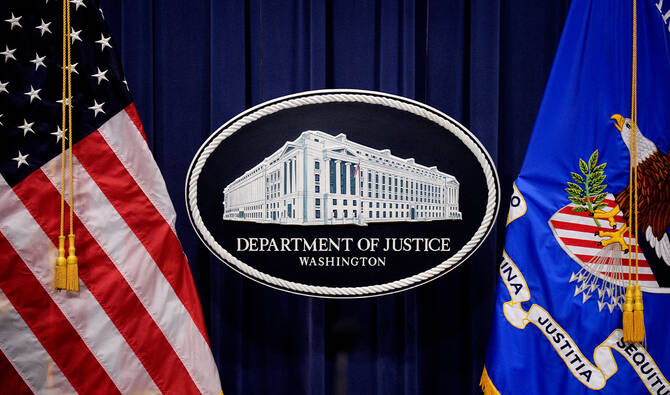
The Department of Justice logo is displayed before US Attorney General Pam Bondi arrives for a news conference at the Department of Justice in Washington DC, US, on May 6, 2025. (AFP/File)
Short Url
Updated 12 February 2026
Follow

Two Pakistani men indicted in $10 million Medicare fraud scheme in Chicago

  • Prosecutors say defendants billed Medicare and private insurers for nonexistent services
  • Authorities say millions of dollars in proceeds were laundered and transferred to Pakistan

ISLAMABAD: Two Pakistani nationals have been indicted in Chicago for allegedly participating in a $10 million health care fraud scheme that targeted Medicare and private insurers, the US Justice Department said on Thursday.

A federal grand jury charged Burhan Mirza, 31, who resided in Pakistan, and Kashif Iqbal, 48, who lived in Texas, with submitting fraudulent claims for medical services and equipment that were never provided, according to an indictment filed in the US District Court for the Northern District of Illinois.

Medicare is the US federal health insurance program primarily serving Americans aged 65 and older, as well as certain younger people with disabilities.

“Rooting out fraud is a priority for this Justice Department, and these defendants allegedly billed millions of dollars from Medicare and laundered the proceeds to Pakistan,” Deputy Attorney General Todd Blanche said in a statement.

“These alleged criminals stole from a program designed to provide health care benefits to American seniors and the disabled, not line the pockets of foreign fraudsters,” he added. “We will not tolerate these schemes that divert taxpayer dollars to criminals.”

Prosecutors said that in 2023 and 2024, the defendants and their alleged co-conspirators used nominee-owned laboratories and durable medical equipment providers to bill Medicare and private health benefit programs for nonexistent services.

According to the indictment, Mirza obtained identifying information of individuals, providers and insurers without their knowledge and used it to support fraudulent claims submitted on behalf of shell companies. Iqbal was allegedly linked to several durable medical equipment providers that filed false claims and is accused of laundering proceeds and coordinating transfers of funds to Pakistan.

Mirza faces 12 counts of health care fraud and five counts of money laundering. Iqbal is charged with 12 counts of health care fraud, six counts of money laundering and one count of making a false statement to US law enforcement. Arraignments have not yet been scheduled.

Three additional defendants, including an Indian, previously charged in the investigation, have pleaded guilty to federal health care fraud charges and are awaiting sentencing.

An indictment contains allegations, and the defendants are presumed innocent unless proven guilty in court.


Pakistan raises India's suspension of water-sharing treaty with UNGA president, seeks action

Updated 15 February 2026
Follow

Pakistan raises India's suspension of water-sharing treaty with UNGA president, seeks action

  • New Delhi said in April last year it was holding the treaty in abeyance after a gun attack in Indian-administered Kashmir
  • Official says such actions threaten lives of 240 million Pakistanis, particularly at a time of climate stress, water scarcity

ISLAMABAD: Pakistan has taken up India’s suspension of a decades-old water-sharing treaty with the president of the United Nations General Assembly (UNGA), urging action over the move that Islamabad said sets "dangerous precedents."

The Indus Waters Treaty (IWT) divides control of the Indus basin rivers between the two nuclear-armed neighbors. India said in April last year it would hold the treaty “in abeyance” after a gun attack in Indian-administered Kashmir killed more than 26 tourists. New Delhi blamed the assault on Pakistan, Islamabad denied it.

The attack led to a four-day military conflict between the neighbors last May that say them attack each other with fighter jets, missiles, drones and artillery before the United States-brokered a ceasefire. Tensions have remained high between the nuclear-armed neighbors.

During a meeting on the sidelines of the Inter-Parliamentary Union (IPU) annual hearing, Pakistan Senate Chairman Yusuf Raza Gilani told UNGA President Annalena Baerbock that India's unlawful action constituted a blatant violation of the treaty’s provisions and principles of customary international law.

"Such actions threaten the lives and livelihoods of over 240 million Pakistanis and set dangerous precedents, particularly at a time when climate stress and water scarcity demand cooperation and strict respect for international agreements," he was quoted as saying by the Pakistani information ministry.

The treaty, mediated by the World Bank, grants Pakistan rights to the Indus basin’s western rivers — Indus, Jhelum, and Chenab — for irrigation, drinking, and non-consumptive uses like hydropower, while India controls the eastern rivers — Ravi, Beas, and Sutlej — for unrestricted use but must not significantly alter their flow.

Highlighting the adverse impacts of climate change, Gilani said countries like Pakistan remain among the most severely affected and underscored the urgency of collective action, climate justice and strengthened international cooperation.

"The United Nations provides an indispensable platform for addressing these interconnected challenges," he said at the meeting.

Gilani, who was leading a six-member parliamentary delegation, this week delivered the national statement at the IPU annual hearing at the UN headquarters, calling for democratic, transparent, and accountable decision-making in order to enhance the UN’s credibility, according to the Senate of Pakistan.

“Parliaments are indispensable partners in ensuring national ownership of international commitments,” he was quoted as saying by the Senate. “Reform is essential. But it must be ‘Reform for All, Privilege for None’.”

The Senate chairman highlighted the continuing importance of the United Nations as the cornerstone of multilateral cooperation, stressing that the organization’s universal membership and Charter-based mandate remain central to promoting global peace and security.