

Turkish firm ULAQ Global and SAMI ink partnership deal 

1 / 2
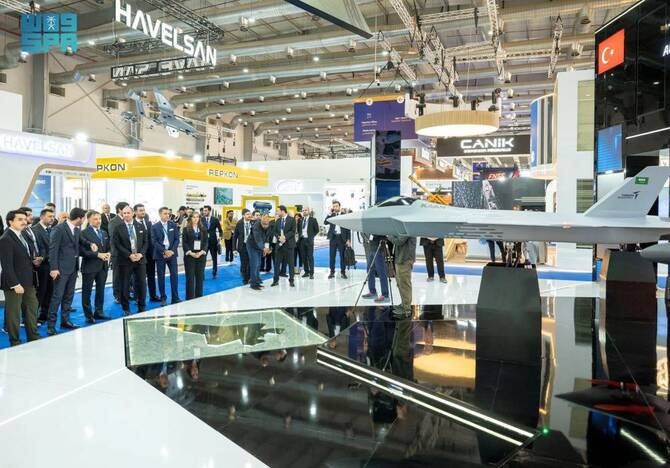
The Turkish pavilion at World Defense Show 2026. (SPA)
2 / 2
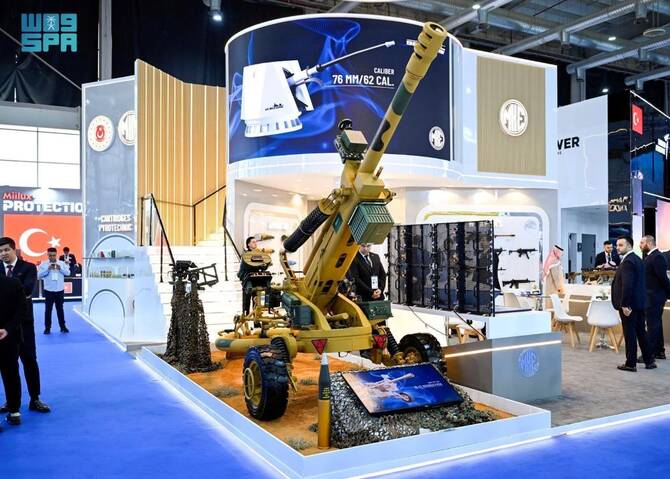
The Turkish pavilion at World Defense Show 2026. (SPA)
Short Url
Updated 12 February 2026
Follow

Turkish firm ULAQ Global and SAMI ink partnership deal 

  • Turkish firm ULAQ Global Autonomous Systems inked a deal with SAMI Autonomous Co. to strengthen cooperation in unmanned naval systems
  • World Defense Show 2026 brought together more than 1,480 exhibitors from 89 countries, including government entities and leading national and international defense companies

RIYADH: The third annual World Defense Show, which was held from Feb. 8–12, drew broad participation from companies, authorities, and government entities worldwide, showcasing the latest military and security technologies.

The Turkish pavilion drew strong international interest, featuring specialized defense companies that presented a range of advanced systems and capabilities. It also attracted senior officials and international experts in the military and security fields, who reviewed recent developments in Turkiye’s defense industry. 

Turkish firm ULAQ Global Autonomous Systems, maker of the country’s first unmanned surface vehicle, inked a deal with SAMI Autonomous Co., a subsidiary of Saudi Arabia’s Public Investment Fund, to strengthen cooperation in unmanned naval systems, Turkiye’s state-run agency Anadolu reported on Thursday.

The firm will contribute to the domestic USV production in Saudi Arabia by transferring the know-how accumulated over the years with the Saudi partner.

The deal, in line with the country’s Vision 2030 goals, will make significant contributions to Saudi Arabia’s maritime and defense capabilities.

It will establish a comprehensive cooperation framework involving design, development, production, system integration, and maintenance of unmanned maritime systems in Saudi Arabia.

Kerem Kalafatoglu, a member of the board of directors at ULAQ Global, said that their aim is to expand ULAQ on a global scale, with projects underway in Europe and the US as well. 

Kalafatoglu told Anadolu that the deal between the two firms is aimed at prioritizing joint development, technology transfer, and the domestic production of USVs.

“Our business activities are ongoing, not only with Saudi Arabia but worldwide,” he said. “This initiative will offer us the opportunity to generate sustainable profits, and we aim to export the ULAQ USV not only to Saudi Arabia but also to the rest of the world.”

The World Defense Show brings together more than 1,480 exhibitors from 89 countries, including government entities and leading national and international defense companies.


Iran will be the ‘biggest loser’ from escalation: Riyadh

Updated 09 March 2026
Follow

Iran will be the ‘biggest loser’ from escalation: Riyadh

  • Attacks on neighbors violates international law, threatens region
  • KSA rejects claims it allowed use of airspace for assaults on Iran

RIYADH: Saudi Arabia has condemned what it describes as Iran’s sustained campaign of aggression against the Kingdom, fellow GCC and other nations, cautioning that continued escalation would ultimately devastate Iran itself.

In a statement issued on Monday, Saudi Arabia’s Ministry of Foreign Affairs said that if Iran presses ahead with its attacks, it would bear the heaviest diplomatic, economic, and strategic consequences, and be “the biggest loser.”

The ministry stated that the attacks were “unacceptable under any circumstances,” and reaffirmed the Kingdom’s right to take measures to protect its people, territory, and sovereignty.

Riyadh condemned Iran’s attacks on civilian airports and oil infrastructure, calling them a violation of international law and a deliberate attempt to destabilize the region.

“The targeting of civilian airports and oil facilities is nothing but a demonstration of determination to threaten security and stability and a flagrant violation of international covenants and international law,” the statement said.

The ministry also pushed back against recent remarks by Iran’s President Masoud Pezeshkian, who had publicly stated that Tehran had no intention of attacking neighboring countries.

The ministry rejected that assurance as hollow, arguing that Iran’s strikes had continued unabated both during and after the speech, driven by what Riyadh called “flimsy pretexts.”

Saudi Arabia rejected Iran’s allegation that the Kingdom had allowed fighter jets and refueling aircraft to launch from Saudi territory to participate in hostilities against Iran.

“The reality is that those aircraft are conducting air patrols to monitor and protect the airspace of the Kingdom and the GCC states from Iranian missiles and drones,” the ministry stated.