

IMF bailout should advance economic rights of Pakistanis – Human Rights Watch

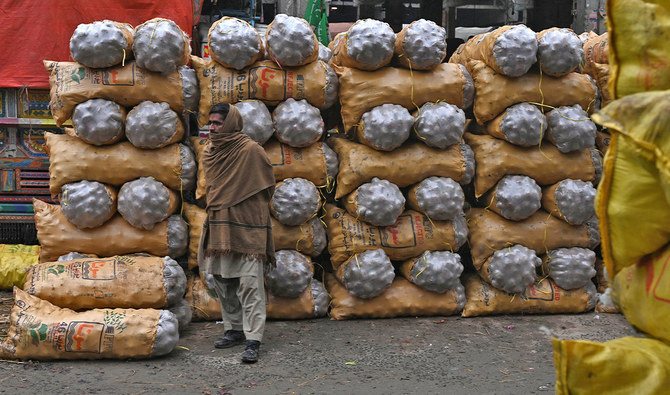
A labourer stands beside sacks of potatoes at a market in Lahore, Pakistan, on January 30, 2023. (AFP)
Short Url
Updated 08 February 2023
Follow

IMF bailout should advance economic rights of Pakistanis – Human Rights Watch

  • Human Rights Watch says the economic reforms recommended by the international lender will burden low-income segments
  • HRW maintains the IMF and Pakistan must deal with the economic crisis in a way that protects financially vulnerable people

ISLAMABAD: A global rights organization has called for the protection of economically disadvantaged people in Pakistan by broadening social protection systems in the country as officials in Islamabad discuss structural reforms with an International Monetary Fund (IMF) delegation to unlock a stalled bailout program amid a severe dollar liquidity crunch.

The negotiations between the two sides began on February 1 and are expected to conclude during the ongoing week. A successful outcome of the talks will help the government secure $1.1 billion from the international lender under a loan agreement signed in 2019.

The financial assistance from the IMF is likely to ease the crippling shortage of foreign exchange in Pakistan and make other sources of funding accessible to the country. However, the economic reforms currently under discussion are likely to put significant burden on low-income segments, making the government concerned about a likely political backlash in an election year while forcing rights organizations to ring alarm bells.

“Millions of Pakistanis have been pushed into poverty and denied their fundamental social and economic rights,” said Patricia Gossman, associate Asia director at Human Rights Watch (HRW). “The IMF and the Pakistani government have a responsibility to address this crisis in a way that prioritizes and protects low-income people.”

In a statement issued earlier this week, HRW noted the IMF was asking Pakistan to remove energy and fuel subsidies, move to a market-based exchange rate and increase its general sales tax rate. It maintained this was likely to make it harder for many people to meet their basic needs amid the rapid depreciation of local currency and soaring inflation.

“The IMF program should conduct a thorough assessment of the direct and indirect impact these adjustments would have on low-income people and adequately mitigate them,” it added. “New tax measures should be progressive in nature and should not exacerbate inequality and increase the cost of living in ways that undermine rights.”

HRW said the IMF recommendations should encourage government spending on social services, such as education, health care, and poverty-reduction programs while shoring up government revenues by improving the tax collection infrastructure and adopting stringent and transparent accountability measures.

It asked the international lender to make needed funds available as soon as possible, putting into place safeguards to protect people’s economic and social rights while pointing out they were still reeling from the devastating floods last year.

“Pakistan’s government should use the influx of funds to expand support for those worst affected by the economic crisis,” Gossman said. “The IMF should provide Pakistan the time and flexibility to achieve a sustainable, inclusive, and rights-based recovery.”


Pakistan presses UN to prevent Afghan soil from being used against neighboring countries

Updated 5 sec ago
Follow

Pakistan presses UN to prevent Afghan soil from being used against neighboring countries

  • Pakistan, which faces a renewed surge in militancy, has frequently accused Afghanistan of allowing militant groups on its soil, an allegation Kabul denies
  • Islamabad’s UN envoy says the UN Security Council has spoken with a unanimous voice and ‘it is for the Taliban to decide what path they wish to choose’

ISLAMABAD: Pakistan on Thursday urged the United Nations (UN) to prevent the use of Afghan soil by militant groups to threaten neighboring countries, saying “efforts must be made to prevent external spoilers from exploiting the situation.”

Pakistan, which has been witnessing a renewed surge in militant violence, has frequently accused Afghanistan of allowing militant groups, including the Tehreek-e-Taliban Pakistan (TTP) and the Baloch Liberation Army (BLA), to operate on its soil and India of backing them in attacks against Pakistan. Kabul and New Delhi deny the allegations.

The surge in militant violence in Pakistan triggered one of the worst skirmishes between Pakistan and Afghanistan in Oct. last year, after Islamabad hit what it called TTP targets inside Afghanistan. Pakistan has since suspended all trade with Afghanistan, despite a ceasefire reached between the neighbors in Doha that same month.

On Thursday, Pakistan voted in favor of a UN Security Council resolution that extended for 12 months the mandate of the team tasked with monitoring sanctions against the Taliban and their associated groups and individuals, welcoming the unanimous adoption of the resolution that is both “timely and necessary.”

“Pakistan remains seriously concerned by the active presence of terrorist groups on Afghan soil,” Islamabad’s permanent representative to UN Asim Iftikhar Ahmad said, while addressing the Council.

“We reiterate our call that Afghan territory must not be used for terrorism against neighboring countries and efforts must be made to prevent external spoilers from exploiting the situation.”

There was no immediate comment from the Afghan side to the statement, which came days after a suicide attack on a mosque in the Pakistani capital of Islamabad killed at least 32 people and injured dozens more. Officials said while the suicide attacker was a Pakistani national, he was trained in Afghanistan ahead of the bombing claimed by Daesh.

Unanimously adopting resolution 2816, the 15-member UNSC decided that all states will continue to implement the sanctions measures imposed both on the Taliban and related “individuals, groups, undertakings and entities” that threaten Afghanistan’s peace, stability and security.

It further renewed the mandate of the monitoring team charged with assisting the Afghanistan Sanctions Committee, which was first established in resolution 2011, for a period of 12 months from the date of its expiration this month. Among other tasks, the Council directed the monitoring team to gather information on instances of non-compliance with sanctions, keep the Committee informed of such instances and to provide recommendations on actions to respond to non-compliance.

“The Council has spoken with a unanimous voice today by highlighting these problems and remains committed to reviewing these sanctions as and when appropriate while taking into account the ground realities in Afghanistan,” Ahmad said.

“It is for the Taliban to decide what path they wish to choose for Afghanistan; whether it is the path to isolation or the path to peace and prosperity as a responsible member of the international community.”