MADRID: The suspect in a machete attack on two churches in southern Spain in which one clergyman was killed and another seriously injured is a 25-year-old Moroccan man who was due to be deported from the country, police said on Thursday.
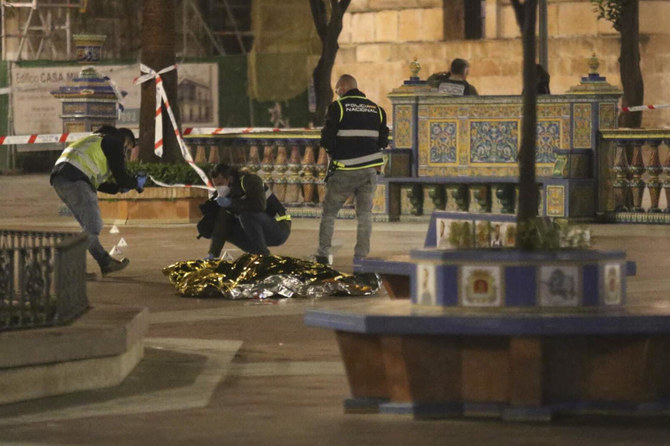
The suspect was arrested on Wednesday evening after a man wielding a machete attacked several people at the churches of San Isidro and Nuestra Senora de La Palma, around 300 meters apart, in the southern port city of Algeciras.
Police said they took the suspect to his home overnight for detectives to conduct a search, a spokesman for Spain’s National Police said.
He is expected to be transferred to the Spanish capital Madrid later on Thursday to appear before a High Court judge on terrorism charges at a time to be confirmed, police and court spokespeople said.
A police source denied local media reports that the suspect had been under surveillance by security operatives in the days or months before the attack.
He had no criminal nor terrorism-related convictions either in Spain or other allied countries, the source said, declining to be identified due to the sensitivity of the case.
The man was not in Spain legally and his deportation process began in June last year and was ongoing, the source added.
Diego Valencia, a sacristan at the Nuestra Senora de La Palma church, was killed after the assailant chased him out of the church and attacked him in the busy square outside, police and church groups said.
A second man, the priest of the parish church of San Isidro, Antonio Rodriguez, was operated on last night for serious knife wounds and is said to be in a stable condition, the city’s mayor told local television.
Local media said three others were injured, though police did not confirm.
Mayor José Antonio Landaluce said the attacker’s knife narrowly missed the priest’s spinal cord. “He lost a lot of blood, the stretcher was soaked with blood but if everything goes well he could be discharged today at the end of the day,” he told TVE. An official day of mourning has been declared by the city’s mayor who will host a gathering at midday on Thursday outside the church where Valencia died.
Spain’s Interior Minister Fernando Grande-Marlaska, who will travel to the city on Thursday, said the search of the suspect’s home will help police determine whether terrorism was at play.
“There were no third persons involved in what happened,” he said.
Mayor José Antonio Landaluce has also called on the Interior Ministry for an increase in security for the city, according to an interview with COPE radio.
The port of Algeciras in the Andalucia region serves as the main entry point for Moroccans arriving in Spain.
Spain suffered the worst Islamist militant attack on record in Europe in 2004, when 192 people were killed and more than 1,800 injured in multiple bombings on Madrid’s train system.
According to a High Court ruling, the perpetrators were linked to Al Qaeda and the Moroccan Islamic Combatant Group.
In 2017, 16 people were killed and nearly 200 injured in a series of attacks that included Islamist militants in a van mowing down pedestrians on Barcelona’s iconic Las Ramblas boulevard.

Spain church machete attack suspect was 25-year-old Moroccan, police confirm
https://arab.news/4734a
Spain church machete attack suspect was 25-year-old Moroccan, police confirm
- The man was in Spain illegally and his deportation process began in June last year and was ongoing
- The port of Algeciras in the Andalucia region serves as the main entry point for Moroccans arriving in Spain
Venezuelans await political prisoners’ release after government vow
- Rights groups estimate there are 800 to 1,200 political prisoners held in Venezuela
CARACAS: Venezuelans waited Sunday for more political prisoners to be freed as ousted president Nicolas Maduro defiantly claimed from his US jail cell that he was “doing well” after being seized by US forces a week ago.
The government of interim president Delcy Rodriguez on Thursday began to release prisoners jailed under Maduro in a gesture of openness, after pledging to cooperate with Washington over its demands for Venezuelan oil.
The government said a “large” number would be released — but rights groups and the opposition say only about 20 have walked free since, including several prominent opposition figures.
Rights groups estimate there are 800 to 1,200 political prisoners held in Venezuela.
Rodriguez, vice president under Maduro, said Venezuela would take “the diplomatic route” with Washington, after Trump claimed the United States was “in charge” of the South American country.
“Venezuela has started the process, in a BIG WAY, of releasing their political prisoners. Thank you!” Trump said in a post late Saturday on his Truth Social platform.
“I hope those prisoners will remember how lucky they got that the USA came along and did what had to be done.”
Maduro and his wife Cilia Flores were captured in a dramatic January 3 raid and taken to New York to stand trial on drug-trafficking and weapons charges, to which they pleaded not guilty.
Anxiety over prisoners
A detained police officer accused of “treason” against Venezuela died in state custody after a stroke and heart attack, the state prosecution service confirmed on Sunday.
Opposition groups said the man, Edison Jose Torres Fernandez, 52, had shared messages critical of Maduro’s government.
“We directly hold the regime of Delcy Rodriguez responsible for this death,” Justice First, part of the Venezuelan opposition alliance, said on X.
Families on Saturday night held candlelight vigils outside El Rodeo prison east of Caracas and El Helicoide, a notorious jail run by the intelligence services, holding signs with the names of their imprisoned relatives.
Prisoners include Freddy Superlano, a close ally of opposition figurehead Maria Corina Machado. He was jailed after challenging Maduro’s widely contested re-election in 2024.
“He is alive — that was what I was most afraid about,” Superlano’s wife Aurora Silva told reporters.
“He is standing strong and I am sure he is going to come out soon.”
Maduro meanwhile claimed he was “doing well” in jail in New York, his son Nicolas Maduro Guerra said in a video released Saturday by his party.
The ex-leader’s supporters rallied in Caracas on Saturday but the demonstrations were far smaller than Maduro’s camp had mustered in the past, and top figures from his government were notably absent.
The caretaker president has moved to placate the powerful pro-Maduro base by insisting Venezuela is not “subordinate” to Washington.
Pressure on Cuba
Vowing to secure US access to Venezuela’s vast crude reserves, Trump pressed top oil executives at a White House meeting on Friday to invest in Venezuela, but was met with a cautious reception.
Experts say Venezuela’s oil infrastructure is creaky after years of mismanagement and sanctions.
Washington has also confirmed that US envoys visited Caracas on Friday to discuss reopening their embassy there.
Trump on Sunday pressured Caracas’s leftist ally Cuba, which has survived in recent years under a US embargo thanks to cheap Venezuelan oil imports.
He urged Cuba to “make a deal” or face unspecified consequences, warning that the flow of Venezuelan oil and money to Havana would stop now that Maduro was gone.
Cuba’s President Miguel Diaz-Canel retorted on X that the Caribbean island was “ready to defend the homeland to the last drop of blood.”
“No one tells us what to do.”
Venezuela’s government in a statement called for “political and diplomatic dialogue” between Washington and Havana.
“International relations should be governed by the principals of international law — non-interference, sovereign equality of states and the right of peoples to govern themselves.”