

Migrants in Morocco limbo as they cling to Europe dreams

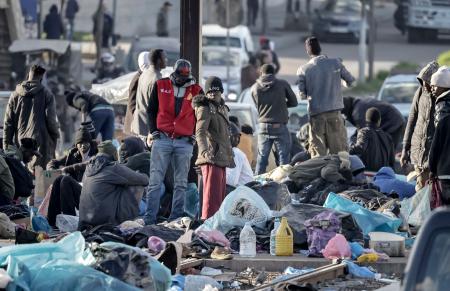
A man looks on while standing with other sub-Saharan migrants at a tramway rail construction site near the Ouled Ziane bus station in Morocco's Atlantic coastal city of Casablanca. (AFP)
Short Url
Updated 26 January 2023
Follow

Migrants in Morocco limbo as they cling to Europe dreams

  • Morocco taken periodic steps to regularise the status of migrants on its territory
  • EU considering a 500 million euro grant for Rabat to tackle clandestine migration.

Casablanca: Oumar left home in Guinea five years ago in search of a better life in Europe, but today he inhabits a daily purgatory of hunger, cold and police violence in Morocco.
“Just surviving every day is a battle,” said the 25-year-old.
“It’s exhausting not eating enough, not sleeping under a roof, not feeling safe, experiencing racism.”
He spends his nights camped out on the pavement outside a Casablanca bus station, the makeshift home of hundreds of sub-Saharan Africans whose dreams of reaching Europe are on hold in Morocco.
“We get chased away early in the morning by the police. Then we wander around and come back to the same place at the end of the day,” said Oumar.
Like the other migrants interviewed in this report, Oumar’s name has been changed.
He has tried several times to reach Spanish territory from Morocco but has so far been unsuccessful.
Oumar sits killing time opposite the Oulad Ziane bus station with a few dozen, mostly Guinean migrants.
Some cook in a makeshift kitchen while others lie exhausted on the pavement.
Someone has hung clothes and blankets on a nearby wall to dry.
Bakary, also from Guinea, said he had been living here for three years. “This is our sad reality but nobody wants to see it,” the 18-year-old said.
The migrants set up this makeshift camp on the edge of the coastal port city of 4.2 million people because of its proximity to the bus station, a major transport hub.
Today, the down-at-heel neighborhood sees repeated flare-ups with the authorities.
This month, six migrants were arrested following clashes during a police operation to evict people camping on the site of a tramway extension.
Today, they’re back on the same site, divided into groups by country of origin with everyone pitching in to survive.
“Wherever we set up camp, they chase us away,” said Boubacar, 27, from Mali. “It’s not as if we want to sleep on the tram tracks, but they don’t offer us any alternative.”
Most residents were reluctant to speak to a journalist, but one Moroccan sweets vendor said the migrants were “part of the landscape now, they don’t bother anyone.”
The station toilets are the only place the migrants have to wash.
“Sometimes they let us in, sometimes no,” said Boubacar, accusing residents of the neighborhood of racism.


Catholic charity Caritas provides migrants with basic medicines and health care.
The Moroccan press regularly voices opposition to the migrants. “End clandestine immigration!” said a recent headline in weekly newspaper Maroc Hebdo, calling it “a social, security and political problem that the state is struggling to manage.”
Noureddine Riadi of Morocco’s main human rights group, the AMDH, said the migrants were facing “difficult conditions” and called on authorities to do more to help.
“The most vulnerable should be housed in temporary residential centers,” he said.
Lamine, a 20-year-old who has tried five times to penetrate the heavily secured Spanish enclave of Melilla on Morocco’s northern coast, said he has almost given up.
“We’re struggling to keep believing, but my optimism is fading every day,” he said.
Morocco has taken periodic steps to regularise the status of migrants on its territory, many of whom arrive via the country’s desert border with Algeria, which is officially closed.
But it is under growing European pressure to strengthen border controls and restrict the movement of migrants within its territory.
Spanish newspaper El Pais has reported that the EU is considering a 500 million euro grant for Rabat to tackle clandestine migration.
In 2022, Moroccan police detained more than 32,000 migrants and arrested 566 people suspected of involvement in people trafficking, according to official figures.
But migrants in Casablanca say they are not giving up on the dream of reaching Europe.
Bakary said going home would mean “admitting defeat.”
“For me, it’s Europe or death,” he said.


Netanyahu says Israel and Hamas will enter ceasefire’s second phase soon

Updated 08 December 2025
Follow

Netanyahu says Israel and Hamas will enter ceasefire’s second phase soon

  • Says the second phase addresses the disarming of Hamas and withdrawal of Israeli troops from Gaza
  • Second stage also includes the deployment of an international force to secure Gaza and forming a temporary Palestinian government

TEL AVIV, Israel: Israeli Prime Minister Benjamin Netanyahu said Sunday that Israel and Hamas are “very shortly expected to move into the second phase of the ceasefire,” after Hamas returns the remains of the last hostage held in Gaza.
Netanyahu spoke during a news conference with visiting German Chancellor Friedrich Merz and stressed that the second phase, which addresses the disarming of Hamas and the withdrawal of Israeli troops from Gaza, could begin as soon as the end of the month.
Hamas has yet to hand over the remains of Ran Gvili, a 24-year-old police officer who was killed in the Hamas-led Oct. 7, 2023, attack that sparked the war. His body was taken to Gaza.
The ceasefire’s second stage also includes the deployment of an international force to secure Gaza and forming a temporary Palestinian government to run day-to-day affairs under the supervision of an international board led by US President Donald Trump.
A senior Hamas official on Sunday told The Associated Press the group is ready to discuss “freezing or storing or laying down” its weapons as part of the ceasefire in a possible approach to one of the most difficult issues ahead.

Netanyahu says second phase will be challenging
Netanyahu said few people believed the ceasefire’s first stage could be achieved, and the second phase is just as challenging.
“As I mentioned to the chancellor, there’s a third phase, and that is to deradicalize Gaza, something that also people believed was impossible. But it was done in Germany, it was done in Japan, it was done in the Gulf States. It can be done in Gaza, too, but of course Hamas has to be dismantled,” he said.
The return of Gvili’s remains — and Israel’s return of 15 bodies of Palestinians in exchange — would complete the first phase of Trump’s 20-point ceasefire plan.
Hamas says it has not been able to reach all remains because they are buried under rubble left by Israel’s two-year offensive in Gaza. Israel has accused the militants of stalling and threatened to resume military operations or withhold humanitarian aid if all remains are not returned.
A group of families of hostages said in a statement that “we cannot advance to the next phase before Ran Gvili returns home.”
Meanwhile, Israeli military Chief of Staff Lt. Gen. Eyal Zamir on Sunday called the so-called Yellow Line that divides the Israeli-controlled majority of Gaza from the rest of the territory a “new border.”
“We have operational control over extensive parts of the Gaza Strip and we will remain on those defense lines,” Zamir said. “The Yellow Line is a new border line, serving as a forward defensive line for our communities and a line of operational activity.”
Germany says support for Israel is unchanged
Merz said Germany, one of Israel’s closest allies, is assisting with the implementation of the second phase by sending officers and diplomats to a US-led civilian and military coordination center in southern Israel, and by sending humanitarian aid to Gaza.
The chancellor also said Germany still believes that a two-state-solution is the best possible option but that “the German federal government remains of the opinion that recognition of a Palestinian state can only come at the end of such a process, not at the beginning.”
The US-drafted plan for Gaza leaves the door open to Palestinian independence. Netanyahu has long asserted that creating a Palestinian state would reward Hamas and eventually lead to an even larger Hamas-run state on Israel’s borders.
Netanyahu also said that while he would like to visit Germany, he hasn’t planned a diplomatic trip because he is concerned about an arrest warrant issued by the International Criminal Court, the UN’s top war crimes court, last year in connection with the war in Gaza.
Merz said there are currently no plans for a visit but he may invite Netanyahu in the future. He added that he is not aware of future sanctions against Israel from the European Union nor any plans to renew German bans on military exports to Israel.
Germany had a temporary ban on exporting military equipment to Israel, which was lifted after the ceasefire began on Oct. 10.
Israel kills militant in Gaza
The Israeli military said it killed a militant who approached its troops across the Yellow Line.
Gaza’s Health Ministry says Israeli forces have killed more than 370 Palestinians since the start of the ceasefire, and that the bodies of six people killed in attacks had been brought to local hospitals over the past 24 hours.
In the original Hamas-led attack in 2023, the militants killed around 1,200 people and took more than 250 others hostage. Almost all the hostages or their remains have been returned in ceasefires or other deals.
Israel’s offensive in Gaza has killed at least 70,360 Palestinians, according to Gaza’s Health Ministry, which operates under the Hamas-run government. The ministry does not differentiate between civilians and combatants, but says that nearly half the dead have been women and children. The ministry is part of Gaza’s Hamas government and its numbers are considered reliable by the UN and other international bodies.