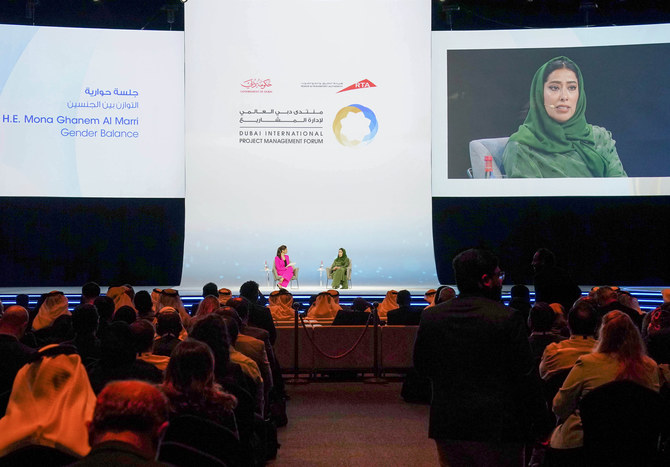
DUBAI: The UAE has become a global leader in gender balance because of the confidence the country’s leaders have shown in the abilities and potential of women, delegates at the eighth Dubai International Project Management Forum heard on Wednesday.
Mona Ghanem Al-Marri, vice president of the UAE Gender Balance Council, told the forum that the leadership’s vision for the empowerment of women ensures that they are considered equal participants and major contributors to sustainable development efforts in the nation.
The four-day forum, which concludes on Thursday, is being held under the patronage of Sheikh Hamdan bin Mohammed Al-Maktoum, the crown prince of Dubai, the Emirates News Agency reported.
Al-Marri said the rapid progress the UAE has achieved in terms of gender balance is demonstrated by the fact that the country ranked best in the Arab world, and 11th globally, on the Gender Inequality Index of the UN Development Program’s Human Development Report 2022.
The country has jumped 38 positions on the GII since the nation’s Gender Balance Council was established seven years ago. The UAE also ranked first, for a second consecutive year, in both the World Bank’s 2022 Women, Business and the Law report, and the World Economic Forum’s 2022 Gender Gap Report, she added.
Last year, Al-Marri said, the private sector in the UAE further strengthened its involvement in initiatives designed to accelerate the implementation of UN Sustainable Development Goal 5, which aims to “achieve gender equality and empower all women and girls.”
A total of 56 local and international companies operating in the country have joined a national initiative to increase the percentage of senior leadership positions filled by women to 30 percent by 2025. Some companies have already increased the percentage of senior women leaders in their organizations to 27 percent, Al-Marri noted.
She said that by demonstrating their capabilities in a variety of fields, women have gained the confidence of the UAE leadership; they now fill 27.5 percent of UAE cabinet posts, 50 percent of positions on the UAE Federal National Council, and hold key positions in the diplomatic corps.
“UAE women have made substantial contributions in various sectors and play vital leadership roles in accelerating the growth and sustainable development of the nation,” Al-Marri said.
The work of the UAE Gender Balance Council has been instrumental in improving the country’s rankings in global gender balance reports and indices, she added.
Al-Marri also highlighted the remarkable efforts of Sheikha Fatima bint Mubarak Al-Ketbi, chairperson of the General Women’s Union, to promote women’s development. She said the “mother of the nation” has worked tirelessly to ensure that women become equal partners in the development of the UAE.
She commended the Dubai International Project Management Forum for including topics related to gender balance on the agenda for the event, and said the media has a vital role to play as a partner in conveying an accurate picture of the UAE’s gender balance achievements.


Leaders’ vision for empowerment of women has made UAE a leader in gender balance, expert says
https://arab.news/yewsz
Leaders’ vision for empowerment of women has made UAE a leader in gender balance, expert says

- Since establishing a Gender Balance Council seven years ago, the country has moved up 38 places on the UN’s Gender Inequality Index
- Women now fill 27.5 percent of UAE cabinet posts, 50 percent of positions on the UAE Federal National Council, and hold key positions in the diplomatic corps


Iran envoy: Saudi Arabia a pivotal partner, relations ‘fortified’
- ‘Our contacts continue at all levels,’ Ambassador Alireza Enayati tells Asharq Al-Awsat
- Alireza Enayati: Iran and the Kingdom are keen on the security and stability of the region
RIYADH: A senior Iranian official said that relations with Saudi Arabia are “fortified” and cannot be undermined, highlighting both nations’ shared commitment to regional security and stability.
Alireza Enayati, Iran’s ambassador to Saudi Arabia, said in an exclusive interview with Asharq Al-Awsat that both countries are committed to preventing escalation and avoiding actions that could destabilize the region.
He added that contacts and coordination between the two countries are taking place at various levels, including visits, meetings and private discussions.
Enayati said: “We must recognize the sensitivity of the current situation amid repeated threats facing the region and the risk of sliding into unprecedented escalation.
“In Iran, we believe that regional stability serves the interests of all countries in the region, and we have repeatedly sensed this affirmation during our meetings and encounters with Saudi officials.”
A senior Saudi official had told Asharq Al-Awsat on Saturday that reports circulated by some media outlets about a change in the Kingdom’s position regarding escalation in the region were inaccurate.
The source said that Saudi Arabia supports efforts aimed at reaching a peaceful solution to all disputed issues between the US and Iran through dialogue and diplomatic means, stressing the Kingdom’s rejection of the use of its airspace or territory for any military actions against Iran.
Enayati pointed to the existence of “ongoing contacts and exchanges between the two countries at various levels, including visits and meetings — some of which are public, while others are held away from the media.”
The Iranian diplomat said that Tehran “considers Saudi Arabia a pivotal and influential state in the region,” adding that cooperation between the two countries on issues of mutual interest “contributes to strengthening the region’s security and stability.”
He said: “Iran and the Kingdom are keen on the security and stability of the region, and emphasize the need to avoid escalation and steer clear of anything that could disturb regional calm.”
Consultations are taking place between the two sides “stemming from a strategic conviction that has crystallized for both parties and serves their interests as well as those of the region as a whole,” Enayati added.
“The Kingdom views Iran as a reliable partner, while Iran regards Saudi Arabia as an important and effective state in the region, and their cooperation on issues of mutual interest helps consolidate regional security and stability.”
The ambassador said: “These relations are fortified and cannot be undermined, thanks to the leadership of both countries and their understanding of the inevitability of these relations, ensuring their continuity and growth, and the reflection of their positive effects on all.”
Enayati recalled the Saudi position in support of Tehran during its recent war with Israel, saying: “Iran welcomed the Saudi position supporting it during the war imposed on it, as Saudi Arabia strongly condemned the Israeli aggression against Iran, and we received a phone call that morning from the Saudi foreign minister. This stance was not surprising from our Saudi brothers, who stood by us during that phase.”
He added: “Second, any harm to Iran affects the security of the entire region, and this was clearly reflected in constructive positions, including that of the Kingdom. Third, the attack on Iran comes within a series of Israeli attacks that have targeted countries across the region, and no state is immune from these aggressions.”
Regarding talk of a negotiating framework taking shape between Iran and the US, Enayati said that Iran “entered the negotiations in 2015 and 2025 with full seriousness, but the US withdrew from them and dealt with them in a contradictory manner.”
He added: “If the US is serious about an equal dialogue without preconditions, Iran welcomes that, and Iranian officials have repeatedly affirmed this position.
“We recently heard statements indicating that the two sides are working to establish a framework for negotiations; however, negotiations cannot begin with predetermined outcomes. Rather, their results must emerge from the negotiating process itself, not be imposed on it in advance.”
Crown Prince Mohammed bin Salman, during a phone call he received from Iranian President Masoud Pezeshkian last week, highlighted the Kingdom’s support for any efforts aimed at resolving disputes through dialogue in a manner that enhances regional security and stability.
During the call, the Saudi crown prince stressed Riyadh’s position on respecting Iran’s sovereignty and the Kingdom’s refusal to allow the use of its airspace or territory for any military actions against Iran, or for attacks by any party, regardless of their direction.
Pezeshkian expressed his gratitude to Saudi Arabia for its respect of Iran’s sovereignty and territorial integrity, and his appreciation for the crown prince’s efforts and initiatives to achieve regional security and stability.


