

Green energy policies pose risk of ‘stranded lives’ in poorer countries, says IEF chief 

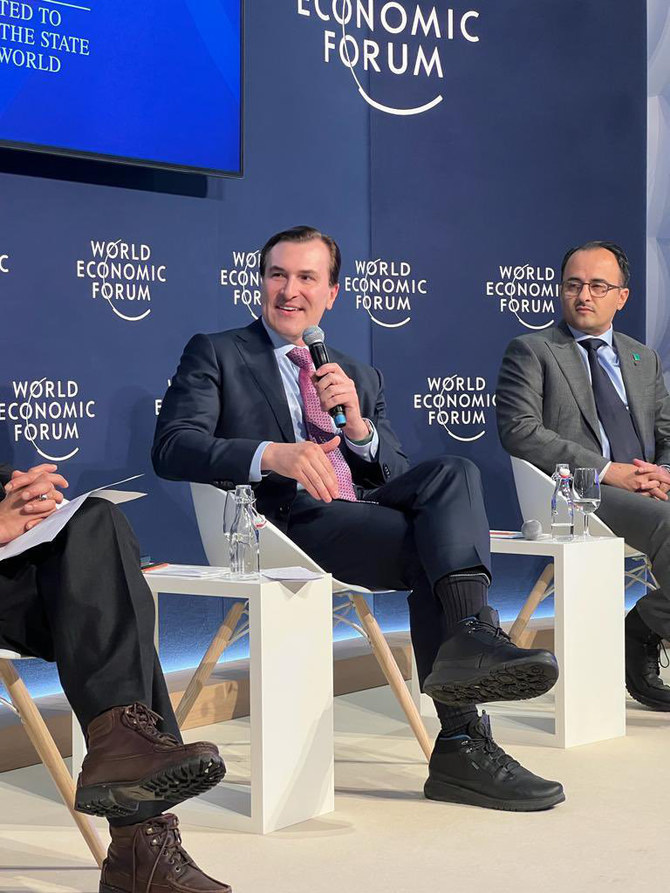
International Energy Forum Secretary-General Joe McMonigle at a WEF panel on an inclusive energy transition. (Joe McMonigle/ Twitter)
Short Url
Updated 21 January 2023
Follow

Green energy policies pose risk of ‘stranded lives’ in poorer countries, says IEF chief 

  • Developing nations are suffering because of “green” investment policies of rich countries, Joe McMonigle tells Arab News
  • OPEC+ decision to cut oil production has been proven correct, says International Energy Forum secretary general 

DAVOS: The Global South — Latin America, Africa and parts of Asia — is suffering disproportionately from the energy crisis because of the “green” investment policies of wealthier nations, according to the boss of the International Energy Forum, a Riyadh-based think-tank.

Speaking on the sidelines of the World Economic Forum in Davos, Joe McMonigle, IEF secretary general, told Arab News that government policies in the West — specifically on environmental, social and governance issues — could lead to “stranded lives” in the poorer parts of the world.

“I just think, globally, there are policies in place either on the finance sector or investors, or sometimes specifically on the energy industry, to get out of the oil and gas business. You cannot finance the Global South, you can’t finance an oil and gas project in Africa or any other place. It’s even harder to finance a renewable project, because the cost is more in a place like Africa,” he said.

“At conferences like this, and energy conferences I attend, there’s so much emphasis on stranded assets. But in Africa, they’re concerned about stranded lives today,” he added.

However, McMonigle hopes that Western hostility to fossil-fuel investment might decrease as a result of what he called a new “two-way conversation” about the energy transition and climate change, especially after the Sharm El-Sheik UN Climate Change Conference, COP27, last year and the upcoming COP28 in the UAE.

“Up until Sharm El-Sheikh, the conversation had been very much one-way, with climate groups and NGOs on the environmental and climate side doing all the talking and not really listening to other viewpoints. But now, it’s very much a two-way conversation. 

“Two years in a row of (the UN conference) being held outside of a Western capital is very important, because it brings a different perspective,” he added.

“Now you’re seeing a lot more participation by oil and gas companies. And I think there’s just an overall general acceptance now of the reality of the energy crisis and the imperatives of energy security. I think people are starting to realize that the energy transition is not easy,” he said.

The OPEC+ decision to cut 2 million barrels of oil per day last October had been proven correct, he said. “I think they’re feeling a little bit vindicated after the last cut. You know, there was a lot of hyperbole about what that would do to prices — none of that has really panned out.”

McMonigle said the outlook for oil demand was positive. “I think we’re going to see a spike in demand because of China reopening, unless something totally unforeseen happens there. In terms of the recession, though, I think that’s still very much an open question.”


Armah Sports net profit up 62% on strong personal training demand

Updated 14 sec ago
Follow

Armah Sports net profit up 62% on strong personal training demand

RIYADH: Strong demand for personal training services and continued expansion in its membership base drove Armah Sports Co.’s net proft to shareholders up 62 percent to SR62 million ($16.53 million) in 2025.

Revenue increased rising 27 percent annually to SR224.9 million in the year ending Dec. 31, while while operating revenue climbed 48 percent to SR81.1 million, reflecting operating leverage as revenue growth outpaced cost increases.

Personal training profit increased 51 percent during the year, supported by sustained demand for high-quality training services. 

Subscription and membership revenue grew 24 percent, driven by expansion in the average member base and the increasing maturity of existing clubs. The company also recorded growth in ancillary revenue streams from its fitness centers.

Industry data suggests the company’s performance reflects broader structural growth in the Kingdom’s fitness sector.

Ahmed Attallah, manager at the organizers of health and fitness exhibition FIBO Arabia, told Arab News: “Saudi Arabia’s fitness industry is undergoing structural expansion rather than cyclical growth.”

He added: “The market has grown from approximately SR3.4 billion in 2017 to SR7.7 billion in 2024 and is projected to reach SR15.5 billion by 2030. This growth is supported by regulatory reform, rising female participation, and sustained private-sector investment aligned with Vision 2030.” 

FIBO Arabia is one of the largest annual health, fitness and wellness industry exhibitions in Riyadh that brings together operators, suppliers, investors and other sector stakeholders to showcase innovations and business opportunities.

Attallah added that revenue growth across operators is increasingly driven by premium services. 

“Personal training and premium services remain underdeveloped compared to mature markets, creating room for further revenue growth. At the same time, boutique formats and digitally integrated models are attracting younger, experience-driven consumers,” he said.

Attallah stated that strong financial results from leading operators reflect underlying market fundamentals, and said: “Capital inflows, international brand expansion, and fitness infrastructure embedded within gigaprojects and mixed-use developments point to long-term confidence in the sector.”

He added: “Saudi Arabia is moving from rapid expansion to institutional maturity, positioning it as the Middle East’s leading growth market for fitness and wellness investment.”

Deferred revenue at Armah rose to SR62.6 million across the year, reflecting strong membership renewals and enhancing revenue visibility for future periods.

Cost of revenue increased 22 percent in line with higher activity levels, while operating expenses rose 46 percent, reflecting investments in automation and key senior hires to support future expansion. Interest expenses were linked to financing and lease liabilities associated with the company’s growth strategy.

During the year, Armah recorded non-recurring items including a SR9.5 million gain from a sublease transaction, a SR0.8 million gain from a rent waiver on a lease, and SR1.5 million in expenses related to preparations for transitioning to the Kingdom’s Main Market from Nomu.

Excluding non-recurring items, adjusted net income attributable to shareholders reached SR53.2 million, while adjusted earnings before interest, taxes, depreciation and amortization totaled SR115 million, in line with the reconciliation disclosed in the audited financial statements.

Armah has advanced its expansion and market positioning over the past year, announcing plans in January for a new men’s B_FIT club in Riyadh’s Irqah district. In 2025, it signed agreements for additional clubs in Al Maseef and a SR224 million development deal with Qimam Noshoz.