

Saudi mining sector achievements fuelling optimism for minerals forum with multibillion dollar investments: Minister

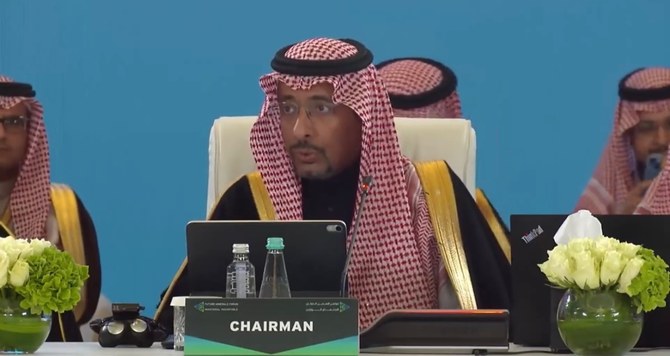
Minister of Industry and Mineral Resources Bandar Alkhorayef (Screenshot)
Short Url
Updated 11 January 2023
Follow

Saudi mining sector achievements fuelling optimism for minerals forum with multibillion dollar investments: Minister

RIYADH: Saudi Arabia’s success in attracting a record amount of investment of $32 billion last year is merely the starting point of the potential impact of the Future Minerals Forum taking place in Riyadh, the Minister of Industry and Mineral Resources said at the event's opening.

Bandar Alkhorayef used his welcome address to present evidence of tangible results from last year’s gathering to convey optimism towards the second FMF.   

The accomplishments include de-risking investments in mining exploration, production and processing, growing value chains in gold, phosphate and aluminum, as well as beginning to develop an electric vehicle ecosystem. 

In addition, Saudi Arabia “initiated the first auctions for sites on the Arabian Shield, attracting about 20 participants from around the world, bidding on our digital platform,” Alkhorayef said.  

“We achieved these results while facing the headwinds the entire world is facing: inflationary pressures, trade tensions, geopolitical polarization, and lingering public health issues.”  

He added: “But we cannot go it alone. None can.”  

Global mining leaders have come together to discuss the vital governmental roles in Africa, Western and Central Asia as catalysts for change to create a responsible and sustainable future.  

In the FMF, more than 60 countries are represented to “focus on solutions to accelerate net-zero transition and strengthen economic development through minerals and metals,” he said.  

Leaders will discuss decarbonization in addition to minerals and metals supply and value chains which are capable of satisfying global demand and thus managing global disputes. 

The development of minerals and metals in the region is crucial to form robust communities and enhance the balance of trade between this region and the rest of the world.  

“It is undeniable that the world needs more minerals and metals. The World Bank says that extraction of energy transition minerals will need to increase five-fold by 2050 to meet demand for clean energy technologies.”  

Alkhorayef went on to emphasize the large potential of the Africa, Western and Central Asia region in becoming a key bridge in the global transition.  

Since it possesses almost half of the global population and only contributes 11 percent to global gross domestic product, it shows ample room for growth.  

“This points to the high potential for the nearly 80 countries that make up the region, and a possibility to be a game changer in terms of optimizing technology, community engagement and responsible practices as a new industrial revolution begins,” he said. 

Alkhorayef also stressed the importance of trust of all stakeholders involved, including upstream, midstream and downstream, as well as the vitality of collaborating together as a region.  

“Together, we have a stronger voice when decisions about our future are made. Together, we can shape the future of mining and minerals. Together, we can chart a course toward a future that is green and equitable.” 

The Future Minerals Forum is being held in Riyadh from Jan. 10 to Jan. 12, with an estimated 200 speakers from around the world expected to attend the event. 

The summit is set to tackle several topics, including sustainability, the future of mining, energy transition, the contribution of minerals to the development of societies, digital transformation, and integrated value chains.

The second edition of the FMF comes as Saudi Arabia’s mining sector is witnessing a rapid transformation and is attracting investors from around the globe.

According to geological surveys dating back 80 years, the Kingdom is thought to have an estimated reserve of untapped mining potential valued at $1.3 trillion.

However, with the prices of valuable minerals, especially gold, copper and zinc rising, the true value of the Kingdom’s current mineral wealth could be double that figure, CEO of the Saudi Geological Survey Abdullah Al-Shamrani said in September 2022.


First EU–Saudi roundtable on critical raw materials reflects shared policy commitment

Updated 16 January 2026
Follow

First EU–Saudi roundtable on critical raw materials reflects shared policy commitment

RIYADH: The EU–Saudi Arabia Business and Investment Dialogue on Advancing Critical Raw Materials Value Chains, held in Riyadh as part of the Future Minerals Forum, brought together senior policymakers, industry leaders, and investors to advance strategic cooperation across critical raw materials value chains.

Organized under a Team Europe approach by the EU–GCC Cooperation on Green Transition Project, in coordination with the EU Delegation to Saudi Arabia, the European Chamber of Commerce in the Kingdom and in close cooperation with FMF, the dialogue provided a high-level platform to explore European actions under the EU Critical Raw Materials Act and ResourceEU alongside the Kingdom’s aspirations for minerals, industrial, and investment priorities.

This is in line with Saudi Vision 2030 and broader regional ambitions across the GCC, MENA, and Africa.

ResourceEU is the EU’s new strategic action plan, launched in late 2025, to secure a reliable supply of critical raw materials like lithium, rare earths, and cobalt, reducing dependency on single suppliers, such as China, by boosting domestic extraction, processing, recycling, stockpiling, and strategic partnerships with resource-rich nations.

The first ever EU–Saudi roundtable on critical raw materials was opened by the bloc’s Ambassador to the Kingdom, Christophe Farnaud, together with Saudi Deputy Minister for Mining Development Turki Al-Babtain, turning policy alignment into concrete cooperation.

Farnaud underlined the central role of international cooperation in the implementation of the EU’s critical raw materials policy framework.

“As the European Union advances the implementation of its Critical Raw Materials policy, international cooperation is indispensable to building secure, diversified, and sustainable value chains. Saudi Arabia is a key partner in this effort. This dialogue reflects our shared commitment to translate policy alignment into concrete business and investment cooperation that supports the green and digital transitions,” said the ambassador.

Discussions focused on strengthening resilient, diversified, and responsible CRM supply chains that are essential to the green and digital transitions.

Participants explored concrete opportunities for EU–Saudi cooperation across the full value chain, including exploration, mining, and processing and refining, as well as recycling, downstream manufacturing, and the mobilization of private investment and sustainable finance, underpinned by high environmental, social, and governance standards.

From the Saudi side, the dialogue was framed as a key contribution to the Kingdom’s industrial transformation and long-term economic diversification agenda under Vision 2030, with a strong focus on responsible resource development and global market integration.

“Developing globally competitive mineral hubs and sustainable value chains is a central pillar of Saudi Vision 2030 and the Kingdom’s industrial transformation. Our engagement with the European Union through this dialogue to strengthen upstream and downstream integration, attract high-quality investment, and advance responsible mining and processing. Enhanced cooperation with the EU, capitalizing on the demand dynamics of the EU Critical Raw Materials Act, will be key to delivering long-term value for both sides,” said Al-Babtain.

Valere Moutarlier, deputy director-general for European industry decarbonization, and directorate-general for the internal market, industry, entrepreneurship and SMEs at European Commission, said the EU Critical Raw Materials Act and ResourceEU provided a clear framework to strengthen Europe’s resilience while deepening its cooperation with international partners.

“Cooperation with Saudi Arabia is essential to advancing secure, sustainable, and diversified critical raw materials value chains. Dialogues such as this play a key role in translating policy ambitions into concrete industrial and investment cooperation,” she added.