

UAE voices support for initiatives to boost Pakistan climate resilience — Islamabad

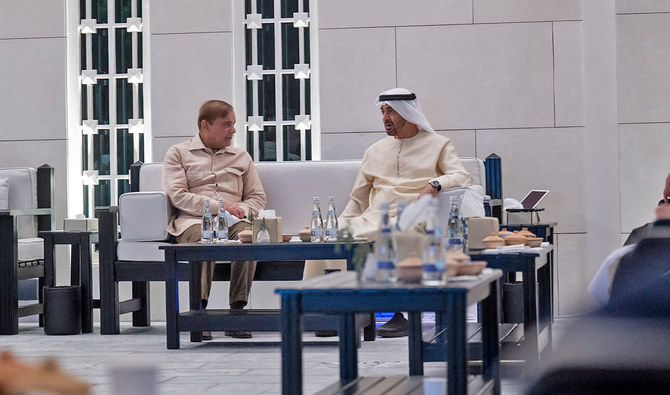
A handout picture released by UAE's Ministry of Presidential Affairs on April 30, 2022, shows UAE President Mohamed bin Zayed Al Nahyan (R) meeting with Pakistan Prime Minister Shahbaz Sharif in the Gulf emirate. (AFP/File)
Short Url
Updated 03 January 2023
Follow

UAE voices support for initiatives to boost Pakistan climate resilience — Islamabad

  • PM urges UAE president for high-level participation in Geneva donor conference for flood-hit Pakistanis 
  • Monday's gathering in Geneva aims to raise funds for the victims of last summer’s unprecedented flooding 

ISLAMABAD: United Arab Emirates (UAE) President Sheikh Mohamed bin Zayed Al-Nahyan on Tuesday assured Pakistan Prime Minister Shehbaz Sharif of the Gulf nation's support for initiatives aimed at strengthening Pakistan against the impacts of climate change, the Pakistani foreign office said. 

The statement came after a telephonic conversation between the two leaders, during which PM Sharif thanked Sheikh Mohamed for the UAE's financial and material support to Pakistan after the recent devastation caused by the climate-induced floods in Pakistan.   

The two leaders reiterated their mutual commitment to further expand and diversify special bilateral relations between Pakistan and the UAE. 

"The Prime Minister briefed His Highness on the upcoming ‘International Conference on Resilient Pakistan,’ to be held in Geneva on 9 January 2023 and solicited His Highness support for High level participation from the UAE," the foreign office said in a statement. 

"His Highness expressed UAE’s whole hearted support for the initiatives to strengthen Pakistan’s climate resilience which is the main agenda of the Conference." 

The gathering in Geneva, which is being jointly hosted by the United Nations and Pakistan, aims to raise funds for the victims of last summer’s unprecedented flooding, which experts partly attribute to climate change. The disaster killed 1,739 Pakistanis, affected 33 million and caused more than $30 billion in economic losses.  

Pakistan and the UAE enjoy close fraternal ties for five decades that are rooted firmly in common belief and shared values and culture. The UAE is Pakistan’s largest trading partner in the Middle East and a major source of investments. 

PM Sharif also invited the UAE president to visit Pakistan. 


At least 15 killed, over 80 injured in blast at Islamabad mosque

Updated 7 min 8 sec ago
Follow

At least 15 killed, over 80 injured in blast at Islamabad mosque

  • Explosion strikes during Friday prayers in Tarlai area on capital’s outskirts
  • Attack follows deadly suicide bombing near Islamabad court complex last year

ISLAMABAD: At least 15 people were killed and more than 80 injured after a blast hit a mosque on the outskirts of the Pakistani capital Islamabad on Friday, the city’s district administration said. 

The explosion occurred in the Tarlai area around the time of Friday prayers, when large numbers of worshippers gather at mosques across the country, raising fears of a mass-casualty attack. 

The attack comes amid a renewed surge in militant violence in Pakistan and follows a suicide bombing outside a district court complex in Islamabad in November last year that killed at least 12 people and wounded dozens, underscoring growing security concerns even in heavily guarded urban centers.

“The death toll from the blast in the federal capital has risen to 15,” a spokesperson for the district administration said in a statement, adding that at least 80 people were injured.

Emergency measures were imposed at the Pakistan Institute of Medical Sciences (PIMS), Polyclinic Hospital and the Capital Development Authority (CDA) Hospital, the statement said, adding that assistant commissioners had been deployed to oversee treatment of the wounded.

“The site of the blast has been completely sealed,” the district administration spokesperson said.

Earlier, police spokesperson Taqi Jawad said the blast occurred at an imambargah, a place of worship for the Shiite Muslim community.

“More details will be shared in due course,” Jawad said.

No group has so far claimed responsibility for the attack.

Islamabad has historically been less affected by militant violence than Pakistan’s northwestern and southwestern regions, but the November suicide bombing near the district courts, and Friday’s explosion, have heightened concerns about the capital’s vulnerability amid a broader nationwide resurgence of militancy.