

Pakistan’s political drama drags on as government invites ex-PM Khan’s party to rejoin parliament

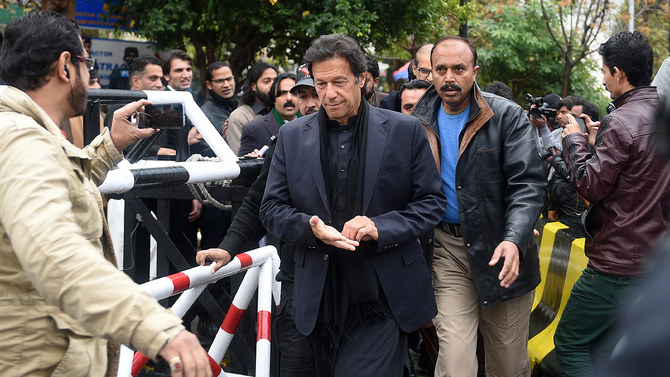
In this file photo taken on January 4, 2017, Pakistan's for prime minister Imran Khan (C) walks with officials as he leaves The Supreme Court in Islamabad. (Photo courtesy: AFP/File)
Short Url
Updated 28 December 2022
Follow

Pakistan’s political drama drags on as government invites ex-PM Khan’s party to rejoin parliament

  • Foreign minister Bilawal Bhutto Zardari tells Khan to return to parliament and become part of electoral reforms
  • Khan aide Shah Mahmood Qureshi says PTI willing to join parliament but government does not seem "serious"

ISLAMABAD: A showdown between the coalition government led by Prime Minister Shehbaz Sharif and ousted premier Imran Khan and his allies continued this week, heightening political uncertainty as the South Asian nation struggles to stave off financial default.

On Tuesday, Bilawal Bhutto Zardari, the foreign minister and a coalition partner of PM Sharif, invited Khan’s Pakistan Tehreek-e-Insaf (PTI) party to rejoin parliament instead of agitating against the government.

Khan, who was ousted from power in April following a parliamentary vote of no-confidence, has refused to accept the Sharif-led government and been holding protest rallies across the country since to demand early elections.

Khan has asked parliamentary members of the PTI party and its allies to dissolve the legislative assemblies of Punjab and Khyber Pakhtunkhwa to force the government into holding snap polls. In April, Khan also announced en masse resignations of his party’s lawmakers but the resignations were not accepted since PTI members did not appear before the assembly speaker to certify they had willingly decided to leave their seats. The PTI parliamentarians who resigned from the National Assembly in April have now asked to set up a meeting with the speaker of the assembly to get their resignations verified and continue their agitation against the government.

Against this background, Bhutto Zardari on Tuesday issued a “last warning” to Khan and asked him to return to parliament so that he could become part of electoral and accountability reforms.

“It’s a good thing that Bilawal Bhutto Zardari asked Imran Khan to return to the parliament,” Defense Minister Khawaja Asif said in a late night TV interview. “Khan’s desire to resign [from the national assembly] is not being followed by his party, as most parliamentarians of the PTI are asking the speaker not to summon them to approve the resignations.”

In response to Asif and Bhutto Zardari’s comments, Shah Mahmood Qureshi, a senior leader of the PTI, said the PTI was willing to return to the parliament but the government did not seem “serious.”

“The government is not serious about [PTI’s return] to the parliament as they are not announcing a date for the election,” he told reporters.


Pakistan slashes power tariff for industries by Rs4.4 per unit to spur growth

Updated 12 min 40 sec ago
Follow

Pakistan slashes power tariff for industries by Rs4.4 per unit to spur growth

  • The development comes as Pakistan seeks to boost exports to ensure economic recovery under a $7 billion IMF program
  • PM Sharif also announces lowering export refinance rate from 7.5 percent to 4.5 percent, and electricity wheeling charges to Rs9 per unit

ISLAMABAD: Prime Minister Shehbaz Sharif on Friday announced a Rs4.4 ($0.014) cut in electricity tariffs for industrial consumers, saying the move is aimed at lowering production costs and spurring economic activity in Pakistan.

Manufacturers in Pakistan have long complained of high electricity price, i.e. Rs22.98 per unit, for industrial consumers, arguing that it has dampened industrial growth and made local products less competitive globally.

The reduction in power tariffs for industries is expected to lower production costs that will allow exporters to offer more competitive prices in international markets and increase profit margins through higher capacity utilization.

Addressing businessmen and exporters at a ceremony in Islamabad, Sharif said there was no alternative to export-driven economic growth and his government will devise all future economic policies in consultation with them.

“Four rupees and four paisas per unit are being reduced in electricity tariffs for industry,” the prime minister announced at the ceremony. “If it were up to me, I would reduce it by another 10 rupees, but my hands are tied.”

The development comes as Pakistan, which has long struggled with boom-bust cycles, seeks to boost foreign investment and increase exports as it navigates a long path to economic recovery under a $7 billion International Monetary Fund (IMF) program.

The prime minister said they have reduced the export refinance rate from 7.5 percent to 4.5 percent.

“I believe this is a very significant facility being extended to you,” he said. “God willing, it will help Pakistan’s exports rebound and it will certainly be of immense benefit, especially to those who need financing.”

During his address, Sharif also announced lowering wheeling charges for industries by Rs9 ($0.032) per unit, noting the country’s economy had stabilized, inflation had come down to single digits and the policy rate stood at 10.5 percent.

In Pakistan, wheeling charges refer to fees paid by electricity consumers and generators to use the national grid’s transmission and distribution network to move electricity from suppliers to end-users under the Competitive Trading Bilateral Contracts Market (CTBCM).

“I think this should help you sell your power to neighboring industries,” he told businesspersons at the event.