

Egypt’s net foreign assets continue to fall as currency devaluation hurts economy

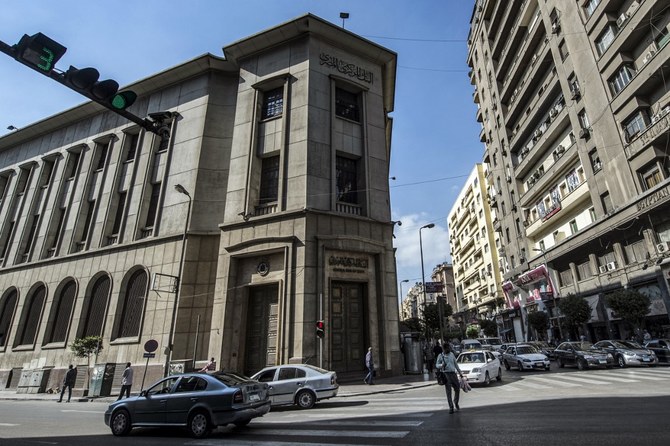
The Central Bank of Egypt in October had been allowing the pound to fall in increments of about 0.01 pounds per working day. (AFP)
Short Url
Updated 01 December 2022
Follow

Egypt’s net foreign assets continue to fall as currency devaluation hurts economy

RIYADH: Egypt’s net foreign assets fell by 109.9 billion Egyptian pounds ($4.47 billion) in October, extending a decline that began in September 2021, central bank data showed. 

The decrease works out to about $228 million after calculating for devaluations during October, Reuters reported. 

NFAs represent banking system assets that are owned by its non-residents minus liabilities, and foreign assets held by the central bank. Egypt has been relying on its NFAs to steady its devaluing currency.  

Egypt has been facing a currency crisis following Russia's invasion of Ukraine in February, prompting the North African country to begin negotiating with the International Monetary Fund for a financial assistance package. 

In October, the IMF agreed to a 46-month, $3 billion Extended Fund Facility with Egypt, welcoming a move to “durable exchange rate flexibility” and commitments to boosting social protections, according to Reuters. 

The arrangement was aimed at catalyzing a large multi-year financing package, including about $5 billion in the financial year ending in June 2023, reflecting broad international and regional support for Egypt, the IMF said in a statement. 

The Central Bank of Egypt in October had been allowing the pound to fall in increments of about 0.01 pounds per working day, but on Oct. 27 devalued it by 14.5 percent in one go as part of the $3 billion support package it concluded with the IMF last month. 

NFAs fell to a negative 551.0 billion pounds at the end of October from a negative 441.1 billion pounds a month earlier, according to the central bank data. 

NFAs stood at a positive 248 billion pounds in September 2021, before the decline began. Russia's invasion of Ukraine in February sparked further investor unease, unleashing an even bigger flood of outflows. 

Changes in the amount of NFAs represent net transactions of the banking system with the foreign sector, including those of the central bank, according to the bank. 

On Nov. 29, Saudi Arabia extended the term for a $5 billion deposit the Kingdom made to Egypt’s central bank in March after the North African country came under increasing financial pressure following Russia’s invasion of Ukraine, Saudi Press Agency reported. 

This came as the two countries want to enhance coordination, especially with regard to pumping numerous investments in foreign currencies into the Egyptian market in addition to Saudi deposits, SPA said. 

It is hoped that these investments will contribute to opening new funding channels with regional and international organizations, SPA added. 


First EU–Saudi roundtable on critical raw materials reflects shared policy commitment

Updated 16 January 2026
Follow

First EU–Saudi roundtable on critical raw materials reflects shared policy commitment

RIYADH: The EU–Saudi Arabia Business and Investment Dialogue on Advancing Critical Raw Materials Value Chains, held in Riyadh as part of the Future Minerals Forum, brought together senior policymakers, industry leaders, and investors to advance strategic cooperation across critical raw materials value chains.

Organized under a Team Europe approach by the EU–GCC Cooperation on Green Transition Project, in coordination with the EU Delegation to Saudi Arabia, the European Chamber of Commerce in the Kingdom and in close cooperation with FMF, the dialogue provided a high-level platform to explore European actions under the EU Critical Raw Materials Act and ResourceEU alongside the Kingdom’s aspirations for minerals, industrial, and investment priorities.

This is in line with Saudi Vision 2030 and broader regional ambitions across the GCC, MENA, and Africa.

ResourceEU is the EU’s new strategic action plan, launched in late 2025, to secure a reliable supply of critical raw materials like lithium, rare earths, and cobalt, reducing dependency on single suppliers, such as China, by boosting domestic extraction, processing, recycling, stockpiling, and strategic partnerships with resource-rich nations.

The first ever EU–Saudi roundtable on critical raw materials was opened by the bloc’s Ambassador to the Kingdom, Christophe Farnaud, together with Saudi Deputy Minister for Mining Development Turki Al-Babtain, turning policy alignment into concrete cooperation.

Farnaud underlined the central role of international cooperation in the implementation of the EU’s critical raw materials policy framework.

“As the European Union advances the implementation of its Critical Raw Materials policy, international cooperation is indispensable to building secure, diversified, and sustainable value chains. Saudi Arabia is a key partner in this effort. This dialogue reflects our shared commitment to translate policy alignment into concrete business and investment cooperation that supports the green and digital transitions,” said the ambassador.

Discussions focused on strengthening resilient, diversified, and responsible CRM supply chains that are essential to the green and digital transitions.

Participants explored concrete opportunities for EU–Saudi cooperation across the full value chain, including exploration, mining, and processing and refining, as well as recycling, downstream manufacturing, and the mobilization of private investment and sustainable finance, underpinned by high environmental, social, and governance standards.

From the Saudi side, the dialogue was framed as a key contribution to the Kingdom’s industrial transformation and long-term economic diversification agenda under Vision 2030, with a strong focus on responsible resource development and global market integration.

“Developing globally competitive mineral hubs and sustainable value chains is a central pillar of Saudi Vision 2030 and the Kingdom’s industrial transformation. Our engagement with the European Union through this dialogue to strengthen upstream and downstream integration, attract high-quality investment, and advance responsible mining and processing. Enhanced cooperation with the EU, capitalizing on the demand dynamics of the EU Critical Raw Materials Act, will be key to delivering long-term value for both sides,” said Al-Babtain.

Valere Moutarlier, deputy director-general for European industry decarbonization, and directorate-general for the internal market, industry, entrepreneurship and SMEs at European Commission, said the EU Critical Raw Materials Act and ResourceEU provided a clear framework to strengthen Europe’s resilience while deepening its cooperation with international partners.

“Cooperation with Saudi Arabia is essential to advancing secure, sustainable, and diversified critical raw materials value chains. Dialogues such as this play a key role in translating policy ambitions into concrete industrial and investment cooperation,” she added.