



LAHORE: In late August 2011, Shahbaz Taseer was driving to his office in Lahore when he was kidnapped at gunpoint by members of the Islamic Movement of Uzbekistan (IMU), a Taliban-affiliated Uzbek militant group.
Taseer was subsequently held captive for nearly five years in northwest Pakistan and Afghanistan, his fate determined by the infighting of the IMU, the Taliban, and the Daesh group.
Those five years are the subject of “Lost to the world: A Memoir of Faith, Family, and Five Years in Terrorist Captivity,” an acutely observed memoir released earlier this month and packed with action from drone attacks, car chases and carpet bombings. But above all, it is, as Pulitzer Prize-winning reporter Hector Tobar describes it, “a survival narrative unlike any other.”
The first few chapters feature his father, the late governor Salman Taseer, and his rise as one of Pakistan’s most successful businessmen and outspoken politicians, assassinated by his own guard in 2011 for speaking in support of a Christian woman who had been accused of blasphemy and sentenced to death.
“But at some point, I told myself, I can’t write a book about my father,” an emotional Taseer told Arab News at an interview at his home in Lahore last week. “I had to write a book about what happened to me.”
“I wanted to pull the reader into my isolation. I minimized everybody else’s experiences, my family, my mother, my wife, even my father, because that isolation was all that was mine.”
“This upside-down world” of darkness included daily whippings, Taseer said, having his fingernails pulled out and his body lashed to “ruins.” Hunger was a constant companion.
But between the stomach-churning torture and starvation as bombs rained outside his prison, Taseer recalls an image of a wanted commander wiping his children’s tears, and a young prison guard listening to a Manchester United football match with his hostage, and asking him at some point:
“If your friends met me outside of this situation, do you think they would like me?”
In the summer of 2013, the torture suddenly stopped, Taseer said, when Aya Jaan, whom he described as a “very influential woman” and “my kidnapper’s mother-in-law,” intervened.
“Women over there, they live in burqas and they live behind curtains and you can’t hear their voice,” Taseer said. “How god found this instrument to save my life — till this day I cannot believe it.
At the peak of my torture, as they were removing flesh from me, I was bleeding in buckets, this woman just tore through whatever barrier there was and said, ‘You can no longer touch this man, he is a guest in my house’.”
With tears in his eyes, Taseer described that the first time he smiled in years was because of something one of Jaan’s grandchildren did.
Even from his time in the clutches of militants, Taseer had something to miss:
“I lost her, and the children.”
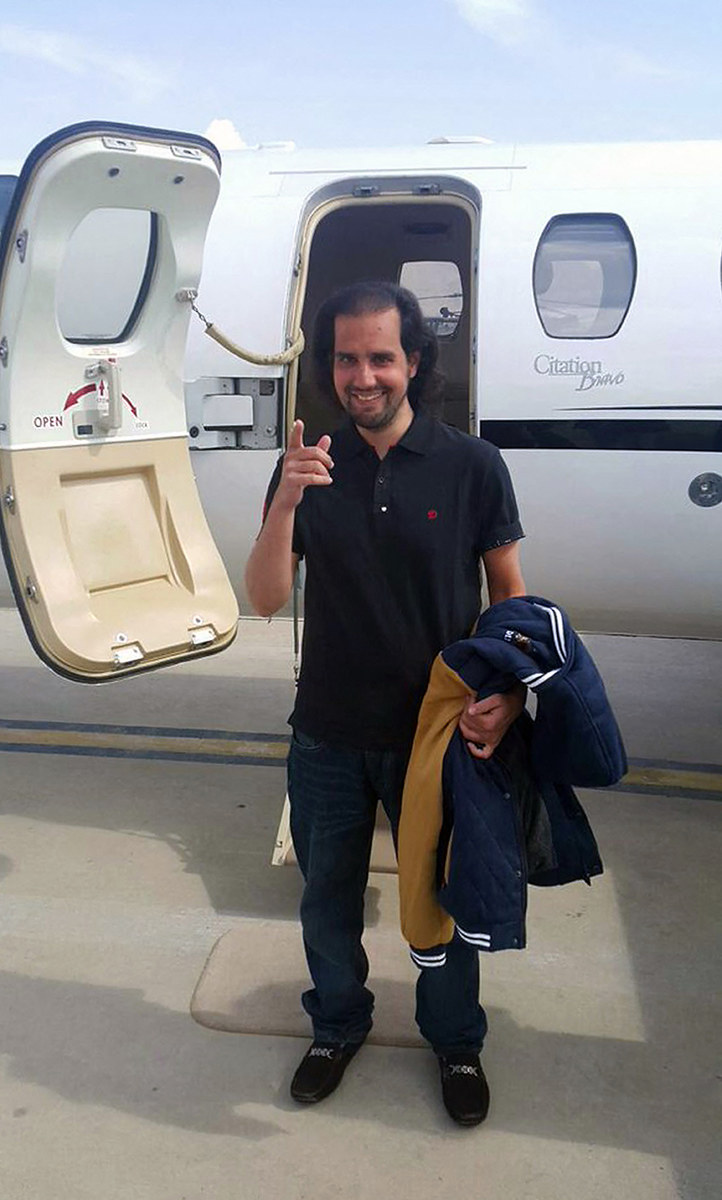
This handout picture released by Pakistan's Inter Services Public Relations (ISPR) on March 9, 2016, shows Shahbaz Taseer gesturing before boarding a chartered plane in Quetta on his way to Lahore. (Photo courtesy: AFP/File)
In 2016, Taseer secured a miraculous release from a prison in Afghanistan and, with nothing but his wits and a fake identity to keep him safe, walked free for the first time in four-and-a-half years. Coincidentally, it was the same day that his father’s killer was hanged to death in Islamabad.
As he spoke in the plush drawing room, surrounded by artefacts and old family photos of vacations and weddings, Taseer’s five-year-old niece walked in yelling his name, followed closely by a blue-eyed husky.
As he gestured her out with the dog in tow, he said with a smile: “Ultimately, it’s a happy ending.”
Asked if he had ever considered leaving Pakistan given what his family had endured here, Taseer said:
“This is my home. This is where my father died … he was murdered in cold blood for his convictions … I would never be able to look at myself in the mirror if I left this country, I would rather die.”


