Malaysia faces hung parliament for first time in history after tight election race

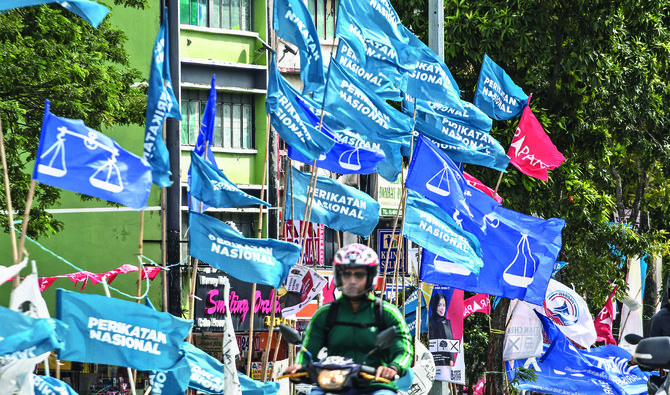
Motorcycles pass campaign flags of Malaysia’s ruling National Front coalition and Pakatan Harapan displayed in Kuala Lumpur on Sunday. (AP)
Short Url
Updated 20 November 2022
Follow

Malaysia faces hung parliament for first time in history after tight election race

  • About 14.7 million Malaysian voters cast their ballots on Saturday
  • Barisan Nasional alliance led by long-ruling UMNO saw worst-ever election performance

KUALA LUMPUR: Malaysia is facing a hung parliament for the first time in its history, with the nation’s king on Sunday calling for political leaders to propose a coalition government after a tightly contested general election failed to produce a clear winner.
Three main coalitions competed in Malaysia’s 15th general election on Saturday, which saw around 14.7 million Malaysians, almost 74 percent of the 21 million eligible voters, casting their votes.
Opposition leader Anwar Ibrahim’s reformist alliance, Pakatan Harapan, topped the race with 82 out of 222 parliamentary seats, but fell far short of the 112 needed for a majority. The Malay-centric Perikatan Nasional, led by former Prime Minister Muhyiddin Yassin, had an unexpectedly strong showing with 73 seats.
The Barisan Nasional alliance led by Prime Minister Ismail Sabri Yaakob’s long-ruling UMNO party was the biggest loser, winning only 30 seats in its worst-ever election performance as Muhyiddin’s alliance pulled support from the incumbent government’s traditional strongholds.
In a statement on Sunday, the palace said that “leaders of political parties and coalitions that have a large number of seats” must propose a new government and name a candidate for prime minister by Monday afternoon.
“His Majesty advises the people and leaders of political parties to respect the democratic process, and accept the results of the GE15 with a calm and open mind in order to maintain the integrity of the country,” the statement said.
Malaysian voters cast their ballots in the hope of ending a spate of political uncertainty in the country, which has seen three prime ministers since the previous election in 2018, amid uncertainties in the economy and fallout from the COVID-19 pandemic.
Many of Malaysia’s political old guard were wiped out in the election battle. These included former PM Mahathir Mohamad, who suffered his first election defeat in 53 years in a blow that signaled an end to his political influence and career.
The two biggest winners of Saturday’s elections were competing on Sunday to forge alliances needed to form a simple majority government, with both Anwar and Muhyiddin announcing that they have enough seats to do so.
James Chin, professor of Asian studies at the University of Tasmania, said he is expecting Perikatan Nasional to win the race and Muhyiddin to become Malaysia’s premier for the second time.
“It’s the same government coming back, so there won’t be any difference,” Chin told Arab News.
Perikatan Nasional’s ally, the Pan Malaysian Islamic Party, or PAS, was the biggest winner with a haul of 49 Parliamentary seats, securing more than double what it won in the 2018 elections.
The PAS is now the single largest party, with its rise stoking fears of identity politics in multi-ethnic Malaysia, where minorities make up 40 percent of the 32 million population.
Chin said that this year’s elections have resulted in “negative” sentiments among non-Malays, who largely feared that there will be “less space for non-Muslims” in the country.
A government led by Perikatan Nasional may result in a “stronger Malay-Muslim hegemony in the government bench,” Aizat Shamsuddin, founder of Initiate.My, a Kuala Lumpur-based organization promoting tolerance, told Arab News.
Saturday’s election outcome was not surprising for some voters, such as Kuala Lumpur-based hospitality worker Marzianie Basaludin, who told Arab News she was seeking “something new” in the country’s leadership.
“I just do not want Barisan Nasional to be the government again,” she said.


WHO chief says reasons US gave for withdrawing ‘untrue’

Updated 5 sec ago
Follow

WHO chief says reasons US gave for withdrawing ‘untrue’

  • US Secretary of State Marco Rubio and US Health Secretary Robert F. Kennedy Jr. announced in a joint statement Thursday that Washington had formally withdrawn from the WHO
  • And in a post on X, Tedros added: “Unfortunately, the reasons cited for the US decision to withdraw from WHO are untrue”

GENEVA: The head of the UN’s health agency on Saturday pushed back against Washington’s stated reasons for withdrawing from the World Health Organization, dismissing US criticism of the WHO as “untrue.”
Tedros Adhanom Ghebreyesus warned that US announcement this week that it had formally withdrawn from the WHO “makes both the US and the world less safe.”
And in a post on X, he added: “Unfortunately, the reasons cited for the US decision to withdraw from WHO are untrue.”
He insisted: “WHO has always engaged with the US, and all Member States, with full respect for their sovereignty.”
US Secretary of State Marco Rubio and US Health Secretary Robert F. Kennedy Jr. announced in a joint statement Thursday that Washington had formally withdrawn from the WHO.
They accused the agency, of numerous “failures during the Covid-19 pandemic” and of acting “repeatedly against the interests of the United States.”
The WHO has not yet confirmed that the US withdrawal has taken effect.

- ‘Trashed and tarnished’ -

The two US officials said the WHO had “trashed and tarnished” the United States, and had compromised its independence.
“The reverse is true,” the WHO said in a statement.
“As we do with every Member State, WHO has always sought to engage with the United States in good faith.”
The agency strenuously rejected the accusation from Rubio and Kennedy that its Covid response had “obstructed the timely and accurate sharing of critical information that could have saved American lives and then concealed those failures.”
Kennedy also suggested in a video posted to X Friday that the WHO was responsible for “the Americans who died alone in nursing homes (and) the small businesses that were destroyed by reckless mandates” to wear masks and get vaccinated.
The US withdrawal, he insisted, was about “protecting American sovereignty, and putting US public health back in the hands of the American people.”
Tedros warned on X that the statement “contains inaccurate information.”
“Throughout the pandemic, WHO acted quickly, shared all information it had rapidly and transparently with the world, and advised Member States on the basis of the best available evidence,” the agency said.
“WHO recommended the use of masks, vaccines and physical distancing, but at no stage recommended mask mandates, vaccine mandates or lockdowns,” it added.
“We supported sovereign governments to make decisions they believed were in the best interests of their people, but the decisions were theirs.”

- Withdrawal ‘raises issues’ -

The row came as Washington struggled to dislodge itself from the WHO, a year after US President Donald Trump signed an executive order to that effect.
The one-year withdrawal process reached completion on Thursday, but Kennedy and Rubio regretted in their statement that the UN health agency had “not approved our withdrawal and, in fact, claims that we owe it compensation.”
WHO has highlighted that when Washington joined the organization in 1948, it reserved the right to withdraw, as long as it gave one year’s notice and had met “its financial obligations to the organization in full for the current fiscal year.”
But Washington has not paid its 2024 or 2025 dues, and is behind around $260 million.
“The notification of withdrawal raises issues,” WHO said Saturday, adding that the topic would be examined during WHO’s Executive Board meeting next month and by the annual World Health Assembly meeting in May.
“We hope the US will return to active participation in WHO in the future,” Tedros said Saturday.
“Meanwhile, WHO remains steadfastly committed to working with all countries in pursuit of its core mission and constitutional mandate: the highest attainable standard of health as a fundamental right for all people.”