

Saudi Arabia ‘taking the lead’ in nature-based climate solutions, says KAPSARC

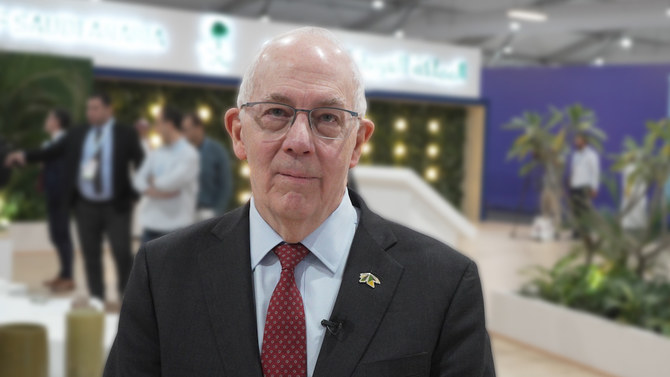
Adam Sieminski, senior adviser to the board of trustees at KAPSARC, speaking to Arab News at COP27. (AN Photo)
Short Url
Updated 21 November 2022
Follow

Saudi Arabia ‘taking the lead’ in nature-based climate solutions, says KAPSARC

  • Mangrove restoration among critical plans
  • Kingdom’s carbon storage hub key to change

SHARM EL-SHEIKH, Egypt: Nature-based solutions to climate challenges are important and somewhat overlooked globally, particularly remedies that Saudi Arabia have been championing, say experts.

The Riyadh-based King Abdullah Petroleum Studies and Research Center, in cooperation with the King Abdullah University for Science and Technology, released two reports last week on the matter at the UN Climate Change Conference, COP27, in Egypt. The solutions focused on the 4Rs of the circular carbon economy which are reduce, reuse, recycle and remove.

“Most people know about the technological type of solutions, carbon capture and storage, putting it into underground aquifers, using it for enhanced oil recovery, direct air capture, and so on,” Adam Sieminski, senior adviser to the board of trustees at KAPSARC, told Arab News.

“But nature-based solutions also fall under this ‘remove’ category, and they’re very, very important, and they are going to be part of everything that Saudi Arabia is doing to put as many opportunities on the table to deal with greenhouse gas emissions as can be done,” he added

Sieminski said the announcements that Saudi Arabia made during COP27 and the Saudi Green Initiative Forum were critical for the future, which included mangrove restoration. He highlighted the plans by Aramco and the Ministry of Energy to build a carbon capture and storage hub in the Eastern Province, and the Public Investment Fund’s initiative to establish a carbon trading platform. “All of these things are going to add very much to the ‘lead by example’ credibility that the Kingdom has been showing.”

KAPSARC, an energy and sustainability think tank, offers research, analysis, consulting and modeling on topics such as oil and gas, utilities, urban transportation, environment, and climate, with a focus on the circular carbon economy.

The think tank also released the second version of its Circular Carbon Economy Index, which was launched during the second edition of the SGI Forum that was held on the sidelines of COP 27. It measures the performance of countries around the world on how they are reducing, reusing, recycling and removing carbon dioxide and other greenhouse gas emissions from the environment. The first version was launched at the previous COP26 in Glasgow last year.

“KAPSARC hopes to continue to play a role in providing good, non-biased, fact-based research and analysis on climate challenges ... that will help to provide a good basis for policymakers and the policies that are debated and put in place at the COP meetings,” he said.

Sieminski also noted the importance of Vision 2030 for the Kingdom. “KAPSARC is trying to provide sort of the fact-based underlying work to show how Vision 2030 can be accomplished in a positive way for both energy sustainability and the economy, and this is ultimately, I think, going to be a good thing, not just for Saudi Arabia, but for the world.”


Silver crosses $77 mark while gold, platinum stretch record highs

Updated 27 December 2025
Follow

Silver crosses $77 mark while gold, platinum stretch record highs

  • Spot silver touched an all-time high of $77.40 earlier today, marking a 167% year-to-date surge driven by supply deficits
  • Spot platinum rose 9.8% to $2,437.72 per ounce, while palladium surged 14 percent to $1,927.81, its highest level in over 3 years

Silver breached the $77 mark for the first time on Friday, while gold and platinum hit record highs, buoyed by expectations of US Federal Reserve rate cuts and geopolitical tensions that fueled safe-haven demand.

Spot silver jumped 7.5% to $77.30 per ounce, as of 1:53 p.m. ET (1853 GMT), after touching an all-time high of $77.40 earlier today, marking a 167% year-to-date surge driven by supply deficits, its designation ‌as a US ‌critical mineral, and strong investment inflows.

Spot gold ‌was ⁠up ​1.2% at $4,531.41 ‌per ounce, after hitting a record $4,549.71 earlier. US gold futures for February delivery settled 1.1% higher at $4,552.70.

“Expectations for further Fed easing in 2026, a weak dollar and heightened geopolitical tensions are driving volatility in thin markets. While there is some risk of profit-taking before the year-end, the trend remains strong,” said Peter Grant, vice president and senior metals strategist ⁠at Zaner Metals.

Markets are anticipating two rate cuts in 2026, with the first likely ‌around mid-year amid speculation that US President Donald ‍Trump could name a dovish ‍Fed chair, reinforcing expectations for a more accommodative monetary stance.

The US ‍dollar index was on track for a weekly decline, enhancing the appeal of dollar-priced gold for overseas buyers.

On the geopolitical front, the US carried out airstrikes against Daesh militants in northwest Nigeria, Trump said on Thursday.

“$80 in ​silver is within reach by year-end. For gold, the next objective is $4,686.61, with $5,000 likely in the first half of next ⁠year,” Grant added.

Gold remains poised for its strongest annual gain since 1979, underpinned by Fed policy easing, central bank purchases, ETF inflows, and ongoing de-dollarization trends.

On the physical demand side, gold discounts in India widened to their highest in more than six months this week as a relentless price rally curbed retail buying, while discounts in China narrowed sharply from last week’s five-year highs.

Elsewhere, spot platinum rose 9.8% to $2,437.72 per ounce, having earlier hit a record high of $2,454.12 while palladium surged 14% to $1,927.81, its highest level in more than three years.

All precious ‌metals logged weekly gains, with platinum recording its strongest weekly rise on record.