

Climate finance promises made in Paris not being kept by rich nations: KAPSARC president

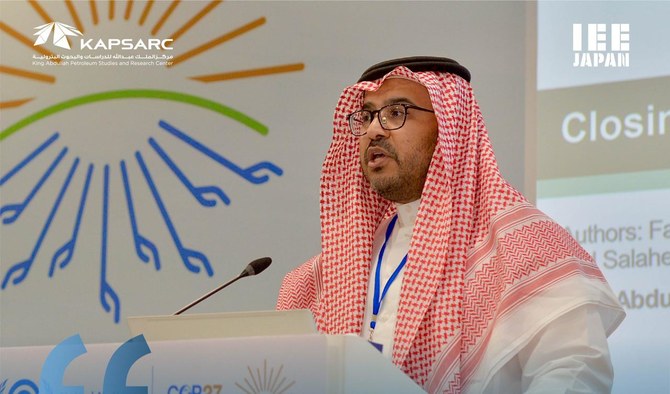
Fahad Alajlan stressed the critical need for climate finance to reach the goals of the Paris Agreement. (Supplied)
Short Url
Updated 17 November 2022
Follow

Climate finance promises made in Paris not being kept by rich nations: KAPSARC president

RIYADH: Nations with underdeveloped economies are not getting the support pledged in the Paris Agreement as richer countries are failing to meet their promises, the president of the King Abdullah Petroleum Studies and Research Center has said.

Speaking in a discussion with the Institute of Energy Economics in Japan on the sidelines of the UN Climate Change Conference in Sharm El-Sheikh, Egypt, Fahad Alajlan stressed the critical need for climate finance to reach the goals of the Paris Agreement.

The Paris Agreement, a legally binding international treaty on climate change and net-zero emission goals signed at COP 21 in 2015, saw nations with developed economies committing to channel $100 billion per year by 2020 to assist with energy transition and frameworks to mitigate global warming — a commitment which, Alajlan pointed out, is not being honored.

“We have to address and acknowledge that we come up short and need to do more in climate finance — this is vital,” he said, reflecting KAPSARC’s position as an advisory think-tank within global energy economics and sustainability, providing consulting services to the Saudi energy sector. 

Underlining the importance of private capital, Alajlan said that multilateral development banks and donors had a key role to play by de-risking energy and infrastructure projects through equity investment to attract institutional investors.

Alajlan pointed out that energy transformation provides fast opportunities for investment in infrastructure and energy and that Circular Carbon Economy frameworks significantly decrease the need for new investment and new infrastructure.

CCE advocates the reduction, recycling and reuse of carbon emissions across industrial processes, which are goals that are now familiar and accepted across the world as a way of mitigating harmful emissions.

During COP27, KAPSARC launched the second edition of the Circular Carbon Economy Index, a tool to compare how 64 countries are deploying various methods and technologies to reduce their CO2 emissions.

The CCE Index covers 90 percent of the global economy and carbon emissions, according to a statement released by the think tank.

In the 2022 edition, Norway, the Netherlands, Germany, the UK, and Switzerland top the CCE Index. At the bottom are five Sub-Saharan African countries.

The gap between these top and bottom performers is notable, which indicates that countries toward the end of the list in particular will be in need of significant assistance to be able to successfully transition to CCEs.

With regard to CCE Performance, many countries were found not yet deploying some of the most important technologies necessary for achieving full carbon circularity.

Compared with the CCE Index of last year, 57 countries improved their total CCE Index scores in 2022, while seven saw a deterioration in their scores.

Joining the KAPSARC-IEEJ discussion, which aimed to highlight the role of finance in achieving the net-zero energy transition from the Asian perspective, IEEJ's chairman, Tatsuya Terazawa said that the event was a continuation of a memorandum of understanding that his organization signed with KAPSARC in August to promote cooperation and research activity in several fields.

The IEEJ is an energy think tank in Japan that focuses on energy, economic and environmental issues, as well as the geopolitics of the Middle East.



First EU–Saudi roundtable on critical raw materials reflects shared policy commitment

Updated 16 January 2026
Follow

First EU–Saudi roundtable on critical raw materials reflects shared policy commitment

RIYADH: The EU–Saudi Arabia Business and Investment Dialogue on Advancing Critical Raw Materials Value Chains, held in Riyadh as part of the Future Minerals Forum, brought together senior policymakers, industry leaders, and investors to advance strategic cooperation across critical raw materials value chains.

Organized under a Team Europe approach by the EU–GCC Cooperation on Green Transition Project, in coordination with the EU Delegation to Saudi Arabia, the European Chamber of Commerce in the Kingdom and in close cooperation with FMF, the dialogue provided a high-level platform to explore European actions under the EU Critical Raw Materials Act and ResourceEU alongside the Kingdom’s aspirations for minerals, industrial, and investment priorities.

This is in line with Saudi Vision 2030 and broader regional ambitions across the GCC, MENA, and Africa.

ResourceEU is the EU’s new strategic action plan, launched in late 2025, to secure a reliable supply of critical raw materials like lithium, rare earths, and cobalt, reducing dependency on single suppliers, such as China, by boosting domestic extraction, processing, recycling, stockpiling, and strategic partnerships with resource-rich nations.

The first ever EU–Saudi roundtable on critical raw materials was opened by the bloc’s Ambassador to the Kingdom, Christophe Farnaud, together with Saudi Deputy Minister for Mining Development Turki Al-Babtain, turning policy alignment into concrete cooperation.

Farnaud underlined the central role of international cooperation in the implementation of the EU’s critical raw materials policy framework.

“As the European Union advances the implementation of its Critical Raw Materials policy, international cooperation is indispensable to building secure, diversified, and sustainable value chains. Saudi Arabia is a key partner in this effort. This dialogue reflects our shared commitment to translate policy alignment into concrete business and investment cooperation that supports the green and digital transitions,” said the ambassador.

Discussions focused on strengthening resilient, diversified, and responsible CRM supply chains that are essential to the green and digital transitions.

Participants explored concrete opportunities for EU–Saudi cooperation across the full value chain, including exploration, mining, and processing and refining, as well as recycling, downstream manufacturing, and the mobilization of private investment and sustainable finance, underpinned by high environmental, social, and governance standards.

From the Saudi side, the dialogue was framed as a key contribution to the Kingdom’s industrial transformation and long-term economic diversification agenda under Vision 2030, with a strong focus on responsible resource development and global market integration.

“Developing globally competitive mineral hubs and sustainable value chains is a central pillar of Saudi Vision 2030 and the Kingdom’s industrial transformation. Our engagement with the European Union through this dialogue to strengthen upstream and downstream integration, attract high-quality investment, and advance responsible mining and processing. Enhanced cooperation with the EU, capitalizing on the demand dynamics of the EU Critical Raw Materials Act, will be key to delivering long-term value for both sides,” said Al-Babtain.

Valere Moutarlier, deputy director-general for European industry decarbonization, and directorate-general for the internal market, industry, entrepreneurship and SMEs at European Commission, said the EU Critical Raw Materials Act and ResourceEU provided a clear framework to strengthen Europe’s resilience while deepening its cooperation with international partners.

“Cooperation with Saudi Arabia is essential to advancing secure, sustainable, and diversified critical raw materials value chains. Dialogues such as this play a key role in translating policy ambitions into concrete industrial and investment cooperation,” she added.