

Saudi energy minister says Kingdom hosting MENA climate week in 2023

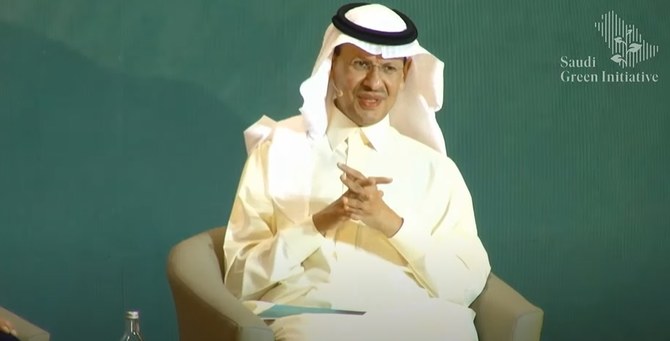
Saudi Energy Minister Prince Abdulaziz bin Salman (Screenshot)
Short Url
Updated 12 November 2022
Follow

Saudi energy minister says Kingdom hosting MENA climate week in 2023

  • Saudi Arabia is also working on establishing a regional center to advance emission reductions

SHARM EL-SHEIKH: Saudi Energy Minister Prince Abdulaziz bin Salman said on Saturday the Kingdom would host the Middle East and North Africa climate week in 2023. 

“We have been talking with UNFCC secretariat and we will be hosting in 2023 the MENA climate week,” the Prince said at a panel at the Saudi Green Initiative event taking place on the sidelines of the COP27 climate conference in Egypt. 

The minister also said Saudi Arabia was working on establishing a regional center to advance emission reductions. 

The center is set to be launched next year and will be located in Riyadh. 

"We have got the approval from the Economic and Social Commission for Western Asia, ECSWA, and next year we will be kick starting to put that center in the middle of Riyadh," said the minister.   

The Prince also revealed that the establishment of a circular carbon economy, or knowledge hub, to kick start on Jan. 1, 2023, in Riyadh. 

"We are going to be launching a CCE knowledge hub, with a hope that our friends and peers can join us in sharing the experience, knowledge and to share lessons learned," he added. 

The announcement was made during the Saudi Green Initiative on Saturday on the sidelines of COP27. 

During the panel, the Prince urged the audience to raise awareness to "the forgotten 2.6 billion citizens" on the planet who try to make a living by burning trees and cooking by using primitive materials to feed their children. 

“We should not lose sight of almost a third of the world's population, who if we were not to attend to their wellbeing, we would be actually causing a much more severe climate change issue.” 

During the summit, Saudi Crown Prince Mohammed bin Salman announced that the Kingdom is going to contribute $2.5 billion to the Middle East Green Initiative over the next 10 years and host its headquarters in the Kingdom. 

The Saudi Green Initiative program seeks to establish a regional carbon capture and storage center, an early storm warning center and cloud seeding programs as part of its efforts to create a greener future. 

On Nov. 10, the Saudi Arabian Oil Co., one of the biggest oil producers in the world, joined hands with the Saudi energy ministry to establish a carbon capture and storage hub as the Kingdom steadily progresses to achieve its net-zero ambition by 2060. 

After the announcement of the new project, the energy minister said that the Kingdom could achieve its net-zero target before the stipulated target in 2060. 


AI models could help to save lives, says experts at WGS 

Updated 11 sec ago
Follow

AI models could help to save lives, says experts at WGS 

  • With the rise of wearable health technology such as the Whoop and the Oura ring, people now have access to their own health data

DUBAI: AI language learning models could soon be used to give reliable medical advice, Director of the Stanford Center for Digital Health Dr. Eleni Linos told the World Governments Summit on Thursday.

“We will get to a point where the accuracy of these models results in people trusting them and using them even more,” she said.

Linos said that the models were currently “good enough” at offering quick guidance on how to react in situations and said they could be very helpful to parents, for example, if their child woke up in the middle of the night and needed immediate medical attention.

“I believe language learning models are equipped to answer these questions. They are definitely not perfect, but they are good enough. It can offer quick guidance into how we can react or respond to situations,” she said.

Linos said that AI language learning models could be crucial in saving lives and making quick decisions, not only in rural areas but in urban societies as well.

“Even in urban areas and for people with health insurance, getting access to doctors can take days or even months. Being able to get an answer within seconds is important, even if it’s not perfect and there is a risk that it’s not the same level as professional advice, it’s still something,” she said.

Co-founder and CEO of CREATE Medicines Daniel Getts said that data was a key element in monitoring the success of health technology.

CREATE Medicines is a clinical-stage biotechnology company based in Massachusetts that focuses on transforming how diseases are treated.

“The key element to success in monitoring health through this tech is data. Baseline data sets are going to be essential on how we apply tech ideas in relation to health,” Getts said.

He said that his company was approaching drug manufacturing and preventive medicine from a one-size-fits-all approach.

“We focus on making drugs that everyone can take, making a drug for one human doesn’t help humanity. We need drugs that are effective to every individual.”

With the rise of wearable health technology such as the Whoop and the Oura ring, people now have access to their own health data.

Linos said that these technologies monitored heart rate, sleep quality and even the food people consumed, and were changing the way people made health-conscious decisions.

“If you can imagine a world where you can call your doctor instantly, where you have the wisdom of traditional medicine passed on from generations, but that is somehow incorporated into available, tech-driven LLM that will give you not just instant, rigorous scientific advice, but that it’s informed by generations of wisdom and is available in moments … I think that would be an incredible vision for the future, where everyone in the world, regardless of where they live, what language they speak, can get the highest standard of medical advice, medical care, informed by science but also traditional wisdom at their fingertips,” she said.

Getts echoed this idea and said that the need to call a doctor was going to decrease in the future.

“Your need to call a doctor is going to become diminished over time because we’re going to empower people with education and access to therapies that are easier to administer and we can just understand how they work,” he said.