Pakistan, China central bank yuan clearing deal to reduce reliance on US dollar – analysts

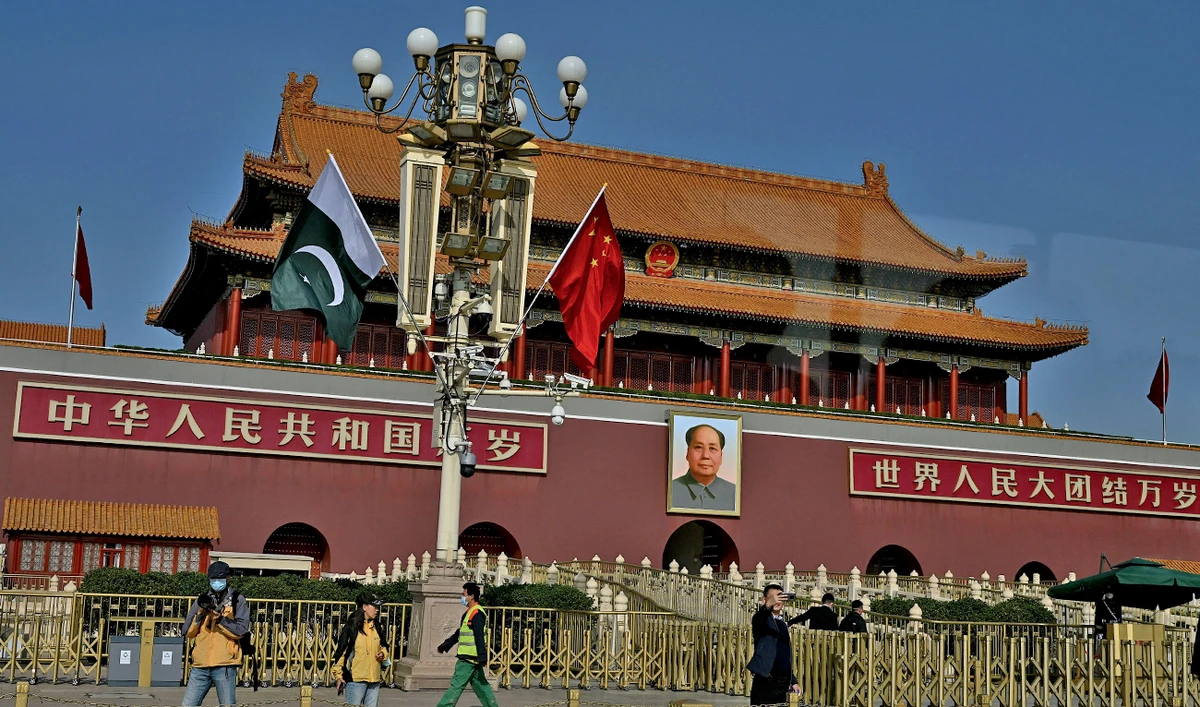
The Pakistan and Chinese national flags are seen together near the Tiananmen Gate in Beijing on November 1, 2022. Pakistan Prime Minister Shahbaz Sharif is set to arrive in China on November 1 for a two-day visit. (AFP/File)
Short Url
Updated 03 November 2022
Follow

Pakistan, China central bank yuan clearing deal to reduce reliance on US dollar – analysts

  • Agreement to boost usage of RMB for transactions between Chinese, Pakistani enterprises and banks
  • Pakistani traders say move to help avoid currency settlement via New York, make products more competitive 

KARACHI: The central banks of China and Pakistan have signed an agreement on establishing RMB (Renminbi) clearing arrangements in Pakistan, a move that would decrease both countries’ reliance on US dollars, analysts and traders said on Thursday. 

The Memorandum of Understanding (MoU) was signed between the People’s Bank of China (PBoC) and the State Bank of Pakistan (SBP) on Wednesday. Governor SBP Jameel Ahmad and Governor PBoC Yi Gang inked the memorandum, the PBOC said. 

“The establishment of the RMB clearing arrangement in Pakistan will further boost usage of RMB for cross-border transactions among Chinese and Pakistani enterprises and financial institutions,” the PBOC said in a statement. 

“This will also promote bilateral trade and investment between the two countries,” the bank added. 

No more details were offered by both sides at the time of the signing. However, Pakistani analysts and traders said the move was meant to reduce reliance on the US dollar. The decision comes at a time when Islamabad faces huge forex reserves depletion as the rupee faces pressure from increasing imports. 

“The development is meant [to bring about] less reliance on the USD (US dollar) and [encourage] more trade in RMB,” Muhammad Sohail, Chief Executive Officer of Topline Securities, told Arab News. Topline Securities is a Karachi-based brokerage firm. 

Pakistani traders said the decision will make bilateral trade between the two countries more competitive and avoid the lengthy process of routing dollar settlements through New York. 

“The major benefit of this agreement would be that Chinese products that will come to Pakistan or the Pakistani products that will go to China will be more competitive due to transactions in our own currencies,” Jawaid Ilyas, Chairman of the Pakistan-China Business Council told Arab News. 

Most dollar base payments and settlements conducted by local banks are cleared in New York for international payments. From there, the currency is sent to the respective bank for its conversion into local currencies. 

At present, the process is a bit complex. Pakistani customers make payments to local banks, who then transfer money to New York where settlements take place. From there, the money flows to the respective Chinese bank where the US dollars are converted into RMB, according to the Pakistani traders. 

“We will be able to avoid this long procedure,” Ilyas explained. “Now, the settlement would be made by both banks, so this is very good for trade.” 

Ilyas said a maximum level of currency swap would be decided by both banks, which they haven’t disclosed. 

The trade between Pakistan and China is heavily tilted in Beijing’s favor, comprising more imports and less exports. 

Overall, exports from Pakistan to China have increased by 2 percent to $2.57 billion during the first nine months of the current calendar year. The bilateral trade volume remained at $20.19 billion with 3 percent growth when compared to the same period in 2021, according to official data shared by China. 

Pakistan offloads wheat stocks, boosts provincial supply to stabilize prices

Updated 28 January 2026
Follow

Pakistan offloads wheat stocks, boosts provincial supply to stabilize prices

  • ECC approves sale of 500,000 tons of wheat, allocates 300,000 tons to Punjab
  • Cabinet body also clears utility arrears and approves vaccine and fertilizer funding

KARACHI: Pakistan’s top economic decision-making body on Wednesday approved the disposal of surplus government wheat stocks and a major inter-provincial allocation to stabilize domestic flour prices, as Islamabad seeks to manage food security risks while containing fiscal pressures.

The decisions come as Pakistan grapples with food inflation sensitivity, climate-related supply disruptions and the fiscal burden of carrying large public stocks. Wheat, the country’s staple food, is politically and economically critical because flour prices directly affect household inflation and living costs, and past volatility has triggered public unrest and costly emergency imports.

On Wednesday, the Economic Coordination Committee (ECC) of the Cabinet authorized the sale of 500,000 metric tons of wheat held by the Pakistan Agricultural Storage and Services Corporation (PASSCO), the federal grain procurement agency, through competitive bidding. It also approved the release of 300,000 metric tons to the Punjab government to ensure uninterrupted supplies to flour mills, according to an official statement issued by the Finance Division.

“The disposal of 500,000 metric tons of PASSCO wheat stock through competitive bidding aims at managing surplus stocks, reducing carrying and storage costs, and ensuring price stability in the domestic wheat market while safeguarding food security considerations,” the Finance Division said in a statement following the ECC meeting.

In a related move, the committee approved the provision of PASSCO wheat to Punjab, the country’s most populous province and a key driver of national wheat consumption, to help maintain adequate supplies for flour mills and prevent supply chain disruptions, the statement said.

Beyond food security, the ECC approved a technical supplementary grant - an off-budget allocation used to meet urgent funding needs - of Rs 10.98 billion ($39 million) to clear long-standing liabilities owed by the Pakistan Post Office Department to utility companies, part of broader efforts to address inter-government arrears that have strained public sector finances.

In the health sector, the committee authorized Rs 29.66 billion ($106 million) for the Federal Directorate of Immunization to ensure uninterrupted procurement of vaccines and syringes under the Expanded Program on Immunization, a move aimed at sustaining routine immunization coverage and preventing outbreaks of vaccine-preventable diseases.

The ECC also approved a Rs 23.42 billion ($84 million) subsidy package for imported urea, to be shared equally between the federal and provincial governments, as authorities seek to cushion farmers from rising fertilizer costs and limit spillover effects on food prices.