

Videos showing Iranian crackdown on protesters go viral as anger grows

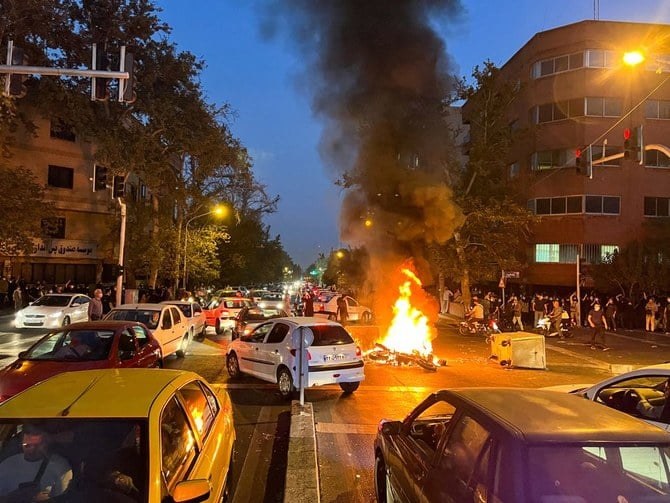
A police motorcycle burns during a protest over the death of Mahsa Amini, a woman who died after being arrested by the Islamic republic's "morality police", in Tehran, in September 2022. (Reuters)
Short Url
Updated 03 November 2022
Follow

Videos showing Iranian crackdown on protesters go viral as anger grows

  • The nationwide demonstrations are posing one of the boldest challenges since the 1979 Islamic Revolution
  • Khamenei said on Wednesday that US officials who support protests are "shameless", state media reported

DUBAI: Videos on social media showing Iranian security forces severely beating protesters have gone viral as anger grows at a widening crackdown with arrests of prominent figures from rappers to economists and lawyers aimed at ending seven weeks of unrest.
Protests ignited by the death in police custody of Mahsa Amini on Sept. 16 after her arrest for inappropriate attire have shaken Iran’s clerical establishment with people from all layers of society demanding wholesale political change.

Opinion

This section contains relevant reference points, placed in (Opinion field)

The nationwide demonstrations which have called for the death of Supreme Leader Ayatollah Ali Khamenei are posing one of the boldest challenges since the 1979 Islamic Revolution.
Iranian leaders have blamed the crisis on the United States and other Western powers, a narrative few Iranians believe.
Khamenei said on Wednesday that US officials who support protests are “shameless,” state media reported.
“Those who think the US is an untouchable power are wrong,” Khamenei said. “It is completely vulnerable as seen with current events.”
Defying a harsh warning by the chief of the widely feared elite Revolutionary Guards, Iranians have risked their lives and arrest by remaining in the street despite a bloody crackdown.
One video dated Oct. 22 that went viral on social media showed a dozen riot police beating a man at night on a street in southern Tehran. One of the officers on a motorbike ran him over then another shot him at close range. Reuters could not verify the authenticity of the footage.
“This shocking video sent from Tehran today is another horrific reminder that the cruelty of Iran’s security forces knows no bounds,” Amnesty International said on Twitter about the Oct. 22 video.
“Amid a crisis of impunity, they’re given free rein to brutally beat & shoot protesters. @UN_HRC must urgently investigate these crimes.”
Other videos of the beating of protesters, which Reuters has been unable to verify, have also spread online.
Iran’s police issued a communique on Tuesday saying that a special order was issued to examine the details of a video showing police officers beating a citizen, without giving any detail on the video in question.
“The police does not approve of harsh and unconventional treatment, the offending police officers will certainly be dealt with according to the law,” the statement read, according to Tasnim news agency.
The activist HRANA news agency said around 300 people had been killed in the unrest, including 46 minors. Iran said at least 36 members of the security forces were also killed.
Some 14,160 people have been arrested, including about 300 students, in protests in 133 cities and towns, and 129 universities, it said.
The crisis has hit Iran’s currency. The US dollar was selling for as much as 342,600 rials on the unofficial market on Wednesday, losing nearly 7 percent of its value since the protests started, according to Bonbast.com.
On Monday night, security forces went to the house of prominent economist Davoud Souri and arrested him. The officers took his laptop and mobile phone with them, and after his arrest, they informed his family that he was at Evin prison, according to a social media post that Reuters could not verify.
Iranian media published on Wednesday a video of the arrest of famous Iranian rapper Toomaj Salehi, showing him blindfolded and saying he did not mean what he had said in previous comments critical of the authorities.
He was detained following his release of several rap clips in support of the protests.



Lebanese finance minister denies any plans for a Kushner-run economic zone in the south

Updated 22 January 2026
Follow

Lebanese finance minister denies any plans for a Kushner-run economic zone in the south

  • Proposal was made by US Envoy Morgan Ortagus but was ‘killed on the spot’
  • Priority is to regain control of state in all aspects, Yassine Jaber tells Arab News

DAVOS: Lebanon’s finance minister dismissed any plans of turning Lebanon’s battered southern region into an economic zone, telling Arab News on the sidelines of the World Economic Forum’s meeting in Davos that the proposal had died “on the spot.”

Yassine Jaber explained that US Envoy to Lebanon Morgan Ortagus had proposed the idea last december for the region, which has faced daily airstrikes by Israel, and it was immediately dismissed.

Jaber’s comments, made to Arab News on the sidelines of the World Economic Forum in Davos, were in response to reports which appeared in Lebanese media in December which suggested that parts of southern Lebanon would be turned into an economic zone, managed by a plan proposed by Jared Kushner, US President Donald Trump’s son in law.

Meanwhile, Jaber also dismissed information which had surfaced in Davos over the past two days of a bilateral meeting between Lebanese ministers, US Middle East Envoy Steve Witkoff and Kushner.

Jaber said that the meeting on Tuesday was a gathering of “all Arab ministers of finance and foreign affairs, where they (Witkoff and Kushner) came in for a small while, and explained to the audience the idea about deciding the board of peace for Gaza.”

He stressed that it did not develop beyond that.

When asked about attracting investment and boosting the economy, Jaber said: “The reality now is that we need to reach the situation where there is stability that will allow the Lebanese army, so the (Israeli) aggression has to stop.”

Over the past few years, Lebanon has witnessed one catastrophe after another: one of the world’s worst economic meltdowns, the largest non-nuclear explosion in its capital’s port, a paralyzed parliament and a war with Israel.

A formal mechanism was put in place between Lebanon and Israel to maintain a ceasefire and the plan to disarm Hezbollah in areas below the Litani river.

But, the minister said, Israel’s next step is not always so predictable.

“They’re actually putting pressure on the whole region. So, a lot of effort is being put on that issue,” he added.

“There are still attacks in the south of the country also, so stability is a top necessity that will really succeed in pushing the economy forward and making the reforms beneficial,” he said.

Lawmakers had also enacted reforms to overhaul the banking sector, curb the cash economy and abolish bank secrecy, alongside a bank resolution framework.

Jaber also stressed that the government had recently passed a “gap law” intended to help depositors recover funds and restore the banking system’s functionality.

“One of the priorities we have is really to deal with all the losses of the war, basically reconstruction … and we have started to get loans for reconstructing the destroyed infrastructure in the attacked areas.”

As Hezbollah was battered during the war, Lebanon had a political breakthrough as the army’s general, Joseph Aoun, was inaugurated as president. His chosen prime minister was the former president of the International Court of Justice, Nawaf Salam.

This year marks the first time a solid delegation from the country makes its way to Davos, with Salam being joined by Jaber, Economy and Trade Minister Amr Bisat, and Telecoms Minister Charles Al-Hage.

“Our priority is to really regain the role of the state in all aspects, and specifically in rebuilding the institutions,” Jaber said.