Lebanese finance minister denies any plans for a Kushner-run economic zone in the south

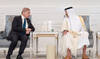
Lebanon’s finance minister Yassine Jaber spoke to Arab News on the sidelines of the World Economic Forum in Davos. (AN photo)
Short Url
Updated 22 January 2026
Follow

Lebanese finance minister denies any plans for a Kushner-run economic zone in the south

  • Proposal was made by US Envoy Morgan Ortagus but was ‘killed on the spot’
  • Priority is to regain control of state in all aspects, Yassine Jaber tells Arab News

DAVOS: Lebanon’s finance minister dismissed any plans of turning Lebanon’s battered southern region into an economic zone, telling Arab News on the sidelines of the World Economic Forum’s meeting in Davos that the proposal had died “on the spot.”

Yassine Jaber explained that US Envoy to Lebanon Morgan Ortagus had proposed the idea last december for the region, which has faced daily airstrikes by Israel, and it was immediately dismissed.

Jaber’s comments, made to Arab News on the sidelines of the World Economic Forum in Davos, were in response to reports which appeared in Lebanese media in December which suggested that parts of southern Lebanon would be turned into an economic zone, managed by a plan proposed by Jared Kushner, US President Donald Trump’s son in law.

Meanwhile, Jaber also dismissed information which had surfaced in Davos over the past two days of a bilateral meeting between Lebanese ministers, US Middle East Envoy Steve Witkoff and Kushner.

Jaber said that the meeting on Tuesday was a gathering of “all Arab ministers of finance and foreign affairs, where they (Witkoff and Kushner) came in for a small while, and explained to the audience the idea about deciding the board of peace for Gaza.”

He stressed that it did not develop beyond that.

When asked about attracting investment and boosting the economy, Jaber said: “The reality now is that we need to reach the situation where there is stability that will allow the Lebanese army, so the (Israeli) aggression has to stop.”

Over the past few years, Lebanon has witnessed one catastrophe after another: one of the world’s worst economic meltdowns, the largest non-nuclear explosion in its capital’s port, a paralyzed parliament and a war with Israel.

A formal mechanism was put in place between Lebanon and Israel to maintain a ceasefire and the plan to disarm Hezbollah in areas below the Litani river.

But, the minister said, Israel’s next step is not always so predictable.

“They’re actually putting pressure on the whole region. So, a lot of effort is being put on that issue,” he added.

“There are still attacks in the south of the country also, so stability is a top necessity that will really succeed in pushing the economy forward and making the reforms beneficial,” he said.

Lawmakers had also enacted reforms to overhaul the banking sector, curb the cash economy and abolish bank secrecy, alongside a bank resolution framework.

Jaber also stressed that the government had recently passed a “gap law” intended to help depositors recover funds and restore the banking system’s functionality.

“One of the priorities we have is really to deal with all the losses of the war, basically reconstruction … and we have started to get loans for reconstructing the destroyed infrastructure in the attacked areas.”

As Hezbollah was battered during the war, Lebanon had a political breakthrough as the army’s general, Joseph Aoun, was inaugurated as president. His chosen prime minister was the former president of the International Court of Justice, Nawaf Salam.

This year marks the first time a solid delegation from the country makes its way to Davos, with Salam being joined by Jaber, Economy and Trade Minister Amr Bisat, and Telecoms Minister Charles Al-Hage.

“Our priority is to really regain the role of the state in all aspects, and specifically in rebuilding the institutions,” Jaber said.


UN Security Council to hold high-level meeting on Gaza

Updated 5 sec ago
Follow

UN Security Council to hold high-level meeting on Gaza

  • UN meeting is expected to include briefings by Israeli and Palestinian civil society representatives for the first time since the war srarted
  • A day later, world leaders head to Washington to discuss the future of the Palestinian territories at the first gathering of Trump’s Board of Peace
UNITED NATIONS: The UN Security Council is set to hold a high-level meeting Wednesday on the Gaza ceasefire deal and Israel’s efforts to expand control in the West Bank before world leaders head to Washington to discuss the future of the Palestinian territories at the
first gathering of President Donald Trump’s Board of Peace.
The UN session in New York was originally scheduled for Thursday but was moved up after Trump announced the board’s meeting for that same date and it became clear that it would complicate travel plans for diplomats planning to attend both. It is a sign of the potential for overlapping and conflicting agendas between the United Nations’ most powerful body and Trump’s new initiative, whose broader ambitions to broker global conflicts have raised concerns in some countries that it may attempt to rival the UN Security Council.
Asked what he hopes to see from the back-to-back meetings this week, Palestinian UN Ambassador Riyad Mansour told reporters: “We expect from the international community to stop Israel and end their illegal effort against annexation, whether in Washington or in New York.”
The foreign ministers of the United Kingdom, Israel, Jordan, Egypt and Indonesia, among others, are expected to attend the monthly Mideast meeting of the 15-member council after many Arab and Islamic countries requested last week that it discuss Gaza and Israel’s contentious West Bank settlement project before some of them head to Washington.
The board to be chaired by Trump was originally envisioned as a small group of world leaders overseeing his 20-point plan for Gaza’s future. But the Republican president’s ambitious new vision for the board to be a mediator of worldwide conflicts has led to skepticism from major allies.
While more than 20 countries have so far accepted an invitation to join the board, close US partners, including France, Germany and others, have opted not to join yet and renewed support for the UN, which also is in the throes of major reforms and funding cuts.
Mike Waltz, the US ambassador to the UN, dismissed concerns about the composition of the Board of Peace, telling conservative radio host Hugh Hewitt in an interview Monday that the most relevant countries, including Qatar and Egypt, which are in touch with Hamas’ leadership, have accepted the invitation.
“All of those countries are on the Board of Peace, singing the same tune as the United States,” he said.
The Security Council will be meeting a day after nearly all of its 15 members — minus the United States — and dozens of other diplomats joined Palestinian ambassador Mansour as he read a statement on behalf of 80 countries and several organizations condemning Israel’s latest actions in the West Bank, demanding an immediate reversal and underlining “strong opposition to any form of annexation.”
Israel, whose UN mission did not immediately respond to requests for comment on Wednesday’s meeting, is launching a contentious land regulation process that will deepen its control in the occupied West Bank. Israeli Energy Minister Eli Cohen said it amounts to “de facto sovereignty” that will block the establishment of a Palestinian state.
Outraged Palestinians, Arab countries and human rights groups have called the moves an illegal annexation of the territory, home to roughly 3.4 million Palestinians who seek it for a future state.
The UN meeting also is expected to delve into the US-brokered ceasefire deal that took effect Oct. 10 after more than two years of war between Israel and Hamas. The UK, which currently holds the presidency of the council, said the meeting will include briefings by UN political chief Rosemary DiCarlo and by Israeli and Palestinian civil society representatives for the first time since the Oct. 7 attacks.
Aspects of the ceasefire deal have moved forward, including Hamas releasing all the hostages it was holding and increased amounts of humanitarian aid getting into Gaza, though the UN says the level is insufficient. A new technocratic committee has been appointed to administer Gaza’s daily affairs.
But the most challenging steps lie ahead, including the deployment of an international security force, disarming Hamas and rebuilding Gaza.
Trump said this week that the Board of Peace members have pledged $5 billion toward Gaza reconstruction and will commit thousands of personnel to international stabilization and police forces for the territory. He didn’t provide details. Indonesia’s military says up to 8,000 of its troops are expected to be ready by the end of June for a potential deployment to Gaza as part of a humanitarian and peace mission.