TRENTON: At a pizzeria along a noisy Ohio highway, Matt Kruse and his family have come to hear J.D. Vance, a Republican Senate candidate who has seized on soaring inflation as the pillar of his campaign.
Kruse, holding a daughter in his arms, is an eager listener, already angry about “runaway inflation.” The message he wants the US midterm elections to send to Democrats is clear: “Stop spending money.”
An hour’s drive away, the tone is different: a dark minivan cruises slowly along a suburban street, looking for a specific house number. “This has to be 800,” says Amy Cox, who gets out to hang a flyer on the front door.
Back behind the wheel, with a dog Toby sitting by the handbrake, the Democratic candidate for state office explains she is campaigning for what moves her — abortion — because for many women “their rights are way more important than inflation.”
With the approach of elections seen by both parties as hugely consequential, one issue is overwhelming all others: soaring prices.
And in the residential towns of Ohio, where Halloween pumpkins and election signs are numerous, Republicans are trying to exploit this theme to rally voters — while Democrats, determined to defend abortion rights, tend to dodge it.
To buy food for one’s family, “Now, you’re spending on one trip $350, $400, you know, for a family of four,” says Kruse, a short- haired man who works in law enforcement. “In the past, it was costing you under 200 bucks.”
“When they talk about abortion or whatever like that, that doesn’t affect everybody. Inflation affects every single person,” Kruse adds.
That is particularly true in Ohio, gateway to the agricultural Midwest, where “a majority... are middle-class working people.”
Until recently Ohio was America’s premier electoral bellwether, holding up a political mirror to the vast nation as the state voted for every presidential winner since 1960.
But that bell was unrung in 2020 when Donald Trump won the state decisively while losing the White House to Democrat Joe Biden — and experts have predicted Ohio will continue tilting rightward.
That dynamic could well benefit J.D. Vance, one of many Republicans pinning blame for cost-of-living woes squarely on Biden.
“The inflation that we’re going through right now in this country is a tax on the middle class,” Vance hammers out in Mt. Orab, where Kruse and his family came to hear him.
In 2020, Brown County surrounding Mt. Orab voted 78 percent for Trump, who is supporting Vance in one of the country’s most-watched duels.
In jeans and white shirt, the 38-year-old bemoans the soaring price of eggs — “it’s crazy” — while 30 or so curious sympathizers and local voters nod in agreement.
Vance makes sure to recall his own humble origins, which he recounted in his best-selling 2016 memoir, “Hillbilly Elegy.”
“We have got to get back to a country where people like my mamaw can go to the grocery store without completely breaking the bank,” he says.
“If the Democrats keep printing money... it’s gonna get worse and we have to stop that,” said Angela Marlow, an annoyed tone to her voice. “We’ve got to get our financial house in order.”
The 58-year-old mother of nine said she believes the state of the economy is pushing voters to cast ballots for Republicans.
Inflation is close to a 40-year high and by far the top concern for American voters.
But the Supreme Court’s June ruling reversing a constitutional right to abortion has also shaken the country, women in particular.
So it is with cold anger that Cox, a 44-year-old mushroom farmer, campaigns along autumn-colored tree-lined roads in Trenton, near the Indiana border.
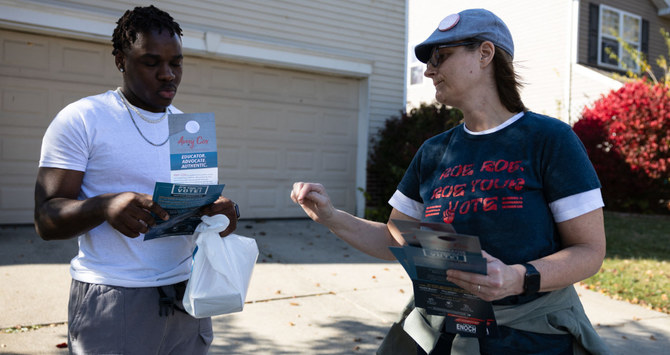
A cap on her head, Cox paces across a yard and knocks on a door. An elderly woman opens, and Cox hands her a leaflet bearing her name and that of Tim Ryan, a Democratic congressman vying with Vance for Ohio’s open Senate seat.
“Are you going to vote on election day?” Cox asks.
“I vote at every election,” the woman responds, sending Cox into a short spiel: “We’re all about higher wages, better health care, better education for our kids, safer communities, and taking care of people — especially women.”
The first point in her campaign flyer: a defense of abortion rights.
Cox climbs back into her van, joining Melissa VanDyke, who is also a candidate for the Ohio House of Representatives but from a neighboring district.
“I don’t campaign on inflation, no, because we don’t call it inflation. We call it corporate greed,” VanDyke says.
The priority for her volunteers: phoning young women in conservative households to convince them to vote Democratic. Many white working-class men, VanDyke says, are “lost” to her party already.


![]()

Inflation vs abortion: two issues at play in US midterms
Short Url
https://arab.news/95yvf
Inflation vs abortion: two issues at play in US midterms


Latest updates


© 2026 SAUDI RESEARCH & PUBLISHING COMPANY, All Rights Reserved And subject to Terms of Use Agreement.