

Trump ordered to testify in Capitol assault probe

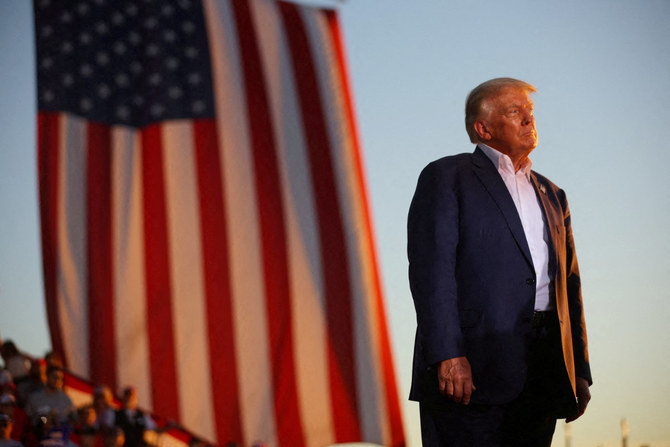
Former US President Donald Trump was ordered to testify on his involvement in the January 6, 2021 violence. (Reuters)
Short Url
Updated 22 October 2022
Follow

Trump ordered to testify in Capitol assault probe

  • Trump is being blamed for inciting the mob that stormed Congress on January 6, 2021, to halt the peaceful transfer of power to Joe Biden
  • It remains highly unlikely that he would agree to give evidence. Trump is notorious for his ability to run down the clock on congressional investigations and legal action

WASHINGTON: Lawmakers probing the 2021 attack on the US Capitol subpoenaed former president Donald Trump Friday to testify on his involvement in the violence, in a major escalation of their sprawling inquiry.
The summons came after the House panel of seven Democrats and two Republicans voted unanimously last week to compel Trump’s appearance before investigators.
It requires the 76-year-old Republican to produce documents by November 4 and to appear for a deposition beginning on or around November 14 — the Monday after the crucial November 8 midterm elections.
“As demonstrated in our hearings, we have assembled overwhelming evidence, including from dozens of your former appointees and staff, that you personally orchestrated and oversaw a multi-part effort to overturn the 2020 presidential election and to obstruct the peaceful transition of power,” the committee told Trump in a letter.
Trump, who urged his supporters to “fight like hell” in a fiery speech near the White House on January 6, 2021, was impeached for inciting the mob to storm Congress later that day to halt the peaceful transfer of power to Joe Biden.
The letter accuses Trump of bidding to overturn the election despite knowing claims of fraud had been overwhelmingly rejected by more than 60 courts and refuted by his campaign staff and senior advisers.
“In short, you were at the center of the first and only effort by any US president to overturn an election and obstruct the peaceful transition of power, ultimately culminating in a bloody attack on our own Capitol and on the Congress itself,” it added.
Without confirming Trump had received the subpoena, his lawyer David Warrington said his team would “review and analyze” the document and “respond as appropriate to this unprecedented action.”
The White House declined to comment on the matter but offered the broad statement that it is “important to get to the bottom of January 6.”

Subpoenas from the panel have proved difficult to enforce, with former White House aide Steve Bannon the only target convicted of contempt of Congress for refusing to comply.
Bannon was sentenced to four months in prison on Friday, although he remains out on bail pending an appeal.
Trump is notorious for his ability to run down the clock on congressional investigations and legal action, and it remains highly unlikely that he would agree to give evidence.
The subpoena expires in any case with the new congressional term in January. Republicans are expected to win back the House of Representatives in November’s elections, and plan immediately to end the investigation.
But the move marks an aggressive escalation of the probe, which has issued more than 100 subpoenas and interviewed more than 1,000 people since its launch in 2021.
While no sitting president has ever been forced to testify before Congress, lawmakers have summoned several former presidents to discuss their conduct in office.
Trump’s compliance would mean testifying under oath and could result in being charged with perjury were he to lie.
If he refuses to comply, the full House can hold him in criminal contempt in a vote recommending him for prosecution, as it did with Bannon.

The panel unveiled reams of evidence across eight hearings in the summer on the former president’s involvement in a complex series of connected schemes to overturn the 2020 election.
Witness testimony provided stunning examples of Trump and his allies pressuring election officials and trying to get lawfully cast votes nullified in swing states, and of Trump’s inertia amid the mob uprising.
The committee also pressed its position that Trump — who continues to be a wellspring of disinformation about the 2020 presidential election — remains a “clear and present” threat to democracy.
Lawmakers plan to release a final report by the end of the year.
The committee has not announced whether it will make direct criminal referrals over the Capitol attack, although the move would amount to little more than a gesture as the Justice Department is already investigating.
The list of records that Trump is required to produce includes all of his communications on the day of the insurrection, as well as various categories of messages in the weeks leading up to the riot.
Investigators specifically mention Signal, suggesting the committee has determined that Trump used the encrypted communications app while participating in the plot.
The software allows users to have messages delete automatically within any time period selected.
The requested documents include any Signal communications between Trump and far-right militias such as the Oath Keepers and Proud Boys.


Supreme Court strikes down Trump’s sweeping tariffs, upending central plank of economic agenda

Updated 2 sec ago
Follow

Supreme Court strikes down Trump’s sweeping tariffs, upending central plank of economic agenda

WASHINGTON: The Supreme Court struck down President Donald Trump’s far-reaching global tariffs on Friday, handing him a significant loss on an issue crucial to his economic agenda.
The 6-3 decision centers on tariffs imposed under an emergency powers law, including the sweeping “reciprocal” tariffs he levied on nearly every other country.
It’s the first major piece of Trump’s broad agenda to come squarely before the nation’s highest court, which he helped shape with the appointments of three conservative jurists in his first term.
The majority found that the Constitution “very clearly” gives Congress the power to impose taxes, which include tariffs. “The Framers did not vest any part of the taxing power in the Executive Branch,” Chief Justice John Roberts wrote.
Justices Samuel Alito, Clarence Thomas and Brett Kavanaugh dissented.
“The tariffs at issue here may or may not be wise policy. But as a matter of text, history, and precedent, they are clearly lawful,” Kavanaugh wrote.
The majority did not address whether companies could get refunded for the billions they have collectively paid in tariffs. Many companies, including the big-box warehouse chain Costco, have already lined up to demand refunds in lower courts. Kavanaugh noted the process could be complicated.
“The Court says nothing today about whether, and if so how, the Government should go about returning the billions of dollars that it has collected from importers. But that process is likely to be a ‘mess,’ as was acknowledged at oral argument,” he wrote.
The Treasury had collected more than $133 billion from the import taxes the president has imposed under the emergency powers law as of December, federal data shows. The impact over the next decade was estimated at some $3 trillion.
The tariffs decision doesn’t stop Trump from imposing duties under other laws. While those have more limitations on the speed and severity of Trump’s actions, top administration officials have said they expect to keep the tariff framework in place under other authorities.
The Supreme Court ruling comes despite a series of short-term wins on the court’s emergency docket that have allowed Trump to push ahead with extraordinary flexes of executive power on issues ranging from high-profile firings to major federal funding cuts.
The Republican president has been vocal about the case, calling it one of the most important in US history and saying a ruling against him would be an economic body blow to the country. But legal opposition crossed the political spectrum, including libertarian and pro-business groups that are typically aligned with the GOP. Polling has found tariffs aren’t broadly popular with the public, amid wider voter concern about affordability.
The Constitution gives Congress the power to levy tariffs. But the Trump administration argued that a 1977 law allowing the president to regulate importation during emergencies also allows him to set tariffs. Other presidents have used the law dozens of times, often to impose sanctions, but Trump was the first president to invoke it for import taxes.
“And the fact that no President has ever found such power in IEEPA is strong evidence that it does not exist,” Roberts wrote, using an acronym for the law called the International Emergency Economic Powers Act.
Trump set what he called “reciprocal” tariffs on most countries in April 2025 to address trade deficits that he declared a national emergency. Those came after he imposed duties on Canada, China and Mexico, ostensibly to address a drug trafficking emergency.
A series of lawsuits followed, including a case from a dozen largely Democratic-leaning states and others from small businesses selling everything from plumbing supplies to educational toys to women’s cycling apparel.
The challengers argued the emergency powers law doesn’t even mention tariffs and Trump’s use of it fails several legal tests, including one called the major questions doctrine that doomed then-President Joe Biden’s $500 billion student loan forgiveness program.
The conservative justices in the majority pointed to that principle in their ruling. “There is no exception to the major questions doctrine for emergency statutes,” Roberts wrote.
The Trump administration had argued that tariffs are different because they’re a major part of Trump’s approach to foreign affairs, an area where the courts should not be second-guessing the president.
But Roberts, joined by Justices Neil Gorsuch and Amy Coney Barrett, brushed that aside, writing that the foreign affairs implications don’t change the legal principle.