

Robotic suit gives paralyzed children gift of walking

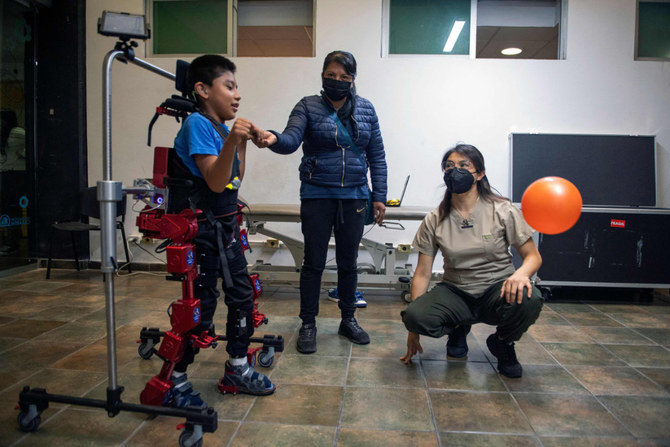
David Zabala, an 8-year-old boy with cerebral palsy, attends a rehabilitation session with the robotic exoskeleton Atlas 2030 in Mexico City on Oct. 18, 2022. (AFP)
Short Url
Updated 20 October 2022
Follow

Robotic suit gives paralyzed children gift of walking

  • David Zabala uses a wheelchair due to his neurological condition, which also left him deaf and reliant on sign language
  • The exoskeleton enabled children who use wheelchairs to walk during muscle rehabilitation therapy

MEXICO CITY: Wearing a robotic exoskeleton designed specially for children, an eight-year-old boy with cerebral palsy walked through a therapy room in Mexico City, smiling triumphantly at the once-unthinkable feat.
David Zabala uses a wheelchair due to his neurological condition, which also left him deaf and reliant on sign language.
But thanks to the Atlas 2030 exoskeleton, which won its creator a European Inventor Award this year, he was able to walk and stand in front of a mirror where he drew smiling faces with colored marker pens.
“He’s taking his first steps. That’s a joy for him,” said the boy’s mother, Guadalupe Cardoso, 41.
“At first it scared him and his hands were very tense, and now I see that he’s already holding the marker pen and starting to draw or (play with) the ball,” Cardoso added.
It makes the exhausting, near two-hour journey from their home in the south of Mexico City to the therapy center totally worth it, she said.
The exoskeleton was designed by Spanish professor Elena Garcia Armada to enable children who use wheelchairs to walk during muscle rehabilitation therapy.
The mechanical joints of the battery-powered titanium suit adapt intelligently to the motion of each child, according to the European Patent Office, which presented Garcia with the European Inventor Award.
Giving paralyzed children the opportunity to walk “not only extends their life expectancy and enhances their physical well-being, but also improves their self-esteem,” it said.

Mexico is the third country, after Spain and France, where the Atlas 2030 has been used to treat children.
The suit helps “to achieve in record time rehabilitation goals” that would take months to achieve with conventional therapies, said Guadalupe Maldonado, director of Mexico’s Association for People with Cerebral Palsy.
The benefits include muscle strengthening, improvement of the digestive and respiratory systems and — above all — a major mood boost, Maldonado said.
The private organization, founded in 1970, has already seen positive results two weeks after acquiring its first exoskeleton, she said.
A second device, worth around $250,000, is due to arrive in Mexico City next month.
The association’s initial goal is to offer rehabilitation to about 200 children with cerebral palsy.
“We want to continue working and empowering, so that more children in the city and the country have access to this type of rehabilitation... that radically changes their lives,” Maldonado said.
The sessions also give joy to the therapists, who carefully fit the exoskeleton using its special corset, cuff and shoes and celebrate the children’s progress with smiles and applause.
“It motivates us a lot as therapists that we will be able to achieve many things in the future,” said Arturo Palafox, 28.


WHO chief says reasons US gave for withdrawing ‘untrue’

Updated 25 January 2026
Follow

WHO chief says reasons US gave for withdrawing ‘untrue’

  • US Secretary of State Marco Rubio and US Health Secretary Robert F. Kennedy Jr. announced in a joint statement Thursday that Washington had formally withdrawn from the WHO
  • And in a post on X, Tedros added: “Unfortunately, the reasons cited for the US decision to withdraw from WHO are untrue”

GENEVA: The head of the UN’s health agency on Saturday pushed back against Washington’s stated reasons for withdrawing from the World Health Organization, dismissing US criticism of the WHO as “untrue.”
Tedros Adhanom Ghebreyesus warned that US announcement this week that it had formally withdrawn from the WHO “makes both the US and the world less safe.”
And in a post on X, he added: “Unfortunately, the reasons cited for the US decision to withdraw from WHO are untrue.”
He insisted: “WHO has always engaged with the US, and all Member States, with full respect for their sovereignty.”
US Secretary of State Marco Rubio and US Health Secretary Robert F. Kennedy Jr. announced in a joint statement Thursday that Washington had formally withdrawn from the WHO.
They accused the agency, of numerous “failures during the Covid-19 pandemic” and of acting “repeatedly against the interests of the United States.”
The WHO has not yet confirmed that the US withdrawal has taken effect.

- ‘Trashed and tarnished’ -

The two US officials said the WHO had “trashed and tarnished” the United States, and had compromised its independence.
“The reverse is true,” the WHO said in a statement.
“As we do with every Member State, WHO has always sought to engage with the United States in good faith.”
The agency strenuously rejected the accusation from Rubio and Kennedy that its Covid response had “obstructed the timely and accurate sharing of critical information that could have saved American lives and then concealed those failures.”
Kennedy also suggested in a video posted to X Friday that the WHO was responsible for “the Americans who died alone in nursing homes (and) the small businesses that were destroyed by reckless mandates” to wear masks and get vaccinated.
The US withdrawal, he insisted, was about “protecting American sovereignty, and putting US public health back in the hands of the American people.”
Tedros warned on X that the statement “contains inaccurate information.”
“Throughout the pandemic, WHO acted quickly, shared all information it had rapidly and transparently with the world, and advised Member States on the basis of the best available evidence,” the agency said.
“WHO recommended the use of masks, vaccines and physical distancing, but at no stage recommended mask mandates, vaccine mandates or lockdowns,” it added.
“We supported sovereign governments to make decisions they believed were in the best interests of their people, but the decisions were theirs.”

- Withdrawal ‘raises issues’ -

The row came as Washington struggled to dislodge itself from the WHO, a year after US President Donald Trump signed an executive order to that effect.
The one-year withdrawal process reached completion on Thursday, but Kennedy and Rubio regretted in their statement that the UN health agency had “not approved our withdrawal and, in fact, claims that we owe it compensation.”
WHO has highlighted that when Washington joined the organization in 1948, it reserved the right to withdraw, as long as it gave one year’s notice and had met “its financial obligations to the organization in full for the current fiscal year.”
But Washington has not paid its 2024 or 2025 dues, and is behind around $260 million.
“The notification of withdrawal raises issues,” WHO said Saturday, adding that the topic would be examined during WHO’s Executive Board meeting next month and by the annual World Health Assembly meeting in May.
“We hope the US will return to active participation in WHO in the future,” Tedros said Saturday.
“Meanwhile, WHO remains steadfastly committed to working with all countries in pursuit of its core mission and constitutional mandate: the highest attainable standard of health as a fundamental right for all people.”