

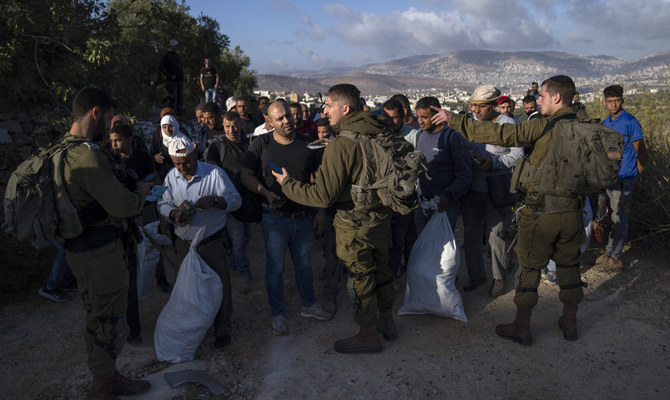

RAMALLAH: The Israeli army’s blockade of 200,000 people in Nablus and surrounding villages in the occupied West Bank continued for an eighth day on Tuesday.
Several main arteries remain closed. Cement blocks have been used to block city entrances and random mobile checkpoints continue to disrupt the life of residents, Palestinian sources told Arab News. There has been no letup in the crackdown by the Israeli Defense Forces, internal security service Shin Bet, or Israeli Border Police forces in Nablus, Jenin and other West Bank towns.
Dozens of people have been arrested and their light arms confiscated as Israeli authorities hunt for members of local military group Areen Al-Osood, which has been accused of targeting Israeli military forces and settlers. Its 150 fighters are not affiliated with traditional Palestinian organizations such as Fatah or Hamas.
Israeli settlers in the area have significantly escalated attacks on Palestinian farmers, targeting villages and towns, closing crossroads, cutting down trees, and smashing Palestinian vehicles.
Analysts view the crackdown against the backdrop of the upcoming legislative election in Israel on Nov. 1. Some have expressed concerns that the attacks might escalate in the coming days as a form of collective punishment, as the heavy-handed treatment of Palestinians can help politicians gain votes among settlers in the West Bank, the number of which is estimated at about 700,000.
More than 120 Palestinians have been killed, dozens injured and hundreds arrested by the Israeli army since the start of the year in the West Bank and East Jerusalem.
Taysir Nasrallah, a member of the Fatah Revolutionary Council in Nablus, told Arab News that the closure of the city, a commercial hub and the economic capital of the West Bank, has led to the complete paralysis of commercial activity in the city.
“All furniture stores and restaurants are suffering from a decrease in the number of shoppers due to the suspension of the economic cycle in Nablus,” Nasrallah said.
“As an employee, I am not ready to spend four hours waiting at an Israeli military checkpoint to reach my workplace in Ramallah. After passing through the checkpoint, I may be exposed to attacks from settlers scattered along the road between Nablus and Ramallah.”
The siege, at the height of the olive-picking season negatively, also affects farmers, he added.
Markets in Nablus are mostly frequented by people from surrounding villages and towns. The residents of the city anticipate an Israeli military invasion as part of the crackdown on Areen Al-Osood. Israeli authorities canceled entry passes to Israel for 164 relatives of groups members this week.
Yassin Dwaikat, a member of Nablus Chamber of Commerce, told Arab News that the city's financial losses amounted to millions of dollars during the first week of the siege, adding that the tourism, restaurant, hotel, resorts, parks, retail and wholesale trade, health and education sectors were affected.
“We cannot currently calculate the exact amount of the financial losses but they are estimated at millions of dollars, and the longer the siege continues, the more losses people incur,” he said.
Nablus was subjected to an Israeli economic siege between 2001 and 2007, which was lifted after an international intervention.
The Palestinian National Initiative said the current siege “by the occupation army constitutes an aggressive crime and collective punishment that targets our people and endangers their lives and deprives them of a normal life. The blockade deprives university and school students of education and represents a threat to the lives of patients, especially those with chronic diseases. It deprives farmers of access to their agricultural land, especially during the olive-harvest season.”
Meanwhile, Israel expressed anger at Palestinian Prime Minister Mohammed Shtayyeh’s visit to the Jenin camp on Sunday, where he offered his condolences to the families of people killed by Israeli forces, and delivered a speech accusing Israeli authorities of using Palestinian blood as a means to make electoral gains on Nov. 1.
“From the camp of sacrifices, Jenin camp, we say that the blood of the martyrs will not go in vain … this struggle is a cumulative process, generation after generation, sacrifices after sacrifices,” Shtayyeh said in a message posted on Facebook.


