

Kuwait appoints new oil, foreign ministers in cabinet reshuffle

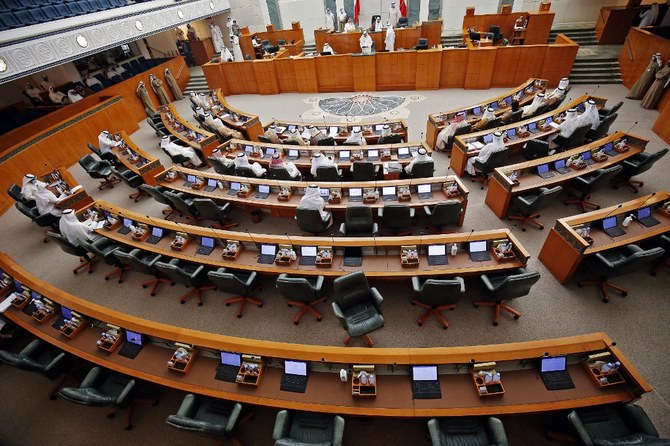
Kuwaiti MPs attend a parliamentary session at the Gulf country’s National Assembly in Kuwait City. (File/AFP)
Short Url
Updated 16 October 2022
Follow

Kuwait appoints new oil, foreign ministers in cabinet reshuffle

  • Mai Jassim Al-Baghli was appointed as minister of social affairs and societal development and minister of state for women and childhood affairs
  • Barrak Ali Barrak Al-Shaitan was given the deputy prime minister and minister of state for cabinet affairs role

DUBAI: Bader Hamed Yousef Al-Mulla was appointed as Kuwait’s new oil minister on Sunday as part of the Gulf country’s new cabinet.

In a reshuffle, Salem Abdullah Al-Jaber Al-Sabah was appointed as foreign minister and Ammar Muhammad Ammar Al-Ajmi was given the minister of state for housing and urban development and minister of state of national assembly affairs portfolios.

Mai Jassim Muhammad Al-Baghli was appointed as minister of social affairs and societal development and minister of state for women and childhood affairs.

Barrak Ali Barrak Al-Shaitan was given the deputy prime minister and minister of state for cabinet affairs role.

Abdulaziz Waleed Abdullah Al-Mujil was appointed as minister of state for municipal affairs and Hamad Abdulwahab Hamad Al-Adwani was appointed minister of education and minister of higher education and scientific research.

Amani Suleiman Bu Qamaz was appointed as minister of public works and minister of electricity, water, and renewable energy.

Abdulaziz Majed Abdulaziz Al-Majed was made minister of justice, minister of endowments and Islamic affairs, and minister of state for Nazaha enhancement.

The first parliament session after the September elections in Kuwait has been postponed to Oct. 18.


UN-sanctioned migrant smuggler killed in western Libya

Updated 58 min 5 sec ago
Follow

UN-sanctioned migrant smuggler killed in western Libya

  • Libyan authorities report that a notorious militia leader, Ahmed Oumar Al-Fitouri Al-Dabbashi, was killed in a raid by security forces on Friday
  • In 2018, the UN and US sanctioned him for controlling migrant departure areas and exposing migrants to fatal conditions

CAIRO: A notorious militia leader in Libya, sanctioned by the UN for migrant trafficking across the Mediterranean Sea, was killed on Friday in a raid by security forces in the west of the country, according to Libyan authorities.
Ahmed Oumar Al-Fitouri Al-Dabbashi, nicknamed Ammu, was killed in the western city of Sabratha when security forces raided his hideout. The raid came in response to an attack on a security outpost by Al-Dabbashi’s militia, which left six members of the security forces severely wounded, according to a statement issued by the Security Threat Enforcement Agency, a security entity affiliated with Libya’s western government.
Al-Dabbashi, who was also sanctioned by the US Treasury for trafficking, was the leader of a powerful militia, the “Brigade of the Martyr Anas Al-Dabbashi,” in Sabratha, the biggest launching point in Libya for Europe-bound African migrants.
Al-Dabbashi’s brother Saleh Al-Dabbashi, another alleged trafficker, was arrested in the same raid, added the statement.
In June 2018, the UN Security Council imposed sanctions on Al-Dabbashi, along with another five Libyan traffickers. At the time, the UN report said that there was enough evidence that Al-Dabbashi’s militia controlled departure areas for migrants, camps, safe houses and boats.
Al-Dabbashi himself exposed migrants, including children, to “fatal circumstances” on land and at sea, and of threatening peace and stability in Libya and neighboring countries, according to the same report.
Al-Dabbashi was also sanctioned by the US Treasury for the same reason.
Libya has been a main transit point for migrants fleeing war and poverty in Africa and the Middle East. The country was plunged into chaos following a NATO-backed uprising that toppled and killed longtime autocrat Muammar Qaddafi in 2011.
The country has been fragmented for years between rival administrations based in the east and the west of Libya, each backed by various armed militias and foreign governments.