

Human rights champions in Belarus, Russia, Ukraine win Nobel Peace Prize

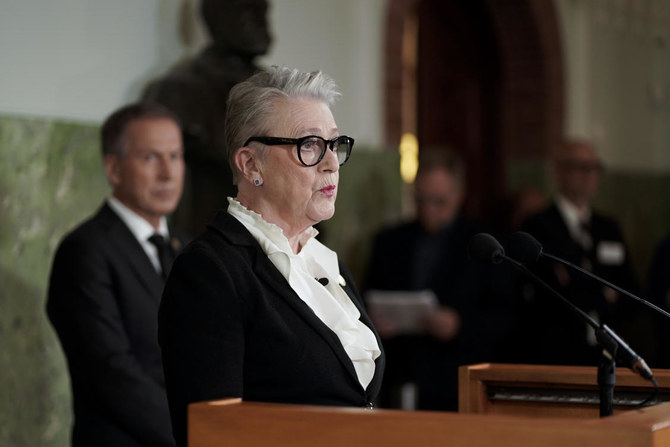
Berit Reiss-Andersen, head of the Nobel Committee, announces the winner of this year's Peace Prize at the Nobel Institute in Oslo, Norway, Friday, Oct. 7, 2022. (AP)
Short Url
Updated 08 October 2022
Follow

Human rights champions in Belarus, Russia, Ukraine win Nobel Peace Prize

  • The prize may be seen by many as a condemnation of Russian President Vladimir Putin and Belarus President Alexander Lukashenko

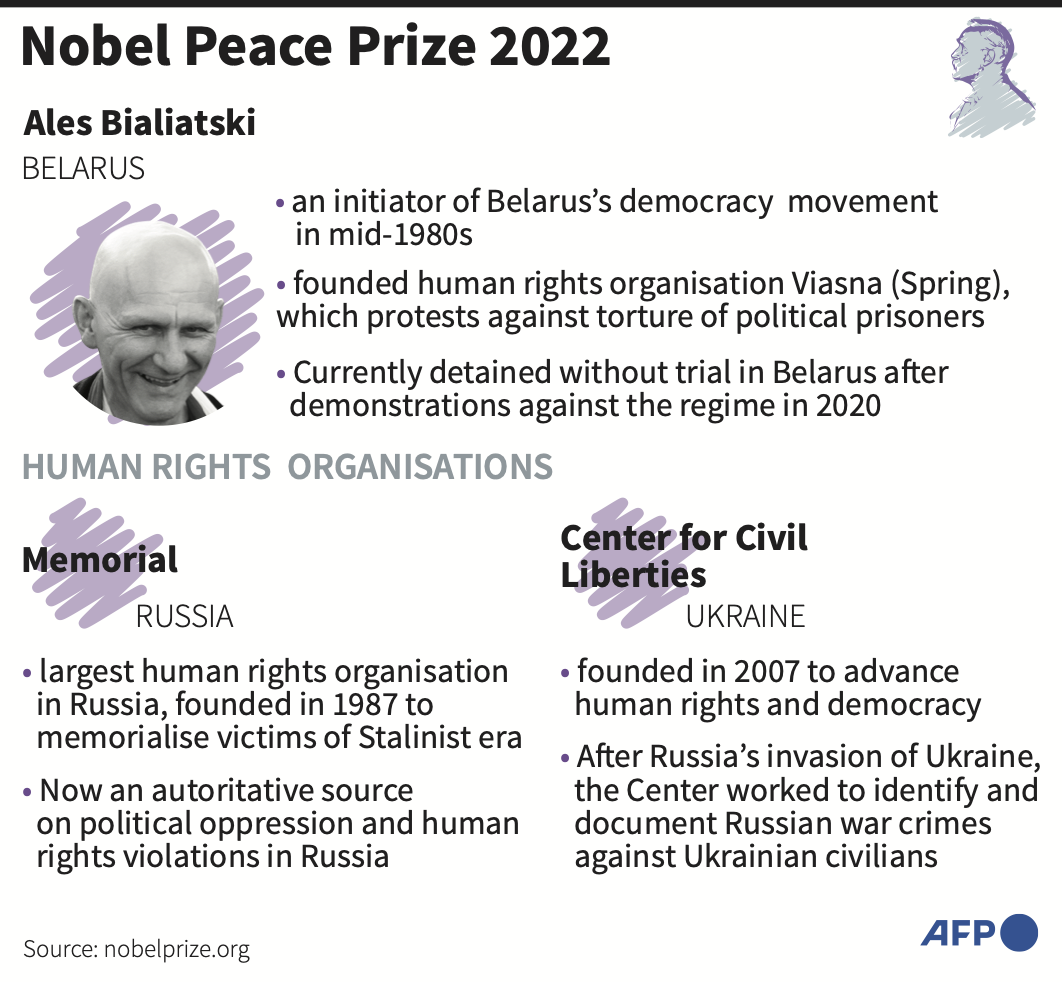
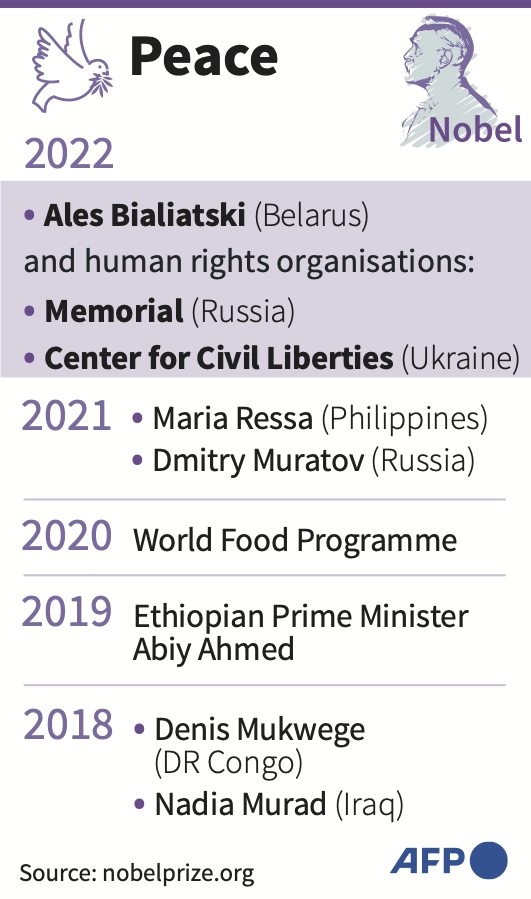
OSLO: Jailed Belarusian activist Ales Byalyatski, Russian organization Memorial and Ukrainian group Center for Civil Liberties won the 2022 Nobel Peace Prize on Friday, highlighting the significance of civil society for peace and democracy.
“The Norwegian Nobel Committee wishes to honor three outstanding champions of human rights, democracy and peaceful co-existence in the neighbor countries Belarus, Russia and Ukraine,” said Committee Chair Berit Reiss-Andersen.
She called on Belarus to release Byalyatski from prison.
The prize will be seen by many as a condemnation of Russian President Vladimir Putin, who is celebrating his 70th birthday on Friday, and Belarus President Alexander Lukashenko, making it one of the most politically contentious in decades.
The award was not an anti-Putin prize, however, Reiss-Andersen said.
“We always give the prize for something and to something and not against someone,” she told reporters.
Belarusian security police in July last year raided offices and homes of lawyers and human rights activists, detaining Byalyatski and others in a new crackdown on opponents of Lukashenko.

Authorities had moved to shut down non-state media outlets and human right groups after mass protests the previous August against a presidential election the opposition said was rigged.
“The (Nobel) Committee is sending a message that political freedoms, human rights and active civil society are part of peace,” Dan Smith, head of the Stockholm International Peace Research Institute, told Reuters.

The prize will boost morale for Byalyatski and strengthen the hand of the Center for Civil Liberties, an independent Ukrainian human rights organization, which is also focused on fighting corruption, he said.
“Although Memorial has been closed in Russia, it lives on as an idea that it’s right to criticize power and that facts and history matter,” Smith added.
The award is recognition for the whole Belarusian people in standing up to Lukashenko, opposition spokesman Franak Viacorka said.

He told Reuters that Byalyatski was jailed in inhuman conditions and he hoped the prize, shared with Russian and Ukrainian human rights organizations, would lead to his release.
“That’s a huge sign of recognition for the Belarusian people, because the Belarusian people deserves it for their bravery in countering the tyranny of Lukashenko .... they deserve all the prizes in the world,” said Viacorka, chief of staff to exiled
Belarusian opposition leader Sviatlana Tsikhanouskaya who is a close friend of Byalyatski.
The Nobel Peace Prize, worth 10 million Swedish crowns, or about $900,000, will be presented in Oslo on Dec. 10, the anniversary of the death of Swedish industrialist Alfred Nobel, who founded the awards in his 1895 will.
“The Peace Prize laureates represent civil society in their home countries. They have for many years promoted the right to criticize power and protect the fundamental rights of citizens,” the Norwegian Nobel Committee said in its citation.
“They have made an outstanding effort to document war crimes, human right abuses and the abuse of power. Together they demonstrate the significance of civil society for peace and democracy.”


WHO chief says reasons US gave for withdrawing ‘untrue’

Updated 25 January 2026
Follow

WHO chief says reasons US gave for withdrawing ‘untrue’

  • US Secretary of State Marco Rubio and US Health Secretary Robert F. Kennedy Jr. announced in a joint statement Thursday that Washington had formally withdrawn from the WHO
  • And in a post on X, Tedros added: “Unfortunately, the reasons cited for the US decision to withdraw from WHO are untrue”

GENEVA: The head of the UN’s health agency on Saturday pushed back against Washington’s stated reasons for withdrawing from the World Health Organization, dismissing US criticism of the WHO as “untrue.”
Tedros Adhanom Ghebreyesus warned that US announcement this week that it had formally withdrawn from the WHO “makes both the US and the world less safe.”
And in a post on X, he added: “Unfortunately, the reasons cited for the US decision to withdraw from WHO are untrue.”
He insisted: “WHO has always engaged with the US, and all Member States, with full respect for their sovereignty.”
US Secretary of State Marco Rubio and US Health Secretary Robert F. Kennedy Jr. announced in a joint statement Thursday that Washington had formally withdrawn from the WHO.
They accused the agency, of numerous “failures during the Covid-19 pandemic” and of acting “repeatedly against the interests of the United States.”
The WHO has not yet confirmed that the US withdrawal has taken effect.

- ‘Trashed and tarnished’ -

The two US officials said the WHO had “trashed and tarnished” the United States, and had compromised its independence.
“The reverse is true,” the WHO said in a statement.
“As we do with every Member State, WHO has always sought to engage with the United States in good faith.”
The agency strenuously rejected the accusation from Rubio and Kennedy that its Covid response had “obstructed the timely and accurate sharing of critical information that could have saved American lives and then concealed those failures.”
Kennedy also suggested in a video posted to X Friday that the WHO was responsible for “the Americans who died alone in nursing homes (and) the small businesses that were destroyed by reckless mandates” to wear masks and get vaccinated.
The US withdrawal, he insisted, was about “protecting American sovereignty, and putting US public health back in the hands of the American people.”
Tedros warned on X that the statement “contains inaccurate information.”
“Throughout the pandemic, WHO acted quickly, shared all information it had rapidly and transparently with the world, and advised Member States on the basis of the best available evidence,” the agency said.
“WHO recommended the use of masks, vaccines and physical distancing, but at no stage recommended mask mandates, vaccine mandates or lockdowns,” it added.
“We supported sovereign governments to make decisions they believed were in the best interests of their people, but the decisions were theirs.”

- Withdrawal ‘raises issues’ -

The row came as Washington struggled to dislodge itself from the WHO, a year after US President Donald Trump signed an executive order to that effect.
The one-year withdrawal process reached completion on Thursday, but Kennedy and Rubio regretted in their statement that the UN health agency had “not approved our withdrawal and, in fact, claims that we owe it compensation.”
WHO has highlighted that when Washington joined the organization in 1948, it reserved the right to withdraw, as long as it gave one year’s notice and had met “its financial obligations to the organization in full for the current fiscal year.”
But Washington has not paid its 2024 or 2025 dues, and is behind around $260 million.
“The notification of withdrawal raises issues,” WHO said Saturday, adding that the topic would be examined during WHO’s Executive Board meeting next month and by the annual World Health Assembly meeting in May.
“We hope the US will return to active participation in WHO in the future,” Tedros said Saturday.
“Meanwhile, WHO remains steadfastly committed to working with all countries in pursuit of its core mission and constitutional mandate: the highest attainable standard of health as a fundamental right for all people.”
