

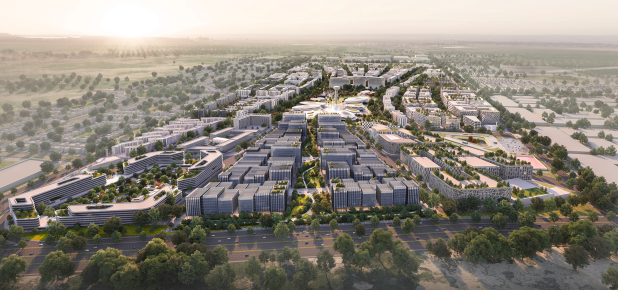

DUBAI: Sharjah property developer Arada is boosting its portfolio with a 6.3 billion dirham ($1.71 billion) office park and five new residential projects in the UAE.
Arada CBD is spread over 4.3 million sq. feet of prime leasable space located in 40 smart office blocks.
It will meet demand for a contemporary business district in Sharjah and will cater to the needs of companies throughout the UAE and beyond in the future, Emirates News Agency WAM reported.
According to analysis firm Oxford Economics, the Sharjah economy is projected to grow at a rate of 5 percent annually for the medium-term due to the launch of Arada CBD.
With 96 percent of its gross domestic product derived from non-oil sectors, the Emirate attracted 808 million dirhams in foreign direct investment in 2021, making it one of the most vibrant and diverse economies in the region.
Arada CBD’s first cluster is scheduled to break ground in 2023 and will feature 812,000 sq. feet of Grade A and Grade B leasable space spread across eight buildings.
There are also 1,666 parking spaces, 76,000 sq. feet of landscaped green space, and 26,500 sq. feet of retail space in the cluster.
Arada will relocate its headquarters to the first building of Arada CBD.
When Arada CBD’s first cluster is ready in 2025, the Aljada community will already have 20,000 residents.
Aljada, Sharjah’s largest ever project, covers 24 million sq. feet and will transform the Emirate.
There are numerous residential districts in Aljada, as well as extensive retail, hospitality, entertainment, sports, educational, and health care facilities, all integrated into a green urban master plan.
Approximately 1,500 homes have already been built at Aljada, and 6,000 more are currently being built.
Abu Dhabi and Dubai are the top most liveable cities in the Middle East and Africa
A massive vaccination drive against the COVID-19 pandemic made Abu Dhabi and Dubai among the safest and fastest to recover from the pandemic in the Middle East and Africa, according to the Economist Intelligence Unit.
Both cities remain the most liveable in the region.
As a result of the vaccination campaign, the country avoided a full-scale lockdown in 2021 and, so far, in 2022, EIU said.
The report, published on Sept. 26, marks 1,000 days since the first COVID-19 case was announced to the World Health Organization in December 2019.
According to EIU, Abu Dhabi and Dubai have largely remained open for business since the first wave in 2020.
All target groups were vaccinated against COVID-19 by the UAE in June. Dubai was one of the first major cities to reopen during the pandemic.
Authorities implemented strict policies to contain the pandemic and reopen the city earlier.
As a result of strong trust between the two emirates, Dubai Airport handled 7.12 million passengers while Abu Dhabi Airport handled 6.3 million.
This year, Dubai’s population crossed the 3.5 million mark for the first time.
The region’s top cities to live in include Tel Aviv, Kuwait City, and Bahrain after the two emirates. Damascus, Lagos, Tripoli, Algiers, and Harare are the least liveable cities.


