

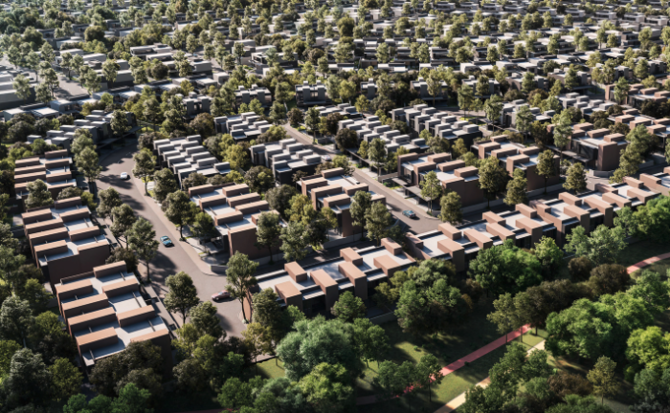
MENA project tracker — UAE’s Arada awards $125m contracts to propel residential construction

Launched in January 2021, Masaar is an upscale forested community in the UAE (arada.com)
Short Url
Updated 11 May 2022
Follow

MENA project tracker — UAE’s Arada awards $125m contracts to propel residential construction

RIYADH: UAE’s Arada is awarding significant sums to advance the building of a residential district at Masaar project, while India’s Shapoorji Pallonji has secured enough funding to help complete the Imperial Avenue project in downtown Dubai.

In the petrochemicals industry, contractors have submitted bids for a major project to be led by QatarEnergy. Meanwhile, Adnoc LNG is evaluating proposals for a large-scale project in the UAE.

Property 

  • UAE-based property development firm Arada has awarded two contracts. with an accumulated value of 460 million dirhams ($125 million), for the construction of the first residential district at its Masaar project located in Sharjah, Meed reported. Intermass Engineering & Contracting has been awarded 232 million dirhams to build 288 homes in the district, while Kuwaiti private company, Mohammed Abdulmohsen al-Kharafi & Sons has been awarded up to 228 million dirhams to construct the remaining 142 villas. 
  • Indian business Shapoorji Pallonji International Real Estate Development has secured enough funding from UK's capital market firm Hayfin Capital Management to help it complete the Imperial Avenue project in downtown Dubai, Meed reported. Construction of the project has been reported to be 55 percent, complete with the project set to be finished by the last quarter of 2023, Meed reported. 

Petrochemicals

  • Contractors have put forward bids for two packages for a major petrochemicals project that state-owned petroleum firm QatarEnergy is constructing, in collaboration with American chemicals company Chevron Phillips Chemical, Meed reported. To be located in Qatar’s Ras Laffan industrial city, the plant is projected to have a capacity to produce as much as 2.08 million tonnes of ethylene per year.

Liquified natural gas 

  • A division of The Abu Dhabi National Oil Co., Adnoc LNG has announced that it is assessing proposals from several contractors for its large-scale liquefied natural gas exports project located in UAE’s Fujairah, Meed reported. 

Multilateralism strained, but global cooperation adapting: WEF report

Updated 10 January 2026
Follow

Multilateralism strained, but global cooperation adapting: WEF report

DUBAI: Overall levels of international cooperation have held steady in recent years, with smaller and more innovative partnerships emerging, often at regional and cross-regional levels, according to a World Economic Forum report.

The third edition of the Global Cooperation Barometer was launched on Thursday, ahead of the WEF’s annual meeting in Davos from Jan. 19 to 23.

“The takeaway of the Global Cooperation Barometer is that while multilateralism is under real strain, cooperation is not ending, it is adapting,” Ariel Kastner, head of geopolitical agenda and communications at WEF, told Arab News.

Developed alongside McKinsey & Company, the report uses 41 metrics to track global cooperation in five areas: Trade and capital; innovation and technology; climate and natural capital; health and wellness; and peace and security.

The pace of cooperation differs across sectors, with peace and security seeing the largest decline. Cooperation weakened across every tracked metric as conflicts intensified, military spending rose and multilateral mechanisms struggled to contain crises.

By contrast, climate and nature, alongside innovation and technology, recorded the strongest increases.

Rising finance flows and global supply chains supported record deployment of clean technologies, even as progress remained insufficient to meet global targets.

Despite tighter controls, cross-border data flows, IT services and digital connectivity continued to expand, underscoring the resilience of technology cooperation amid increasing restrictions.

The report found that collaboration in critical technologies is increasingly being channeled through smaller, aligned groupings rather than broad multilateral frameworks.  

This reflects a broader shift, Kastner said, highlighting the trend toward “pragmatic forms of collaboration — at the regional level or among smaller groups of countries — that advance both shared priorities and national interests.”

“In the Gulf, for example, partnerships and investments with Asia, Europe and Africa in areas such as energy, technology and infrastructure, illustrate how focused collaboration can deliver results despite broader, global headwinds,” he said.

Meanwhile, health and wellness and trade and capital remained flat.

Health outcomes have so far held up following the pandemic, but sharp declines in development assistance are placing growing strain on lower- and middle-income countries.

In trade, cooperation remained above pre-pandemic levels, with goods volumes continuing to grow, albeit at a slower pace than the global economy, while services and selected capital flows showed stronger momentum.

The report also highlights the growing role of smaller, trade-dependent economies in sustaining global cooperation through initiatives such as the Future of Investment and Trade Partnership, launched in September 2025 by the UAE, New Zealand, Singapore and Switzerland.

Looking ahead, maintaining open channels of communication will be critical, Kastner said.

“Crucially, the building block of cooperation in today’s more uncertain era is dialogue — parties can only identify areas of common ground by speaking with one another.”