

Death toll from Syria migrant shipwreck rises

1 / 2
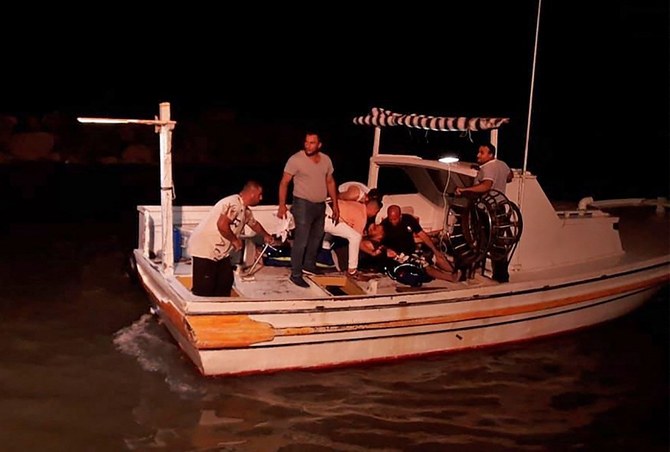
Rescuers search for victims and survivors off the coast of Syria’s southern port city of after a boat carrying migrants from Lebanon capsized in the Mediterranean Sea. (AFP)
2 / 2
Ambulances are seen during the rescue process of migrants in the port of Tartous, Syria on Thursday in this picture obtained from social media. (Reuters)
Short Url
Updated 23 September 2022
Follow

Death toll from Syria migrant shipwreck rises

  • Syria’s health minister: The number of victims from the shipwreck has reached 73 people
  • Tripoli has emerged as a illegal migration hub, with most migrant boats departing from its shores

DAMASCUS: At least 73 migrants drowned when a boat they boarded in Lebanon sank off Syria’s coast, Syria’s health minister said Friday, the deadliest such shipwreck from Lebanon in recent years.

Lebanon, which since 2019 has been mired in a financial crisis branded by the World Bank as one of the worst in modern times, has become a launchpad for illegal migration, with its own citizens joining Syrian and Palestinian refugees clamouring to leave the country.

Around 150 people, mostly Lebanese and Syrians, were on board the small boat that sank Thursday in the Mediterranean Sea off the Syrian city of Tartus.

“The number of victims from the shipwreck has reached 73 people,” Syria’s Health Minister Hassan Al-Ghabash said in a statement, adding that 20 survivors were being treated in hospital in Tartus.

Of those rescued, five were Lebanese, Lebanon’s caretaker transport minister Ali Hamie said.

“I am discussing with Syria’s transport minister a mechanism to retrieve the corpses from Syria,” Hamie said. 

Tartus is the southernmost of Syria’s main ports, and lies some 50 kilometers (30 miles) north of the northern Lebanese port city of Tripoli, where the passengers had boarded.

“We are dealing with one of our largest ever rescue operations,” Sleiman Khalil, an official at Syria’s transport ministry said.

“We are covering a large area that extends along the entire Syrian coast,” he added, saying high waves made their work challenging.

Many of the boat’s Lebanese passengers hail from impoverished regions in the country’s north including the city of Tripoli, Lebanon’s poorest.

Tripoli has emerged as a illegal migration hub, with most migrant boats departing from its shores.

Wissam Al-Talawi, a Tripoli resident who hails from the northern Akkar region, was among the survivors and is being treated in hospital, his brother Ahmad said.

But the corpses of Wissam’s two daughters, aged five and nine, had been returned to Lebanon where they were buried early on Friday, Ahmad said.

“They left two days ago,” he added.

“(My brother) couldn’t afford his daily expenses, or the cost of enrolling his children in school,” he added, saying Wissam’s wife and two sons remain missing.

Other relatives said they had arrived at Syria’s border to check on their relatives.

Last year Lebanon saw a spike in the number of migrants using its shores to attempt the perilous crossing in overcrowded boats to reach Europe.

In April, the sinking of an overcrowded migrant boat pursued by the Lebanese navy off the northern coast of Tripoli killed dozens of people, sparking anger in the country.

The circumstances of that incident were not entirely clear, with some on board claiming the navy rammed their vessel, while officials insisted the smugglers attempted reckless escape manoeuvres.

Many of the bodies were never recovered.

On September 13, Turkey’s coastguard announced the death of six migrants, including two babies, and rescued 73 people trying to reach Europe, off the coast of the southwestern province of aft.

They had reportedly boarded from Tripoli in Lebanon in an attempt to reach Italy.

Most of the boats setting off from Lebanon head for European Union member Cyprus, an island 175 kilometers away to the west.


Trump says Iran government change ‘best thing that could happen’

Updated 14 February 2026
Follow

Trump says Iran government change ‘best thing that could happen’

  • US president's comments come after he ordered a second aircraft carrier to head to the Middle East

FORT BRAGG, United States: US President Donald Trump said a change of government in Iran would be the “best thing that could happen,” as he ordered a second aircraft carrier to head to the Middle East.
“Seems like that would be the best thing that could happen,” Trump told reporters at the Fort Bragg military base in North Carolina when a journalist asked if he wanted “regime change” in Iran.
“For 47 years, they’ve been talking and talking and talking. In the meantime, we’ve lost a lot of lives while they talk,” he told reporters.

Trump declined to say who he would want to take over in Iran from supreme leader Ayatollah Ali Khamenei, but he added that “there are people.”
He has previously backed off full-throated calls for a change of government in Iran, warning that it could cause chaos, although he has made threats toward Khamenei in the past.
Speaking earlier at the White House, Trump said that the USS Gerald R. Ford — the world’s largest warship — would be “leaving very soon” for the Middle East to up the pressure on Iran.
“In case we don’t make a deal, we’ll need it,” Trump said.
The giant vessel is currently in the Caribbean following the US overthrow of Venezuela’s Nicolas Maduro. Another carrier, the USS Abraham Lincoln, is one of 12 US ships already in the Middle East.

When Iran began its crackdown on protests last month — which rights groups say killed thousands — Trump initially said that the United States was “locked and loaded” to help demonstrators.
But he has recently focused his military threats on Tehran’s nuclear program, which US forces struck last July during Israel’s unprecedented 12-day war with Iran.
The protests have subsided for now but US-based Reza Pahlavi, the son of Iran’s last shah, urged international intervention to support the Iranian people.
“We are asking for a humanitarian intervention to prevent more innocent lives being killed in the process,” he told the Munich Security Conference.
It followed a call by the opposition leader, who has not returned to his country since before the revolution, for Iranians at home and abroad to continue demonstrations this weekend.
Iran and the United States, who have had no diplomatic relations since shortly after the revolution, held talks on the nuclear issue last week in Oman. No dates have been set for new talks yet.
The West fears the program is aimed at making a bomb, which Tehran denies.
The head of the UN nuclear watchdog, Rafael Grossi, said Friday that reaching an accord with Iran on inspections of its processing facilities was possible but “terribly difficult.”

Trump said after talks with Israeli Prime Minister Benjamin Netanyahu earlier this week that he wanted to continue talks with Iran, defying pressure from his key ally for a tougher stance.
The Israeli prime minister himself expressed skepticism at the quality of any agreement if it didn’t also cover Iran’s ballistic missiles and support for regional proxies.
According to the US-based Human Rights Activists News Agency, 7,008 people, mostly protesters, were killed in the recent crackdown, although rights groups warn the toll is likely far higher.
More than 53,000 people have also been arrested, it added.
The Norway-based Iran Human Rights (IHR) NGO said “hundreds” of people were facing charges linked to the protests that could see them sentenced to death.
Figures working within the Iranian system have also been arrested, with three politicians detained this week from the so-called reformist wing of Iranian politics supportive of President Masoud Pezeshkian.
The three — Azar Mansouri, Javad Emam and Ebrahim Asgharzadeh — were released on bail Thursday and Friday, their lawyer Hojjat Kermani told the ISNA news agency.