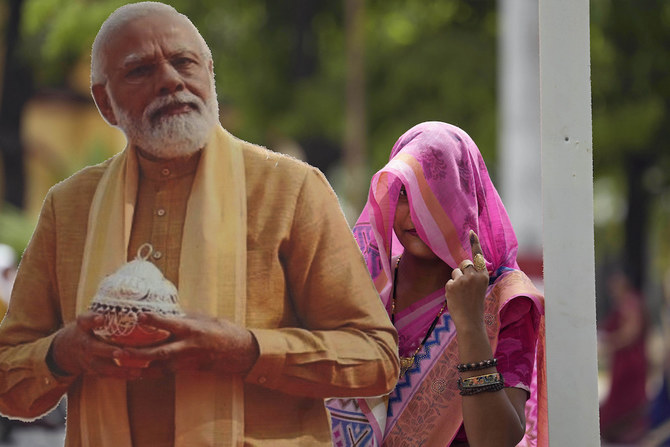
NEW DELHI: India’s Hindu-nationalist Prime Minister Narendra Modi looked set to win a third straight landslide election victory on Saturday at the close of a six-week general election bedevilled by searing heatwaves.
Results will be formally announced on Tuesday but Modi’s victory has long been treated as a foregone conclusion by analysts, in large part due to his aggressive championing of India’s majority faith.
Exit polls showed he was well on track to triumph and Modi himself was certain he had prevailed, saying he was confident that “the people of India have voted in record numbers” to re-elect his government.
“They have seen our track record and the manner in which our work has brought about a qualitative change in the lives of the poor, marginalized and downtrodden,” he said on social media platform X.
An exit poll from broadcaster CNN-News18 forecast Modi’s ruling Bharatiya Janata Party (BJP) and its coalition allies to win 355 seats, well above the 272 needed for a majority in the lower house.
However, such forecasts have proven unreliable in the past at capturing public sentiment in a country with nearly a billion eligible voters.
Many in Modi’s constituency of Varanasi who cast their votes on Saturday were nonetheless excited at the prospect of his return to power.
“I voted for growth and development of my country,” Varanasi resident Brijesh Taksali told AFP outside a polling station where he cast his ballot to re-elect the 73-year-old premier.
Varanasi is the spiritual capital of the Hindu faith, where devotees from around India come to cremate deceased loved ones by the Ganges river.
It was one of the final cities to vote in India’s long election, and where public support for Modi’s ever-closer alignment of religion and politics burns brightest.
Modi presided over the inauguration this year of a grand temple to the deity Ram, built on the grounds of a centuries-old mosque in Ayodhya razed by Hindu zealots in 1992.
Construction of the temple fulfilled a longstanding demand of Hindu activists and was widely celebrated across the country with back-to-back television coverage and street parties.
The ceremony, and numerous other chest-beating demonstrations of fidelity to India’s majority religion over the past decade, have left many among the country’s 200 million-plus minority Muslim community uneasy about their futures.
Modi himself made a number of strident comments about Muslims on the campaign trail, referring to them as “infiltrators.”
He had also accused the motley coalition of more than two dozen opposition parties contesting the poll against him of plotting to redistribute India’s wealth to its Muslim citizens.
Janesar Akhtar, a Muslim clothesmaker working in Varanasi’s famed embroidery workshops, told AFP that the BJP’s sectarian campaigning was an unfortunate distraction from India’s chronic unemployment problems.
“The Modi government has been busy with the politics of temples and mosques,” the 44-year-old said.
“He is supposed to give us jobs and not tensions.”
Political analyst Ramu Manivannan told AFP that Saturday’s exit polls gave a strong indication that Modi would return to power.
But he cautioned that their forecasts were not definitive given a track record of predictions that diverged widely from final results.
“Even minor errors can make a big difference,” he said.
Modi’s prospects were further bolstered by several criminal probes into the bloc’s leaders, which they say were orchestrated by his government.
Western democracies have largely sidestepped concerns over rights and democratic freedoms in the hopes of cultivating an ally that can help check the growing assertiveness of China, India’s northern neighbor and rival regional power.
India’s rising international clout — the country overtook Britain as the world’s fifth-biggest economy in 2022 — has also boosted Modi’s image at home.
“People now look at India and Indians with a lot more respect,” Shikha Aggarwal, 40, told AFP while waiting to cast her vote.
India voted in seven phases over six weeks to ease the immense logistical burden of staging an election in the world’s most populous country.
Turnout is down several percentage points from the last national election in 2019, with analysts partly blaming successive heatwaves across northern India.
Authorities said 10 poll workers had died of heatstroke in the eastern state of Bihar on Thursday while setting up for the vote.
Extensive scientific research shows climate change is causing heatwaves to become longer, more frequent and more intense, with Asia warming faster than the global average.
A scorching sun bore down on Varanasi and its many temples and riverside crematoriums during Saturday’s vote, with afternoon temperatures peaking at 45 degrees Celsius (113 Fahrenheit).
“The last few days have been very tough,” said housewife Bindwasvini Devi, who voted soon after polls opened to beat the scorching temperatures.
“We’ve tried to stay hydrated and avoided going out as much as possible.”


![]()
![]()

India PM Modi appears set to triumph as voting ends in marathon election

Short Url
https://arab.news/bkhqy
India PM Modi appears set to triumph as voting ends in marathon election
- Nearly one billion people were eligible to vote in the seven-phase election that began on April 19


Latest updates



© 2026 SAUDI RESEARCH & PUBLISHING COMPANY, All Rights Reserved And subject to Terms of Use Agreement.