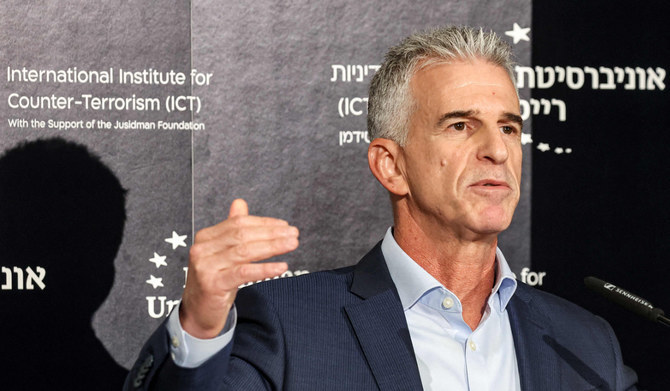
DUBAI: David Barnea, director of Israeli intelligence agency Mossad, is expected to meet Qatari Prime Minister Mohammed bin Abdulrahman Al-Thani in Europe this weekend, news platform Axios reported.
They will discuss resuming negotiations on securing the release of the Israeli hostages still held by Hamas, Axios said.
Israeli Prime Minister Benjamin Netanyahu stopped Barnea from traveling to Qatar for that purpose earlier this week, but Axios reported that Netanyahu had since changed his mind.
On Friday, Israel said its troops had mistakenly killed three hostages, expressing “deep remorse” over a “tragic incident” that sparked protests in Tel Aviv.
The Israeli military said Yotam Haim, Alon Shamriz and Samer El-Talalqa were shot during operations in a neighborhood of Gaza City. The trio were among those kidnapped during the Oct. 7 Hamas attack on Israel.
Netanyahu described the death of the three hostages as an “unbearable tragedy,” while the White House called the incident a “tragic mistake.”
Hundreds of protesters gathered at Israel’s Defense Ministry in Tel Aviv, waving Israeli flags and holding placards with the faces of some of the hostages still held in Gaza. “Every day, a hostage dies,” read one of the placards.


Israeli Mossad chief expected to meet Qatari PM to resume negotiations – Axios
https://arab.news/gawcm
Israeli Mossad chief expected to meet Qatari PM to resume negotiations – Axios


1,965 Israeli violations recorded against Palestinians in February
- Head of Wall and Settlement Resistance Commission condemns attacks as a continuation of ‘terror’ against Palestinians
- Violations included assaults, uprooting trees, burning fields and preventing olive pickers from accessing their lands
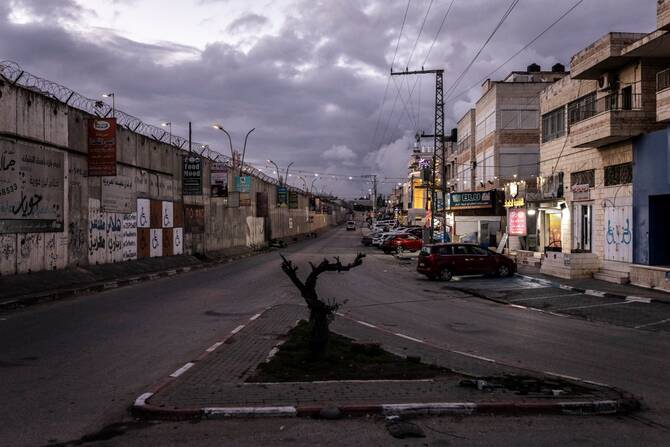
LONDON: Israeli forces and settlers carried out 1,965 attacks across Palestinian towns in the occupied West Bank in February, according to a report by the Palestinian Authority.
Muayyad Shaaban, head of the Wall and Settlement Resistance Commission, condemned the attacks as a continuation of the “terror” against the Palestinian people, their land and property.
The commission documented 1,454 attacks by Israeli forces and 511 by settlers, most of which were concentrated in the governorates of Hebron with 421 attacks, followed by Nablus with 340, Ramallah and Al-Bireh with 320, and East Jerusalem with 210 attacks.
Violations have included direct beatings of Palestinians, uprooting trees, burning fields, and preventing olive pickers from accessing their lands.
Israeli forces have seized land and demolished homes and agricultural facilities under the pretext of “security,” which has enabled settlers to expand their settlements, according to Wafa news agency.
Shaaban said: “What is taking place represents an organized methodology aimed at emptying the land of its owners and imposing an integrated racist colonial system.”
Israeli settlers have poisoned and uprooted a total of 1,314 trees, including 1,054 olive trees, in the areas of Ramallah, Bethlehem, Hebron, Nablus and Tulkarm. The olive groves have been a lifeline for Palestinians in the West Bank, with an estimated 80,000 to 100,000 families relying on the olive harvest for their livelihoods, according to the UN Human Rights Council.
In February, Israeli forces demolished 122 structures belonging to Palestinians, including 56 inhabited homes, nine uninhabited homes, 34 agricultural facilities and 18 sources of livelihood. More than one-third of these demolitions took place in Jerusalem, totaling 46 structures.