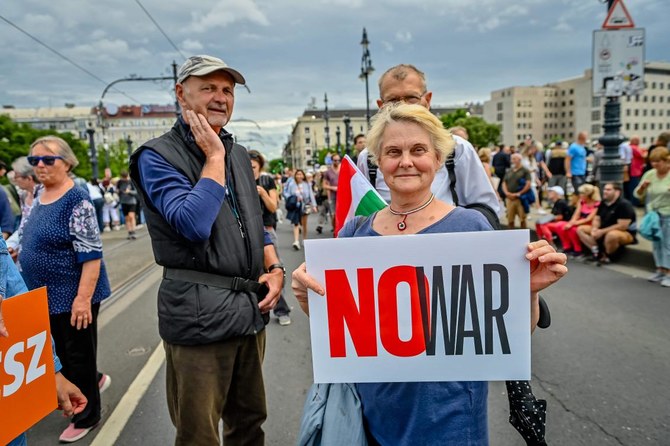
BUDAPEST: Hungarian Prime Minister Viktor Orban was to address a mass rally in Budapest on Saturday, as he increasingly stokes fears of war between the West and Russia with verbal attacks on Brussels and NATO ahead of elections.
As Moscow’s closest EU ally despite its invasion of Ukraine, Orban has refused to send weapons to Kyiv while blocking European military aid.
He repeatedly has said that Ukraine “cannot win” against Russia, claiming that “most people want” a ceasefire and peace negotiations.
In recent weeks, the nationalist leader has ramped up his rhetoric, accusing Brussels and NATO of fueling the war in Ukraine by providing support.
While slamming other EU leaders and those critical of the government as “pro-war,” Orban has characterised the upcoming European elections as a referendum on the conflict, saying he was now “fighting for peace alone” in the bloc.
On Friday, Orban again hit out at NATO, accusing the defense alliance of “dragging” Hungary into war over Ukraine, comparing it to how Adolf Hitler had pressured it into joining in World War II.
He also took a swipe at recent decisions by Western nations to allow Kyiv to use weapons they supply to Ukraine to fire at targets in Russia.
Orban also mentioned the possibility of a compulsory EU conscription in reference to alleged “German and European” plans put forward, even though Brussels had never suggested such an idea and does not have the right to introduce compulsory conscription.
The Hungarian leader said the idea of “someone else (than us) deciding over the blood of Hungarians” was “unacceptable.”
Mass rallies in support of the ruling Fidesz party — dubbed “peace marches” even before Russia’s war in Ukraine — have been routinely organized before important elections since Orban’s return to power in 2010.
Orban, who faces local as well as EU elections in the coming days, was expected to address the rally in central Budapest at 15:00 p.m. (1300 GMT).
According to political analyst Zsuzsanna Vegh, Orban’s attacks on NATO claiming that the alliance “instead of protecting us, is dragging us as a member state into a world war,” have reached a new stage.
Orban recently also suggested that he would like to “redefine” the position of Hungary in the alliance to prevent any participation in operations “outside NATO territory,” claiming that his lawyers were already working on it.
“Even though Orban’s government has come into conflict with NATO before by blocking deeper partnership between NATO and Ukraine, it has always regarded the alliance as the cornerstone of Hungarian security,” she told AFP.
His remarks on the alliance “broke a taboo,” propelling the government’s “whole war discourse into a new dimension,” Vegh explained.
Moreover, the ramped up rhetoric could risk “further deteriorating the already weakened confidence” in Hungary among Western allies, she said.
According to the polls, Orban’s focus on hammering home his “anti-war” talking points so far seem to have been working.
But Orban has faced rare public anger, including from government insider turned rising opposition leader Peter Magyar, who railed against the premier’s system of power and has amassed thousands of supporters.
Magyar — who recently launched his TISZA party — shot to prominence in February on the back of a scandal that hit Orban, posing the most serious challenge in his 14 years in power.
The ruling Fidesz party “needs to demonstrate its strength because Magyar’s party has managed to draw crowds in a way that political parties other than Fidesz have not managed to do for a long, long time,” analyst Zoltan Ranschburg told AFP.


![]()

Orban steps up rhetoric over Ukraine war as elections near
Short Url
https://arab.news/2gwc5
Orban steps up rhetoric over Ukraine war as elections near
- As Moscow’s closest EU ally despite its invasion of Ukraine, Orban has refused to send weapons to Kyiv while blocking European military aid
- Mass rallies in support of the ruling Fidesz party — dubbed “peace marches” even before Russia’s war in Ukraine — have been routinely organized


Latest updates


© 2026 SAUDI RESEARCH & PUBLISHING COMPANY, All Rights Reserved And subject to Terms of Use Agreement.