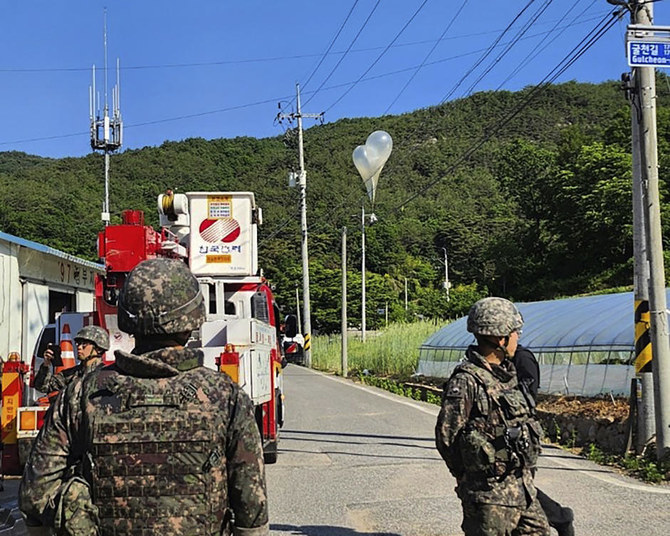
SEOUL: North Korea again sent trash-carrying balloons into the South on Saturday, the South Korean military said, a day after Seoul warned of countermeasures against such activity.
Earlier this week, North Korea sent around 260 balloons carrying bags of trash, including waste batteries, cigarette butts and what appeared to be manure, according to the South Korean Joint Chiefs of Staff.
Authorities in Seoul condemned that act as “low-class,” and the South Korean unification ministry warned Friday that the government would take countermeasures if Pyongyang did not cease such “irrational” provocations.
North Korea is “once again floating balloons carrying waste toward the South,” the JCS said in a text message to reporters.
It advised the public to refrain from touching the balloons if spotted and to report them to authorities.
The Seoul city government also sent a text alert to residents on Saturday, warning of an “unidentified object presumed to be North Korean propaganda leaflets.”
The object has been “detected in the airspace near Seoul and is currently being addressed by the military,” it said, advising residents to “refrain from outdoor activities.”
Pyongyang defended its release of the balloons earlier this week, saying the “sincere gifts” were retaliation for the balloons sent into North Korea with propaganda against leader Kim Jong Un.
North Korea has long been infuriated by the balloons sent by South Korean activists, which carry anti-Pyongyang leaflets. Sometimes, they have also sent cash, rice or USB thumb drives with South Korean drama series.
South Korean defense minister Shin Won-sik on Saturday said North Korea sending balloons with waste was “unimaginably petty and low-grade behavior.”
He added that the balloons sent into the North by activists were “humanitarian aid balloons.”
In 2018, during a period of improved inter-Korean relations, the leaders of the two Koreas agreed to “completely cease all hostile acts against each other in every domain,” including the distribution of leaflets.
The South Korean parliament passed a law in 2020 criminalizing the act of sending leaflets to the North, but the activists did not stop.
That same year, Pyongyang, blaming the anti-North leaflets, unilaterally cut off all official military and political communication links with the South and blew up an inter-Korean liaison office on its side of the border.
Last year, South Korea’s Constitutional Court struck down the 2020 law, calling it an undue limitation on free speech.
Kim Jong Un’s sister Kim Yo Jong — one of North Korea’s key spokespeople — mocked South Korea for complaining about the balloons this week, saying North Koreans were simply exercising their freedom of expression.


North Korea sends balloons with trash into South again
https://arab.news/6ps9s
North Korea sends balloons with trash into South again

- Earlier this week, North Korea sent around 260 balloons carrying bags of trash
- North Korea is “once again floating balloons carrying waste toward the South,” the JCS said in a text message to reporters.


US-Israeli attack violates international law: South Africa
- Ramaphosa “calls on all parties to exercise maximum restraint and to act in a manner consistent with international law,” a statement said
- Ramaphosa “reiterates his call for intensified diplomatic efforts to de-escalate tensions”
JOHANNESBURG: The US and Israeli strikes on Iran Saturday violated international law, South Africa’s president said, calling for restraint and dialogue.
The allies launched the attack citing “threats” from Iran, which retaliated with a barrage of missiles aimed at Gulf states that host US bases, and at Israel.
President Cyril Ramaphosa “calls on all parties to exercise maximum restraint and to act in a manner consistent with international law, international humanitarian law and the principles of the United Nations Charter,” a statement said.
The UN Charter states that self-defense can only be invoked when a state has been subjected to an armed invasion, the statement from his office said.
It condemned “international law violations,” saying: “Anticipatory self-defense is not permitted under international law and self-defense cannot be based on assumption or anticipation.”
Ramaphosa “reiterates his call for intensified diplomatic efforts to de-escalate tensions and create space for continued meaningful negotiations,” the statement said.
US President Donald Trump said Washington’s goal was “eliminating imminent threats” from Iran, while Israel’s Prime Minister Benjamin Netanyahu said the operation was to remove an “existential threat.”


