

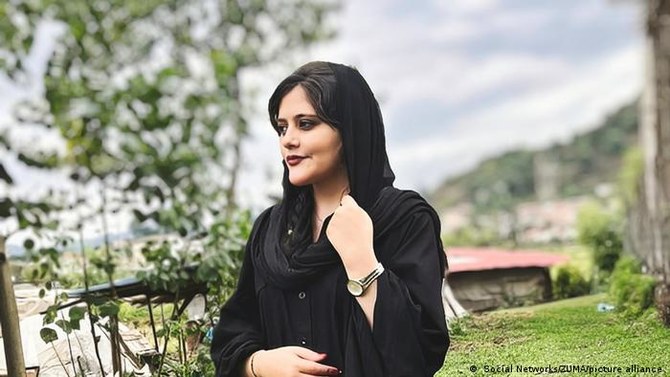
‘Shocked and saddened’: UN experts condemn Amini death in Iranian detention

Mahsa Amini’s death has sparked widespread protests throughout Iran. (Screenshot/Twitter)
Short Url
Updated 22 September 2022
Follow

‘Shocked and saddened’: UN experts condemn Amini death in Iranian detention

  • Independent panel urges Tehran authorities to end use of force against peaceful protesters

LONDON: UN experts have condemned the death of Iranian Mahsa Amini, 22, who died in police custody after being detained for allegedly violating the country’s strict dress code.

Amini’s death has sparked widespread protests throughout Iran, with several peaceful protesters suffering severe injuries after being attacked by security forces.

Amini was arrested by the country’s morality police on Sept. 13. She is believed to have been beaten during her time in detention and fell into a coma, dying three days later in hospital.

Authorities in Iran have claimed that Amini suffered a heart attack, but conflicting reports allege that she died as a result of torture and physical violence.

UN experts have urged Tehran to avoid using force to break up peaceful demonstrations.

The experts included Javaid Rehman, special rapporteur on human rights in Iran, and Reem Alsalem, special rapporteur on violence against women. They are part of the Special Procedures of the Human Rights Council, the largest body of independent experts in the UN human rights system.

“We are shocked and deeply saddened by the death of Amini. She is another victim of Iran’s sustained repression and systematic discrimination against women, and the imposition of discriminatory dress codes that deprive women of bodily autonomy, and the freedoms of opinion, expression and belief,” the experts said in a statement.

“We strongly condemn the use of physical violence against women and the denial of fundamental human dignity when enforcing compulsory hijab policies ordained by state authorities.

“We call on the Iranian authorities to hold an independent, impartial and prompt investigation into Amini’s death, make the findings of the investigation public and hold all perpetrators accountable.”

Iranian authorities have also reportedly authorized internet blackouts in parts of the country, including in the capital Tehran.

“Disruptions to the internet are usually part of a larger effort to stifle the free expression and association of the Iranian population, and to curtail ongoing protests. State-mandated internet disruptions cannot be justified under any circumstances,” the experts said.

“Over the past four decades, Iranian women have continued to peacefully protest against the compulsory hijab rules and the violations of their fundamental human rights.

“Iran must repeal all legislation and policies that discriminate on the grounds of sex and gender, in line with international human rights standards.”


North Korea accuses South of another drone incursion

Updated 12 sec ago
Follow

North Korea accuses South of another drone incursion

  • The North Korean military tracked a drone “moving northwards” over the South Korean border county of Ganghwa
  • South Korea said it had no record of the flight

SEOUL: North Korea accused the South on Saturday of flying another spy drone over its territory this month, a claim that Seoul denied.
The North Korean military tracked a drone “moving northwards” over the South Korean border county of Ganghwa in early January before shooting it down near the North Korean city of Kaesong, a spokesperson said in a statement carried by the state-run Korean Central News Agency (KCNA).
“Surveillance equipment was installed” on the drone and analysis of the wreckage showed it had stored footage of the North’s “important targets” including border areas, the spokesperson said.
Photos of the alleged drone released by KCNA showed the wreckage of a winged craft lying on the ground next to a collection of grey and blue components it said included cameras.
South Korea said it had no record of the flight, and Defense Minister Ahn Gyu-back said the drone in the photos was “not a model operated by our military.”
The office of South Korean President Lee Jae Myung said a national security meeting would be held on Saturday to discuss the matter.
Lee had ordered a “swift and rigorous investigation” by a joint military-police investigative team, his office said in a later statement.
On the possibility that civilians operated the drone, Lee said: “if true, it is a serious crime that threatens peace on the Korean Peninsula and national security.”
Located northwest of Seoul, Ganghwa County is one of the closest South Korean territories to North Korea.
KCNA also released aerial images of Kaesong that it said were taken by the drone.
They were “clear evidence” that the aircraft had “intruded into (our) airspace for the purpose of surveillance and reconnaissance,” Pyongyang’s military spokesperson said.
They added that the incursion was similar to one in September when the South flew drones near its border city of Paju.
Seoul would be forced to “pay a dear price for their unpardonable hysteria” if such flights continued, the spokesperson said.
South Korea is already investigating alleged drone flights over the North in late 2024 ordered by then-President Yoon Suk Yeol. Seoul’s military has not confirmed those flights.
Prosecutors have indicted Yoon on charges that he acted illegally in ordering them, hoping to provoke a response from Pyongyang and use it as a pretext for his short-lived bid to impose martial law.

- Cheap, commercial drone -

Flight-path data showed the latest drone was flying in square patterns over Kaesong before it was shot down, KCNA said.
But experts said the cheap, commercially available model was unlikely to have come from Seoul’s armed forces.
“The South Korean military already has drones capable of transmitting high-resolution live feeds,” said Hong Min, an analyst at the Korea Institute for National Unification.
“Using an outdated drone that requires physical retrieval of a memory card, simply to film factory rooftops clearly visible on satellite imagery, does not hold up from a military planning perspective.”