

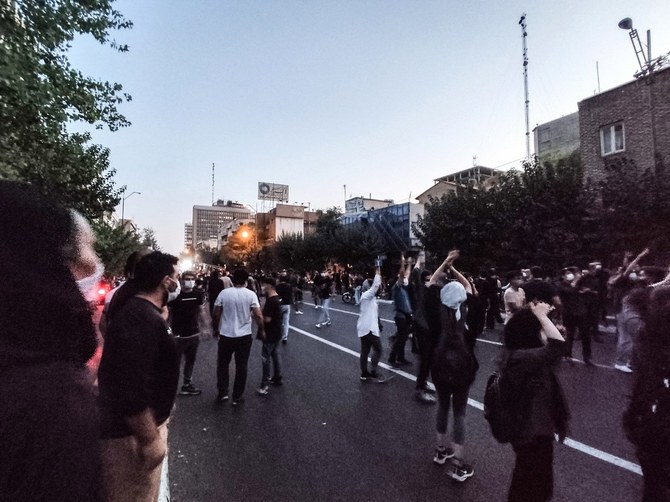

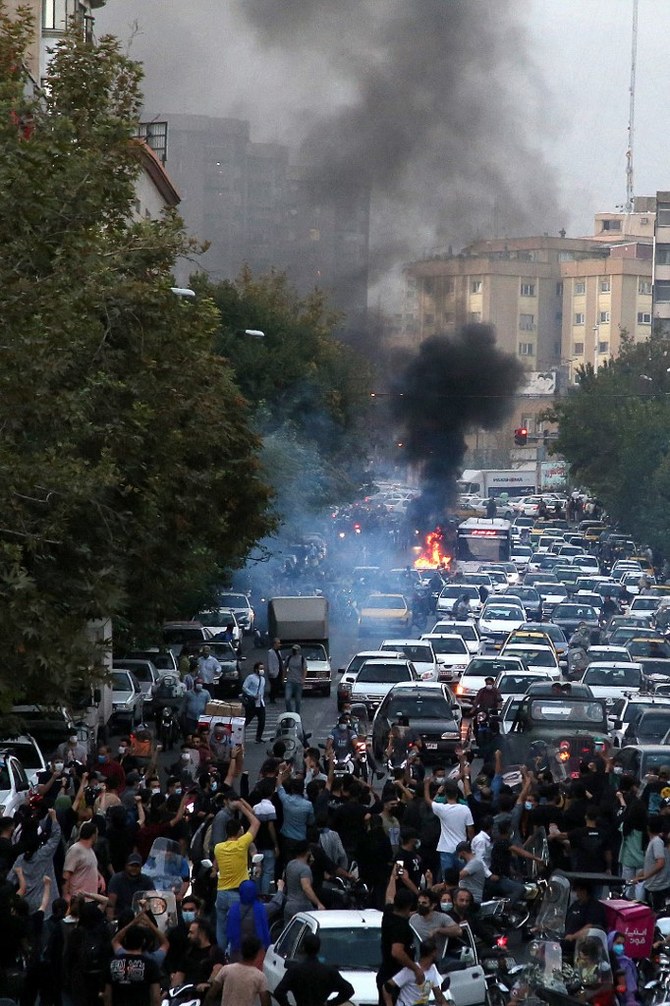
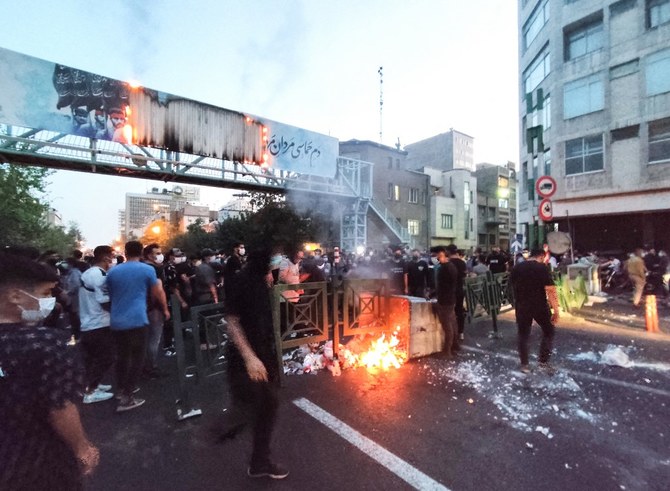

PARIS: Iran restricted Internet access Thursday after days of protests and unrest that have claimed at least 11 lives, following the death of a young woman in the custody of the morality police.
Public anger has flared in the Islamic republic over the death last week of 22-year-old Mahsa Amini, who had been detained for allegedly wearing a hijab headscarf in an “improper” way.
Activists said the woman, whose Kurdish first name is Jhina, had suffered a fatal blow to the head, a claim denied by officials, who have announced an investigation.
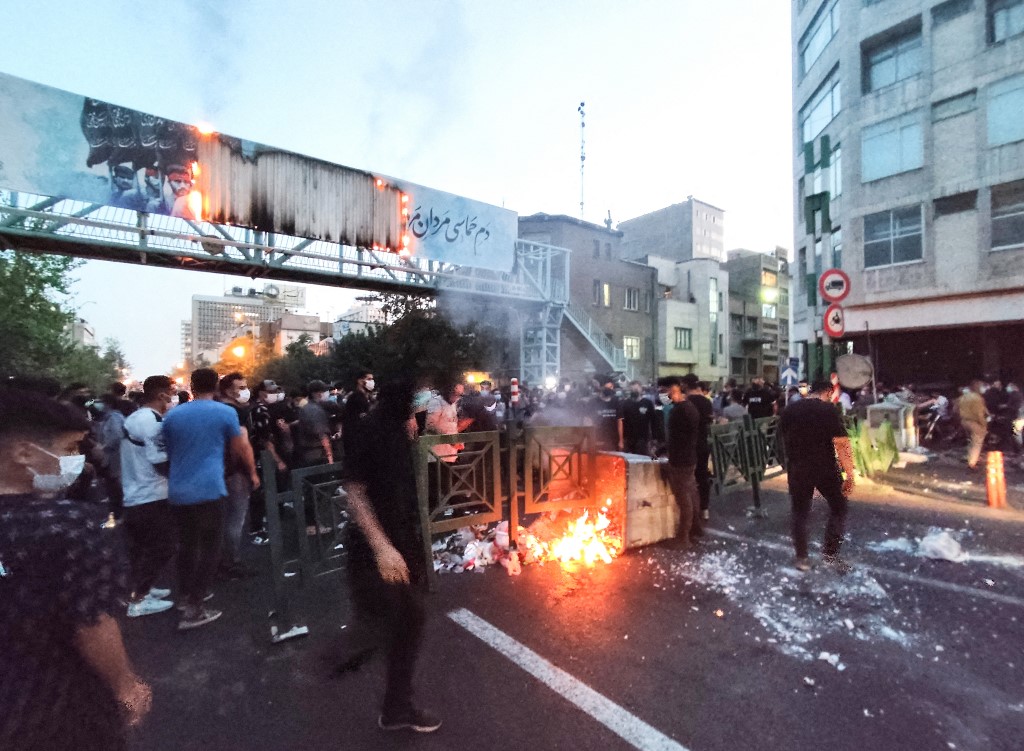
During six straight nights of protests, women demonstrators have defiantly taken off their headscarves and burned them in bonfires or symbolically cut their hair before cheering crowds, video footage spread on social media has shown.
Protesters in Tehran and several other Iranian cities torched police stations and vehicles as unrest triggered by the death of a woman detained by the Islamic Republic’s morality police intensified for a sixth day.
Another police station was set ablaze in the capital Tehran as the unrest spread from Kurdistan, the home province of Amini, according to a Reuters report.
“No to the headscarf ... yes to freedom and equality!” protesters in Tehran were heard chanting in a rally that has been echoed by solidarity protests abroad.
Iranian women interviewed by AFP on the streets of Tehran said they were now more careful about their dress to avoid run-ins with the morality police.
“I’m frightened,” said Nazanin, a 23-year-old nurse, who asked to be identified by her first name only for safety reasons. “They shouldn’t confront people at all” or interfere with how women dress, she added.
There has been growing international alarm at the Iranian crackdown on the protests, including from US President Joe Biden in an address to the United Nations.
“Today we stand with the brave citizens and the brave women of Iran who right now are demonstrating to secure their basic rights,” Biden told the General Assembly on Wednesday.
Iranian state media reported that by Wednesday street rallies had spread to 15 cities, with police using tear gas and making arrests to disperse crowds of up to 1,000 people.
In southern Iran, video footage purportedly from Wednesday showed demonstrators setting fire to a gigantic picture on the side of a building of general Qassem Soleimani, the revered Revolutionary Guards commander killed in a 2020 US drone strike in Iraq.
Demonstrators hurled stones at security forces, set fire to police vehicles and garbage bins, and chanted anti-government slogans, the official IRNA news agency said.
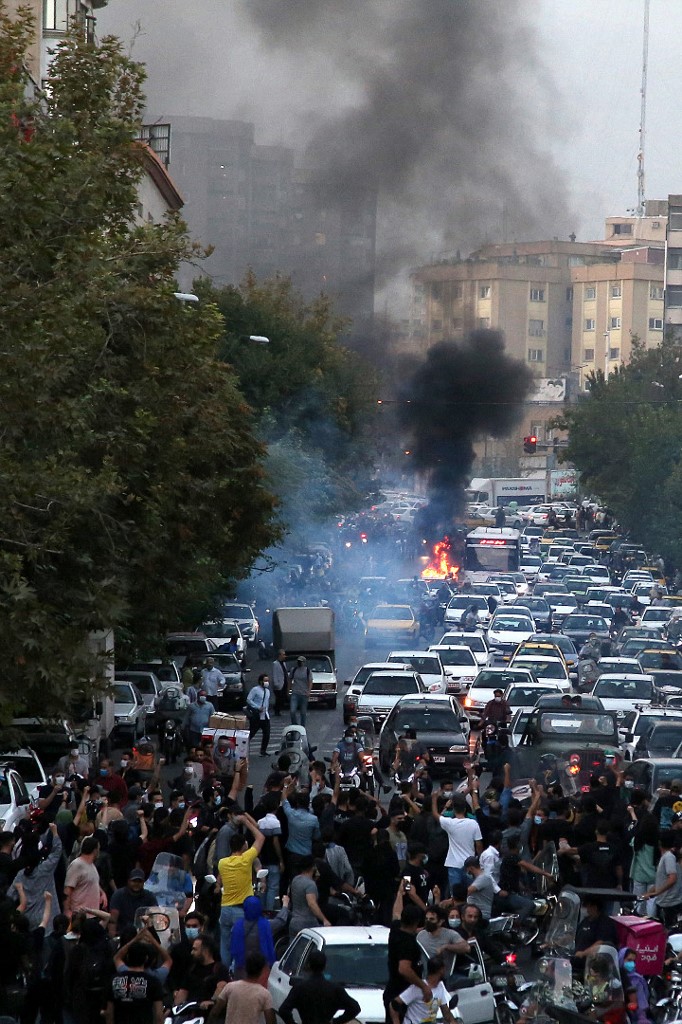
“Death to the dictator” and “Woman, life, freedom,” protesters could be heard shouting in video footage that spread beyond Iran, despite online restrictions first reported by Internet access monitor Netblocks.
Iran moved to further block access to Instagram and WhatsApp on Thursday.
“In accordance with a decision by officials, it has no longer been possible to access Instagram in Iran since yesterday (Wednesday) evening and access to WhatsApp is also disrupted,” the semi-official Fars news agency reported.
The two apps were the most widely used in Iran after the blocking of other platforms in recent years, including Facebook, Twitter, Telegram, YouTube and Tiktok.
UN human rights experts condemned both the “use of physical violence against women” and the “state-mandated Internet disruptions.”
“Disruptions to the Internet are usually part of a larger effort to stifle... free expression... and to curtail ongoing protests,” they said in a statement.
On Thursday, Iranian media said three militiamen “mobilized to deal with rioters” were stabbed or shot dead in northwestern Tabriz, central Qazvin and northeastern Mashhad.
A fourth member of the security forces died in the southern city of Shiraz, the reports said, adding that a protester was stabbed to death in Qazvin, adding to six protester deaths already announced by officials.
But there were fears the death toll could rise, as Norway-based Kurdish rights group Hengaw on Wednesday also reported the deaths of two protesters, aged 16 and 23, in West Azerbaijan province.
The Iranian authorities have denied any involvement in the deaths of protesters.
Amnesty International said it has recorded the deaths of eight people — six men, one woman and a child — with four of them shot by security forces at close range with metal pellets.
The protests are among the most serious in Iran since November 2019 unrest over fuel price rises.
The wave of unrest over Amini’s death “is a very significant shock, it is a societal crisis,” said Iran expert David Rigoulet-Roze of the French Institute for International and Strategic Affairs.


