

Faith leaders call for calm amid fears Hindu-Muslim violence could spread across UK

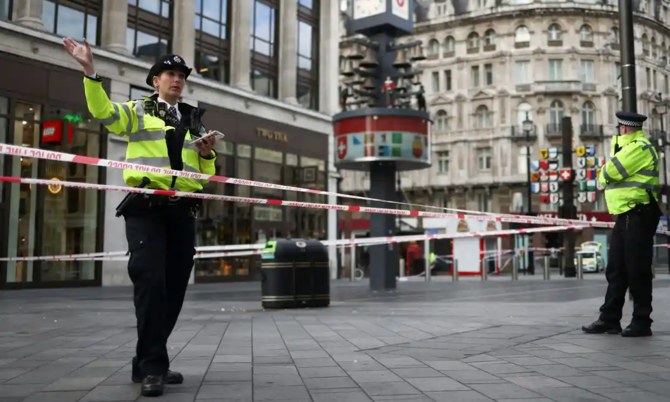
Police have been called to the temple and a mosque in Smethwick for a “search and disperse” operation in a bid to head off further clashes, searching for weapons, fireworks and other suspicious items. (Reuters)
Short Url
Updated 22 September 2022
Follow

Faith leaders call for calm amid fears Hindu-Muslim violence could spread across UK

  • Clashes fueled by false rumors on social media and rise of Hindu nationalism in India
  • Police say ‘troublemakers’ on both sides traveling across England to stir up tensions

LONDON: Faith leaders in the UK have warned that violent clashes between groups of Hindus and Muslims could spread across the country after a flare up of tensions in the Staffordshire town of Smethwick.

It comes after 47 people were arrested over the weekend in the city of Leicester, with other incidents reported in neighboring towns this week, stirred by intercommunal tensions in the UK and in India, and facilitated by false rumors about violence on social media.

There have also been suggestions that the sectarianism in Leicester was sparked as a result of a cricket match between India and Pakistan on Aug. 28, while the violence in Smethwick may have been prompted by false reports that a Hindu nationalist was due to give a talk at a local temple.

Police have been called to the temple and a mosque in Smethwick for a “search and disperse” operation in a bid to head off further clashes, searching for weapons, fireworks and other suspicious items on people congregating nearby.

They also confirmed that young people were traveling to and from affected areas to stoke tensions, adding to fears that the violence could spread.

Hindu and Muslim community leaders issued a joint statement on Tuesday appealing for calm, which was reiterated on Wednesday.


(Screenshot/Twitter)

Ashvani Kumar, a trustee of Smethwick’s Durga Bhawan Center, said: “Interfaith leaders — Sikh, Hindu, Muslim and Christian — were out talking to people and in the end only a few hundred troublemakers turned up.

“Some may have even come from Leicester. We are now trying to make sure this doesn’t happen again.”

The rise of Hindu nationalism in India has also been blamed for prompting the trouble. India’s Prime Minister Narendra Modi has long been accused of Islamophobia and attacks on Muslims across the country have increased during his time in office.

Among the rumors thought to have sparked the clashes was that a Muslim girl had been kidnapped from the area by a group of Hindu men, which police say categorically did not happen.

Footage on Saturday posted to social media, meanwhile, showed a group of young Hindu men in a predominantly Muslim area of Leicester chanting “Jai Shri Ram” — meaning “Glory to Lord Rama” — which has become a favored slogan of Hindu nationalists in India.

Mazhar Mohammed, chair of the trustees at Jamia Masjid in Smethwick, told The Telegraph newspaper: “We’ve lived peacefully in this town together for many years and these tensions have been created overseas by right-wing extremists and brought over to the UK.”

The high commissions of India and Pakistan in London, meanwhile, issued separate statements condemning the violence, calling on authorities to restore order.

A source at the Hindu Council UK told The Telegraph: “Religious leaders have continued to call for calm, but the youths … It’s very difficult. You can’t control them. It’s crazy. It’s going everywhere. I can’t bring myself to say that it will come to London because we want to stop it somehow.”

A Hindu man from Leicester called Vinod told The Telegraph: “Social media is playing a big part in this and there is an agenda — people are looking at creating disarray between communities — not just in Leicester but across all of the UK.

“We’ve been informed that there’s going to be something similar in Nottingham and Coventry. It’s well planned with a narrative of anti-Islam and anti-Hindu sentiment, and it’s the actions of a few fanatics who are trying to get a reaction,” he said.

“My personal opinion is that if we are not careful, it will spread all across Britain, wherever there are south Asian communities,” he added.

A local Sikh, speaking on condition of anonymity, also told the paper that troublemakers were traveling from as far afield as Birmingham, Luton and Bradford.

“There’s a lot of young people behind this, using social media to settle scores,” he said. “People in Leicester are scared to go out in the evenings, especially if it’s dark.”


Afghan returnees in Bamiyan struggle despite new homes

Updated 8 sec ago
Follow

Afghan returnees in Bamiyan struggle despite new homes

  • More than five million Afghans have returned home since September 2023, according to the International Organization for Migration
BAMIYAN, Afghanistan: Sitting in his modest home beneath snow-dusted hills in Afghanistan’s Bamiyan province, Nimatullah Rahesh expressed relief to have found somewhere to “live peacefully” after months of uncertainty.
Rahesh is one of millions of Afghans pushed out of Iran and Pakistan, but despite being given a brand new home in his native country, he and many of his recently returned compatriots are lacking even basic services.
“We no longer have the end-of-month stress about the rent,” he said after getting his house, which was financed by the UN refugee agency on land provided by the Taliban authorities.
Originally from a poor and mountainous district of Bamiyan, Rahesh worked for five years in construction in Iran, where his wife Marzia was a seamstress.
“The Iranians forced us to leave” in 2024 by “refusing to admit our son to school and asking us to pay an impossible sum to extend our documents,” he said.
More than five million Afghans have returned home since September 2023, according to the International Organization for Migration (IOM), as neighboring Iran and Pakistan stepped up deportations.
The Rahesh family is among 30 to be given a 50-square-meter (540-square-foot) home in Bamiyan, with each household in the nascent community participating in the construction and being paid by UNHCR for their work.
The families, most of whom had lived in Iran, own the building and the land.
“That was crucial for us, because property rights give these people security,” said the UNHCR’s Amaia Lezertua.
Waiting for water
Despite the homes lacking running water and being far from shops, schools or hospitals, new resident Arefa Ibrahimi said she was happy “because this house is mine, even if all the basic facilities aren’t there.”
Ibrahimi, whose four children huddled around the stove in her spartan living room, is one of 10 single mothers living in the new community.
The 45-year-old said she feared ending up on the street after her husband left her.
She showed AFP journalists her two just-finished rooms and an empty hallway with a counter intended to serve as a kitchen.
“But there’s no bathroom,” she said. These new houses have only basic outdoor toilets, too small to add even a simple shower.
Ajay Singh, the UNHCR project manager, said the home design came from the local authorities, and families could build a bathroom themselves.
There is currently no piped water nor wells in the area, which is dubbed “the dry slope” (Jar-e-Khushk).
Ten liters of drinking water bought when a tanker truck passes every three days costs more than in the capital Kabul, residents said.
Fazil Omar Rahmani, the provincial head of the Ministry of Refugees and Repatriation Affairs, said there were plans to expand the water supply network.
“But for now these families must secure their own supply,” he said.
Two hours on foot
The plots allocated by the government for the new neighborhood lie far from Bamiyan city, which is home to more than 70,000 people.
The city grabbed international attention in 2001, when the Sunni Pashtun Taliban authorities destroyed two large Buddha statues cherished by the predominantly Shia Hazara community in the region.
Since the Taliban government came back to power in 2021, around 7,000 Afghans have returned to Bamiyan according to Rahmani.
The new project provides housing for 174 of them. At its inauguration, resident Rahesh stood before his new neighbors and addressed their supporters.
“Thank you for the homes, we are grateful, but please don’t forget us for water, a school, clinics, the mobile network,” which is currently nonexistent, he said.
Rahmani, the ministry official, insisted there were plans to build schools and clinics.
“There is a direct order from our supreme leader,” Hibatullah Akhundzada, he said, without specifying when these projects will start.
In the meantime, to get to work at the market, Rahesh must walk for two hours along a rutted dirt road between barren mountains before he can catch a ride.
Only 11 percent of adults found full-time work after returning to Afghanistan, according to an IOM survey.
Ibrahimi, meanwhile, is contending with a four-kilometer (2.5-mile) walk to the nearest school when the winter break ends.
“I will have to wake my children very early, in the cold. I am worried,” she said.