

AmCham Saudi Arabia launches green business initiative

1 / 4
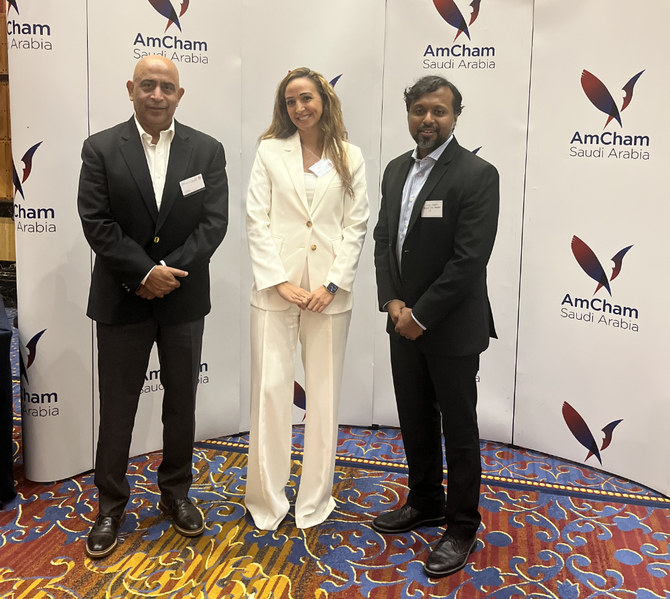
Several leading diplomats, academics and business officials took part in a panel discussion to discuss ESG strategies, plans and reporting at the Jeddah Hilton Hotel where the ESG committee was launched. (Supplied)
2 / 4
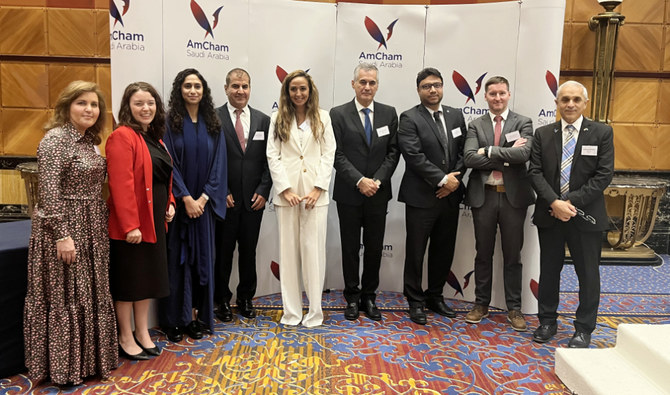
Several leading diplomats, academics and business officials took part in a panel discussion to discuss ESG strategies, plans and reporting at the Jeddah Hilton Hotel where the ESG committee was launched. (Supplied)
3 / 4
Several leading diplomats, academics and business officials took part in a panel discussion to discuss ESG strategies, plans and reporting at the Jeddah Hilton Hotel where the ESG committee was launched. (Supplied)
4 / 4
Several leading diplomats, academics and business officials took part in a panel discussion to discuss ESG strategies, plans and reporting at the Jeddah Hilton Hotel where the ESG committee was launched. (Supplied)
Short Url
Updated 21 September 2022
Follow

AmCham Saudi Arabia launches green business initiative

  • AmCham’s new committee to help firms meet environmental obligations
  • Top local, international executives discuss protections for consumers

JEDDAH: The American Chamber of Commerce in Saudi Arabia, or AmCham Saudi Arabia, launched a new committee on Monday to help companies meet their environmental and social responsibility goals.

The ESG, or Environmental, Social and Corporate Governance, committee was launched at the Jeddah Hilton Hotel.

Several leading diplomats, academics and business officials took part in a panel discussion to discuss ESG strategies, plans and reporting.

Julie LeBlanc, US commercial consul for the western region, said American businesses were committed to support the Kingdom’s plans on this front.

“Major US companies, which are leaders in ESG participated in the panel event including PepsiCo, UL, and AspenTech to discuss innovations and best practices in ESG. The United States is committed to supporting the Kingdom’s Vision 2030 goal to diversify its economy,” she said.

The panel was moderated by Nizar Kammourie, CEO of SAWACO Water Desalination, who said the ESG committee would help raise awareness in the business sector on the need for firms to operate in a socially responsible manner.

“By doing so, the AmCham ESG Committee aims to pave the way for US businesses to explore new venues for opportunities in the Saudi market,” he said.

The panelists shared various sustainability measures adopted by their companies which they described as innovative and pioneering.

Tala Alem, sustainability lead at PepsiCo spoke about the responsibility of her company toward ESG based on its business model, operating systems and products.

“At PepsiCo, we look at everything we are engaged in including our entire value chain and creating a sustainability framework to be applied in each country. As every country has its own objectives, in Saudi Arabia, we take into consideration several areas which include agriculture and climate impact, plastics usage and its packaging as well as social and community responsibilities.”

“While every company on its own has a bigger responsibility to the community and the environment, it is valuable for companies to come together with or without the government and share best practices and present case studies as there is a lot of value in it. Such events should be organized more frequently in order to build awareness and encourage everyone to adopt ESG strategies in their company,” Alem added.

Dareen Ayyad, country manager at Underwriters Laboratories, discussed the benefits and the specifics of ESG reporting.

“We look forward to assisting the companies looking for solutions with ESG reporting. UL is providing solutions when it comes to ESG reporting with the help of a software called UL 360 that will help customers in the Kingdom to gather all the ESG data that compile all the information and manage the data.

“We are also offering reporting software for identifying the ESG risks and opportunities. UL offers third party certification and third party advisory services to address the ESG means. We are hoping to create more awareness amongst corporations on the importance of ESG reporting and look forward to engaging with more stakeholders in the Kingdom.”

Echoing these sentiments, David McKenna, sustainability performance director of The Red Sea Development Co., said: “It is important to raise the topic of ESG reporting as more the companies adopt it, the more transparency can be acquired.

“Some companies will take a step forward whereas some backward as it’s not easy to accept ESG strategies, but it is important to disclose the performance across metrics, which could, for various factors, macro and micro, may go up and down but at least the ESG will set a baseline and that will showcase it to the consumers.”

Saif Sheikh, MENA director of solution consulting at Aspen Technology, and Johnny Obeid, vice president of the Middle East at Veolia, opined that ESG is no longer an option and has to be built into business strategy.

Rola Osta, the engagement manager of the chamber’s Jeddah chapter, said that governments and companies have started to take an increased interest in ESG, gaining it an elevated status of relevance.

“A lot of companies are striving to deliver sustainable solutions and outcomes from their operations while aligning the committee’s goals with the Saudi Green Initiative. The AmCham ESG launched this event to present the effort and strategy of companies and government agencies in adopting ESG principles to provide sustainable solutions for their operations.”

Mohammad Tafesh, vice president of the Jeddah chapter, said: “The ESG committee aims to create bridges between US businesses and their counterparts in the Kingdom to provide environmental and sustainability solutions. This will be the first of many upcoming events related to ESG.”

The event was attended by representatives from the US and Italian consulates, Saudi and international companies, and educators from top Saudi universities.

The event concluded with a round of questions and answers.


Arabian hare returns to Saudi Arabia

Updated 7 sec ago
Follow

Arabian hare returns to Saudi Arabia

JEDDAH: The Prince Mohammed bin Salman Royal Reserve has reintroduced the Arabian hare (Lepus capensis arabicus), the 14th native species returned to the reserve since the ReWild Arabia program began in winter 2022.

The Arabian hare occupies a foundational position in the desert food web, having been found in the central region of Saudi Arabia.

Its return signals another step in the reserve’s long-term ambition to restore functioning, self-sustaining ecosystems across a landscape increasingly shaped by climate pressures.

The reintroduction of this primary consumer supports the re-establishment of a critical layer of the trophic food web, restoring energy pathways from vegetation to predators.

It also supports the recovery of ecosystem functioning at the landscape scale.

As herbivores, they graze and disperse seeds, helping to regulate vegetation across the reserve’s ecosystems.

For desert predators, they are a principal food source, transferring energy upward from scarce desert plant biomass with a high ectotrophic efficiency, sustaining higher-level wildlife.

Twenty Arabian hares were selected to enhance genetic diversity and have been introduced through the reserve’s rewilding program.

Due to their ecological significance, the animals will initially remain in purpose-built breeding enclosures to accelerate population growth before release. The first leveret (hare young) has already been born.

Unlike many desert species that retreat underground to escape extreme heat, Arabian hares are uniquely adapted to life on the land’s surface, hence their other name, the desert hare.

They are among the few mammals able to survive extreme temperatures without burrowing.

Their cryptic coloration provides effective camouflage, reducing detection by predators.

Large ears, which can reach up to 17 centimeters in length, 30 percent of their total body length, act as efficient cooling systems and provide acute hearing, with pinnae capable of rotating independently.

Combined with near-360-degree vision, these adaptations enable early detection of predators.

When threatened, Arabian hares can run at speeds of up to 80 km per hour, zigzagging sharply to evade pursuit.

Despite these defenses, predation rates in desert environments can reach up to 90 percent, underscoring their importance as a primary prey species.

Andrew Zaloumis, the reserve’s CEO, told Arab News exclusively: “By 2050, temperatures in northwestern Saudi Arabia are projected to rise by 2–3 degrees C under medium to high emission scenarios, with annual rainfall declining by 5–10 percent.

“In a hotter and drier future, habitat restoration and rewilding are not optional; they are essential.

“By rebuilding ecosystems, we strengthen biodiversity, enhance natural resilience, increase moisture retention and create one of our most powerful defenses against climate change.”

As climate models point to rising temperatures and declining rainfall across the region, the reserve’s rewilding strategy is designed to strengthen ecological resilience by rebuilding complete food webs rather than restoring isolated species.

The primary indicator used to evaluate long-term success “is that the species is performing its key ecological function.

“This is being assessed through many sub-indicators, including reproduction, dispersal across the landscape and its role within the trophic pyramid.”

Zaloumis added that one of the first indicators of success will be the birth of leverets in the wild and the gradual return of the species across its historical range — moving beyond initial release sites and establishing free-roaming populations across the reserve.

The reserve is also looking at the population growth and stability of predator species that rely on hare, including jackals, foxes and birds of prey, as an indication that ecological connections are being restored.

By monitoring predator populations, their distribution and territories, and overlapping this data with hare distribution and dispersal, it becomes possible to build a clearer picture of ecosystem recovery.

As hares move across the landscape, they deposit organic matter through their droppings, enriching the soil and supporting plant regeneration.

In doing so, they act as effective seed dispersers, spreading native plant seeds and helping vegetation recover across wider areas of the reserve.

This process is particularly important in arid environments, where plant growth can be slow and patchy.

“Hares play an important role as ecosystem engineers within desert landscapes. As herbivores, their grazing helps regulate vegetation growth and influences the structure and composition of plant communities,” Zaloumis said.

By selectively feeding on grasses, shrubs and other low vegetation, they can prevent any one species from becoming dominant, helping maintain a more balanced and diverse plant community.

“Their feeding also contributes to nutrient cycling,” he added.

As Arabian hares typically occupy relatively small territories, often within a few square kilometers, individuals of the same species from different regions are not typically closely related.

“Introducing animals from suitable but separate populations can help increase genetic mixing once they are released and begin breeding with existing wild individuals, improving overall genetic diversity and long-term resilience of the population,” Zaloumis said.

Genetic diversity was assessed by analyzing partial mitochondrial (Cytochrome B) sequences and constructing a phylogenetic tree to understand how closely related different hare samples were and to ensure they are pure-bred Arabian hares.

Statistical testing was used to ensure the robustness of the lineage groupings and confirm relationships between individuals.

“This analysis confirmed that the relocated hares are genetically linked to populations from within the Arabian region and form part of a distinct regional lineage of Lepus capensis arabicus.

“Ensuring that the animals belong to this native lineage was an important first step in maintaining the genetic integrity of the population being restored within the reserve,” Zaloumis said.

Arabian hares are currently in a purpose-built, predator-proof breeding facility where they are under 24-hour monitoring by the reserve’s specialist animal husbandry team. This allows tracking health and breeding success ahead of release.

Following release at sites selected for their suitability, monitoring will continue through the reserve’s ranger and scientific services teams, who will track survival, distribution and habitat use through regular field observations and ongoing ecological monitoring.

Across the reserve, satellite and GPS tracking technologies are deployed where a deeper understanding of dispersal and territory establishment is needed, especially among larger, migratory species such as the griffon vulture.

A similar approach would be considered for a small number of hares when more detailed data is required.

Zaloumis said: “This reintroduction of Arabian hare is helping to establish a viable, resilient, genetically diverse population capable of strengthening ecosystem function across the landscape.”

Since the ReWild Arabia program began, 14 species have been successfully reintroduced.

The Arabian hare marks the sixth species to breed within the program. To date, the reserve has recorded over 100 sand gazelle births, 19 mountain gazelle births, the first two Nubian ibex kids, 36 Arabian oryx calves, and a Persian onager foal.