

US approves possible sale of F-16 equipment to Pakistan – Pentagon

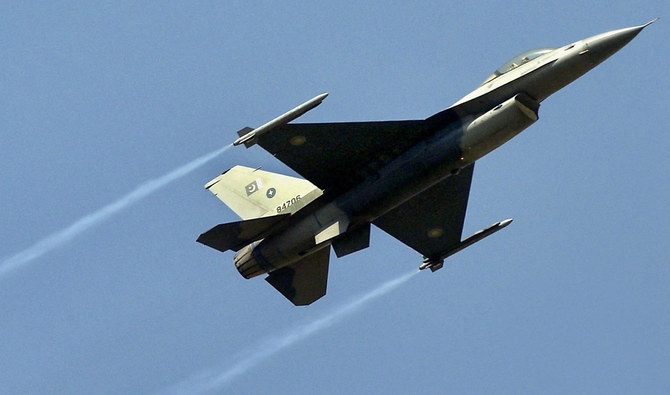
A Pakistani Air Force F16 fighter jet pilot displays his skills during a full-dress rehearsal for the forthcoming National Day celebrations in Islamabad, 20 March 2005. (AFP/File)
Short Url
Updated 08 September 2022
Follow

US approves possible sale of F-16 equipment to Pakistan – Pentagon

  • Proposed sale “greatly improves” Pakistan’s ability to support counterterrorism operations – Pentagon
  • US clarifies proposed sale does not include new capabilities, weapons or munitions

ISLAMABAD: US State Department approved the possible sale of F-16 aircraft sustainment and related equipment to Pakistan on Wednesday in a deal valued at up to $450 million, the Pentagon confirmed.

It is the first major security assistance approval to Pakistan from Washington after former US president Donald Trump’s administration, in 2018, announced ending security assistance to Pakistan. Washington alleged Islamabad was not taking concrete actions against militants.

“@StateDept authorizes a Foreign Military Sales #FMS case for #Pakistan for follow on effort and consolidation of prior F-16 sustainment and support cases to support the Pakistan Air Force F-16 fleet valued at up to $450 million,” the US State Department wrote on Twitter.

“Pakistan has requested to consolidate prior F-16 sustainment and support cases to support the Pakistan Air Force F-16 fleet by reducing duplicate case activities and adding additional continued support elements,” the Security Cooperation Agency of the US Department of Defense, in a statement on Wednesday, said.

However, it clarified that the proposed sale of the aircraft does not include any new capabilities, weapons or munitions.

“This proposed sale will support the foreign policy and national security objectives of the United States by allowing Pakistan to retain interoperability with US and partner forces in ongoing counterterrorism efforts and in preparation for future contingency operations,” the statement added.

It said the proposed sale would continue the sustainment of Pakistan’s F-16 fleet, which “greatly improves” Pakistan’s ability to support counterterrorism operations through its robust air-to-ground capability.

“The proposed sale of this equipment and support will not alter the basic military balance in the region,” it added.

In April this year, Pakistan’s army chief General Qamar Javed Bajwa said the country enjoyed “excellent” ties with the United States and the best military equipment Pakistan had was from Washington.

“We had historically excellent relations with US,” the army chief said in a statement shared by the army’s media wing, the ISPR, quoting what Bajwa had said at a conference in Islamabad on April 05, 2020.

“The good army we have today is largely built and trained by US. The best equipment we have is American equipment. We still have deep cooperation with US and our Western friends.”

Washington has often berated Pakistan for doing too little to fight militants, even as thousands of Pakistanis have died at their hands and the army has lost more than 5,000 soldiers, according to government figures. Pakistan has been attacked for aiding Taliban insurgents while also being asked to bring them to the peace table.


Pakistan says inflation to remain within 5-6 percent range in January

Updated 4 sec ago
Follow

Pakistan says inflation to remain within 5-6 percent range in January

  •  Current account projected to remain in deficit, says Finance Division in monthly economic outlook
  •  Pakistan suffered a financial crisis in 2023, marked by inflation of 38 percent, depleted forex reserves

KARACHI: Inflation is expected to remain within the 5-6 percent range in January, Pakistan’s Finance Division said in its monthly economic outlook report on Tuesday, saying that the country’s economy is well positioned to sustain growth momentum in FY2026. 

Consumer Price Index (CPI) inflation was recorded at 5.6 percent year-on-year (YoY) basis in December 2025 as compared to 6.1 percent in November 2025 and 4.1 percent in December 2024. 

“Inflation is expected to remain within the range of 5.0-6.0 percent in January,” the Finance Division said. 

“On the external front, the current account is projected to remain in a deficit; however, robust remittance inflows and steady performance in IT and services exports are likely to cushion external pressures.”

The report said that the “positive trajectory” of the economy reflects the impact of the government’s prudent policies, ongoing structural reforms and easing of monetary conditions due to subsiding inflationary pressures.

Earlier, Pakistan’s finance ministry adviser Khurram Schehzad said S&P Global Market Intelligence’s latest macroeconomic forecast for Pakistan broadly aligns with projections issued by the State Bank of Pakistan, signaling easing inflation, manageable external balances and a gradual recovery in economic growth.

The assessment came amid stabilizing macroeconomic indicators after Pakistan went through a prolonged financial crisis marked by record inflation of 38 percent, depleted foreign exchange reserves and repeated balance-of-payments pressures, culminating in emergency support from the International Monetary Fund.

Tighter monetary policy, fiscal consolidation and external financing have since helped stabilize prices and ease pressure on the external account, prompting more measured assessments from international credit rating agencies.

“S&P’s projections broadly align with SBP’s outlook, with slight differences on growth and the current account but a shared assessment of easing inflation and gradual economic improvement,” Schehzad said in a statement.

According to S&P, inflation is expected to average 5.1 percent in 2026 and edge up slightly to 5.6 percent in 2027, staying within the SBP’s projected range of 5 percent to 7 percent over the next two years.

On the external front, S&P forecast a current account deficit of 0.5 percent of gross domestic product in 2026, broadly in line with the central bank’s expectation that the deficit will remain between 0 percent and 1 percent of GDP in the fiscal year.

Economic growth is projected to strengthen gradually, with S&P forecasting real GDP growth of 3.5 percent in fiscal year 2026, rising to 4.4 percent the following year. The SBP has projected growth of 3.75 percent to 4.75 percent for FY26.

Both S&P and SBP projections echo the government’s assessment that macroeconomic conditions are stabilizing, as Pakistan seeks to attract foreign investment and push toward export-led growth.