Pakistan’s central bank restricts export of US currency notes amid shortage of greenback in open market

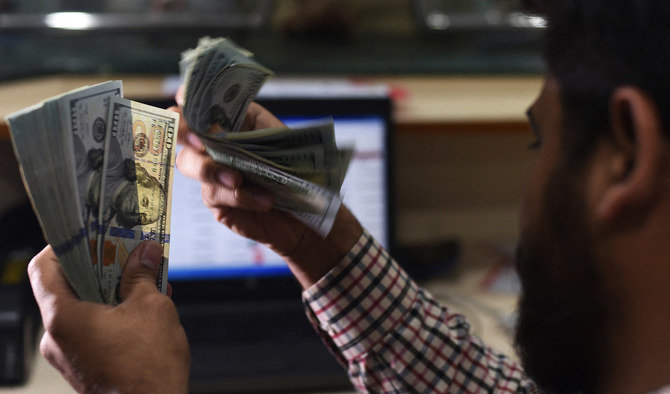
A Pakistani dealer counts US dollars at a currency exchange shop in Karachi, Pakistan, on October 9, 2018. (AFP/File)
Short Url
Updated 07 September 2022
Follow

Pakistan’s central bank restricts export of US currency notes amid shortage of greenback in open market

  • Economists say the measure may have little impact since dollar smuggling to neighboring Afghanistan continues
  • Exchange companies say the government has taken the right decision amid depreciation of the local currency

ISLAMABAD: Pakistan’s central bank has directed all exchange companies to seek prior permission for export of US dollar currency notes which had been allowed last month to boost the foreign exchange flow into the interbank market.

The State Bank of Pakistan’s directive comes at a time when the rupee is depreciating against the US dollar in the interbank market despite the disbursement of $1.16 billion by the International Monetary Fund (IMF) last week which marked the revival of the Extended Funded Facility program.

The rupee lost Rs2 against the US dollar in the interbank market on Wednesday, as the greenback continued to strengthen globally with the dollar index.

“The US dollar is in short supply in the market now, and the state bank has taken the right decision at the right time to restrict its export,” Zafar Paracha, general-secretary of the Exchange Companies Association of Pakistan (ECAP), told Arab News.

The central bank through a notification effective from today (Wednesday) said that exchange companies “shall seek prior approval from SBP for such export of USD currency notes.”

“Exchange companies are advised to ensure meticulous compliance with these instructions,” the notification read.

All the currency exchange companies in Pakistan are allowed to export US dollar currency notes to bring them back in remittances through the interbank market. This conversion of foreign exchange in the US dollars helps stabilize the interbank market and boost foreign exchange reserves to pay for the import bill.

“The state bank sometimes allows us to export the US dollar currency notes as well which are soiled, old notes which banks don’t accept or when the dollars are in abundant supply in the open market,” Paracha informed.

The central bank allows the export of the foreign exchange through cargo after proper vetting from relevant agencies, he said, adding that an exchange company is allowed to export from two million to four million dollars, depending on its business size.

“The exchange companies are then required to bring back this money through banks within 48 hours,” he said, adding the latest restriction on the exports would help bridge a gap between the interbank and open market price of the dollar against the rupee.

“The state bank is vigilant and it is taking all necessary measures to stabilize the country’s currency market,” Paracha added.

Economists remain skeptical about the desired impact of the measure taken by the central bank.

“This restriction is on the official export of the USD currency notes which may have little effect in the market, but we don’t see any significant measure to curb the dollar smuggling to neighboring Afghanistan,” Syed Atif Zafar, chief economist at Topline Securities, told Arab News.

“The dollar is still around ten rupees costlier in the open market,” he said, adding the recent devastating floods in Pakistan had also forced the government to import agricultural products, especially vegetables, which had increased the dollar demand in effect.

Zafar said another reason behind the appreciation of dollar and price difference in the open and interbank market was the UAE government’s regulation for Pakistani travelers to carry at least 5,000 dirhams in cash.


TV reporter dies after falling from rooftop during Pakistan kite-flying festival

Updated 5 sec ago
Follow

TV reporter dies after falling from rooftop during Pakistan kite-flying festival

  • Pakistan's Lahore marked the Basant festival on Feb. 6-8 after the Punjab government lifted an 18-year-old ban on kite flying
  • Malik Zain, a reporter affiliated with GNN news channel, fell from a four-storey building while flying a kite, Lahore police say

ISLAMABAD: A television reporter died after falling from a rooftop while flying a kite during the Basant spring festival in the eastern Pakistani city of Lahore, police and hospital authorities confirmed on Sunday.

Pakistan's Lahore marked the Basant festival on Feb. 6-8 after the Punjab provincial government this year lifted a ban on kite flying after 18 years, with extensive safety measures in place.

The festival, which marks the onset of spring, was banned in 2008 after deaths and injuries to motorcyclists and pedestrians from stray kite strings, sometimes coated with metal to make them more formidable in mid-air battles.

Malik Zain, a reporter affiliated with private news channel GNN, fell from the rooftop of a building during the final day of Basant celebrations in the eastern Pakistani city, according to police.

"Lahore journalist Malik Zain died after falling from the fourth floor while flying a kite in Gulshan-e-Ravi during Basant," the Lahore police said in a statement.

The reporter was shifted to the government-run Mian Munshi District Headquarters Hospital where he was pronounced dead, with cardiopulmonary arrest mentioned as the cause of death.

"Head injury due to fall from height," hospital authorities diagnosed in their report into Zain’s death.

The development came hours after Punjab Chief Minister Maryam Nawaz extended timings for Basant till early Monday morning.

“I am pleased to announce that Basant celebrations timings are being extended till 5:00 AM tomorrow morning,” CM Nawaz said in an X post on Sunday, highlighting the festivity, unity and joy across Lahore.

“This extension is a reward for the people of Lahore for celebrating Basant with great discipline and for responsibly following all safety SOPs (standard operating procedures).”

The Punjab government ‍banned the use of metallic or chemical-coated strings during the festival. Kites ‍and strings had to bear individual QR codes so they could be traced, and ‍motorcyclists had to attach safety rods to their bikes to fend off stray thread.

Some 4,600 producers had registered with the authorities to sell kites and strings ahead of the festival. Authorities had made it mandatory for owners to register rooftops with 30 or more revelers, while dozens of roofs ​had been declared off-limits after inspections.