

Putin says ‘impossible’ to isolate Russia, vowing to cut gas and oil supplies

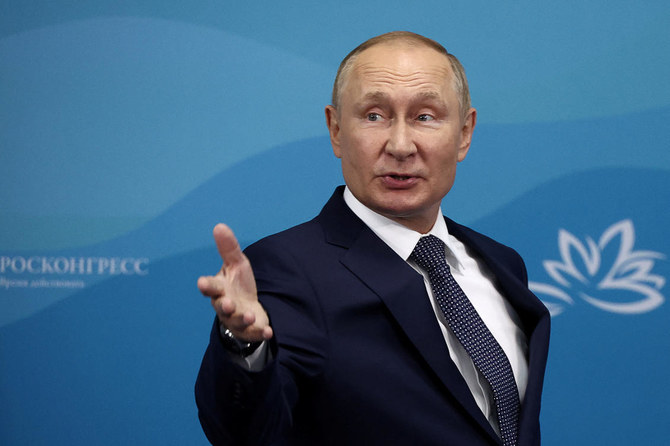
Russian President Vladimir Putin arrives for a meeting with Armenian Prime Minister Nikol Pashinyan on the sidelines of the 2022 Eastern Economic Forum (EEF) in Vladivostok, Russia on Wednesday. (Reuters)
Short Url
Updated 07 September 2022
Follow

Putin says ‘impossible’ to isolate Russia, vowing to cut gas and oil supplies

  • "No matter how much someone would like to isolate Russia, it is impossible to do this," Putin told the Eastern Economic Forum
  • On Wednesday, he vowed to cut off any countries imposing price caps on oil and gas exports, just as the EU proposed to do just that

MOSCOW: Russian President Vladimir Putin said Wednesday it was “impossible” to isolate Moscow and vowed to cut gas and oil deliveries to countries imposing a price cap on supplies.
Speaking Wednesday at an economic forum, over six months after Moscow sent troops into Ukraine, the Russian leader sought to pivot toward allies in Asia, the Middle East and Africa as his country faces a barrage of Western sanctions.
“No matter how much someone would like to isolate Russia, it is impossible to do this,” Putin told the Eastern Economic Forum in Russia’s Pacific port city of Vladivostok.
He said the coronavirus pandemic has been replaced by other global challenges “threatening the whole world,” including “sanctions fever in the West.”
Putin has repeatedly said that Russia’s economy is weathering the barrage of sanctions well, as the Kremlin’s ties with the West sink to new lows.
On Wednesday, he vowed to cut off any countries imposing price caps on oil and gas exports, just as the EU proposed to do just that.
Capping prices “would be an absolutely stupid decision,” Putin said.
“We will not supply anything at all if it is contrary to our interests, in this case economic (interests),” he said.
“No gas, no oil, no coal, no fuel oil, nothing.”
Europe, which is heavily dependent on Russian supplies, has accused Moscow of using energy as a weapon and on Wednesday, EU chief Ursula von der Leyen proposed that member states agree a price cap.
G7 industrialized powers on Friday vowed to move urgently toward implementing a price cap on Russian oil imports, in a bid to cut off a major source of funding for Moscow’s military action in Ukraine.
“Those who are trying to impose something on us are in no position today to dictate their will,” Putin said.
“They should come to their senses.”
Von der Leyen’s remarks come days after Russia closed the key Nord Stream pipeline to Europe, saying it would be under repair for an indefinite period.
“They say that Russia uses energy as a weapon. More nonsense! What weapon do we use? We supply as much as required according to requests” from importers, Putin told the economic forum.
“Give us a turbine, we will turn Nord Stream on tomorrow,” Putin said.
The Kremlin insists sanctions have prevented the proper maintenance of Russian gas infrastructure and, in particular, blocked the return of a Siemens turbine that had been undergoing repairs in Canada.

Putin’s participation in the forum in the Far East — a region with close geopolitical and economic ties to Russia’s neighbors in Asia — comes a day after the Russian president oversaw large-scale military drills there.
The week-long maneuvers, called Vostok-2022, were concluding on Wednesday and involved several Kremlin-friendly countries, including troops sent by Beijing.
As Moscow seeks to bolster ties with Asia — especially key ally China — Putin welcomed the growing role of the Asia-Pacific region in global affairs.
“The role... of the countries of the Asia-Pacific region has significantly increased,” he said at the forum, adding that partnerships will create “colossal new opportunities for our people.”
Putin was joined at Wednesday’s forum by China’s top legislator Li Zhanshu — who ranks third in the Chinese government hierarchy — with a bilateral meeting scheduled for later in the day.
The Russian leader is expected next week to hold an in-person meeting with Chinese counterpart Xi Jinping, who has not left China since 2020 due to the coronavirus pandemic.
The two leaders will meet at a summit of the Shanghai Cooperation Organization (SCO) held in Uzbekistan on September 15 and 16, a Russian diplomat said Wednesday.
Beijing and Moscow have drawn closer in recent years, ramping up cooperation as part of what they call a “no limits” relationship, acting as a counterweight to the global dominance of the United States.
Beijing has refused to condemn Moscow’s intervention in Ukraine, while Moscow was in full solidarity with Beijing during the visit of US House speaker Nancy Pelosi to self-ruled Taiwan, which China considers its territory.
In a sign of further rapprochement, Russia announced Tuesday that China will be switching from US dollars to the national currencies of the two countries — yuan and rubles — to pay for deliveries of Russian natural gas.


First EU–Saudi roundtable on critical raw materials reflects shared policy commitment

Updated 16 January 2026
Follow

First EU–Saudi roundtable on critical raw materials reflects shared policy commitment

RIYADH: The EU–Saudi Arabia Business and Investment Dialogue on Advancing Critical Raw Materials Value Chains, held in Riyadh as part of the Future Minerals Forum, brought together senior policymakers, industry leaders, and investors to advance strategic cooperation across critical raw materials value chains.

Organized under a Team Europe approach by the EU–GCC Cooperation on Green Transition Project, in coordination with the EU Delegation to Saudi Arabia, the European Chamber of Commerce in the Kingdom and in close cooperation with FMF, the dialogue provided a high-level platform to explore European actions under the EU Critical Raw Materials Act and ResourceEU alongside the Kingdom’s aspirations for minerals, industrial, and investment priorities.

This is in line with Saudi Vision 2030 and broader regional ambitions across the GCC, MENA, and Africa.

ResourceEU is the EU’s new strategic action plan, launched in late 2025, to secure a reliable supply of critical raw materials like lithium, rare earths, and cobalt, reducing dependency on single suppliers, such as China, by boosting domestic extraction, processing, recycling, stockpiling, and strategic partnerships with resource-rich nations.

The first ever EU–Saudi roundtable on critical raw materials was opened by the bloc’s Ambassador to the Kingdom, Christophe Farnaud, together with Saudi Deputy Minister for Mining Development Turki Al-Babtain, turning policy alignment into concrete cooperation.

Farnaud underlined the central role of international cooperation in the implementation of the EU’s critical raw materials policy framework.

“As the European Union advances the implementation of its Critical Raw Materials policy, international cooperation is indispensable to building secure, diversified, and sustainable value chains. Saudi Arabia is a key partner in this effort. This dialogue reflects our shared commitment to translate policy alignment into concrete business and investment cooperation that supports the green and digital transitions,” said the ambassador.

Discussions focused on strengthening resilient, diversified, and responsible CRM supply chains that are essential to the green and digital transitions.

Participants explored concrete opportunities for EU–Saudi cooperation across the full value chain, including exploration, mining, and processing and refining, as well as recycling, downstream manufacturing, and the mobilization of private investment and sustainable finance, underpinned by high environmental, social, and governance standards.

From the Saudi side, the dialogue was framed as a key contribution to the Kingdom’s industrial transformation and long-term economic diversification agenda under Vision 2030, with a strong focus on responsible resource development and global market integration.

“Developing globally competitive mineral hubs and sustainable value chains is a central pillar of Saudi Vision 2030 and the Kingdom’s industrial transformation. Our engagement with the European Union through this dialogue to strengthen upstream and downstream integration, attract high-quality investment, and advance responsible mining and processing. Enhanced cooperation with the EU, capitalizing on the demand dynamics of the EU Critical Raw Materials Act, will be key to delivering long-term value for both sides,” said Al-Babtain.

Valere Moutarlier, deputy director-general for European industry decarbonization, and directorate-general for the internal market, industry, entrepreneurship and SMEs at European Commission, said the EU Critical Raw Materials Act and ResourceEU provided a clear framework to strengthen Europe’s resilience while deepening its cooperation with international partners.

“Cooperation with Saudi Arabia is essential to advancing secure, sustainable, and diversified critical raw materials value chains. Dialogues such as this play a key role in translating policy ambitions into concrete industrial and investment cooperation,” she added.