

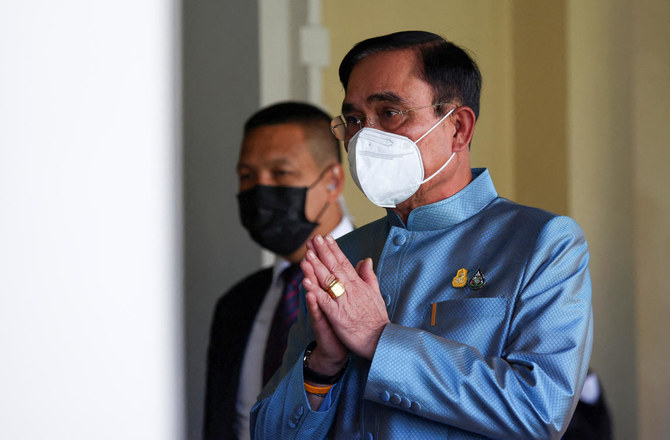

BANGKOK: Thailand’s Constitutional Court suspended Prime Minister Prayuth Chan-ocha on Wednesday after accepting a petition from an opposition party seeking his ousting on the grounds that he has held office for his full, legally mandated term.
The petition filed to Parliament last week by the main opposition Pheu Thai party argued that Prayuth’s time spent as head of a military junta, after he staged a coup when he was army chief in 2014, should count toward his constitutionally stipulated eight-year term.
Though Prayuth could be restored to his position when the court rules on the petition, the surprise suspension threw Thai politics into confusion.
“The court has considered the petition and related documents and sees that the facts from the petition are cause for questioning as demanded,” it said.
Prayuth has 15 days to respond, the court told media in a statement, adding that a panel of judges ruled five to four in favor of his suspension, starting from Wednesday.
Government spokesman Anucha Burapachaisri said Prayuth respected the court’s decision and had ceased active duty, adding that Deputy Prime Minister Prawit Wongsuwan would take over as interim leader and the suspension would have no impact on the government’s work.
“Prime Minister Prayuth also urged the people to respect the decision of the court and avoid criticizing the decision that could further create division,” Anucha said. It was not clear when the court would deliver a final ruling on the petition.
Prayuth ruled as head of a military council after he overthrow an elected government in 2014.
He became a civilian prime minister in 2019 following an election held under a 2017 military-drafted constitution in which an eight-year limit for a prime minister was set.
Thailand’s next general election is due by May next year.
In its review request, the Pheu Thai party, which was forced from power in the 2014 coup, argued that Prayuth should leave office this week because his time as junta chief should count toward his term.
The party’s leader, Chonlanan Srikaew, said in making its decision the court had reflected the party’s concern about the legality and legitimacy of various laws in the absence of a suspension. He declined to make any further comment.
Nearly two-thirds of Thais also want Prayuth out of office by this month, a recent poll showed.
But some supporters argue his term started in 2017, when the new constitution took effect, or after the 2019 election, meaning that he should be allowed to stay in power until 2025 or 2027, if elected.
The controversy is the latest in a country that suffered intermittent political turmoil for nearly two decades, including two coups and violent protests, stemming broadly from opposition to military involvement in politics and demands for greater representation as political awareness grows.
Pro-democracy activists have campaigned against Prayuth and his government, arguing that the 2019 election was not legitimate although student-led demonstrations petered out over the past couple of years with the imposition of COVID-19 bans on gatherings.
Activists gathered again this week in anticipation of the court decision.
Nearly 100 pro-democracy protesters at Bangkok’s Democracy Monument welcomed Prayuth’s suspension but said it was not enough and they planned a march later on Wednesday to press their point.


