

Sri Lanka looks to Saudi travelers to boost tourism industry

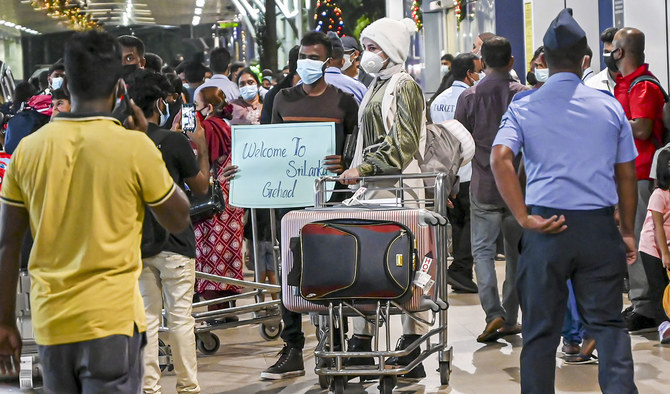
Tourists leave from the Bandaranaike International Airport in Katunayake, on the outskirts of Colombo on January 10, 2022. (AFP/File)
Short Url
Updated 21 August 2022
Follow

Sri Lanka looks to Saudi travelers to boost tourism industry

  • Saudi Arabia is one of the Tourism Development Authority’s primary potential markets
  • Tourists from the Kingdom spend an average of $230 a day when they visit the island nation

COLOMBO: Sri Lankan authorities and travel industry players are pinning hopes on arrivals from Saudi Arabia — a top travel spending market — as the island nation is grappling with the effects of an ongoing financial crisis on its tourism economy.

Tourism has traditionally been one of the key sources of Sri Lanka’s foreign reserves and in 2018 earned it $4.4 billion, contributing 5.6 percent to GDP. But this dropped to just 0.8 percent in 2020, as the country received a major blow when the outbreak of COVID-19 halted global travel.

Earlier this year, to rebound from the pandemic, Sri Lanka declared 2022 the “Visit Sri Lanka Year” to prioritize the tourism industry, but as it sinks deeper into its worst economic crisis since independence, it has been forced to realign its strategies.

Assessing this year’s visitor data until July, Sri Lanka’s Tourism Development Authority has identified its top primary markets and top potential markets, including among them Saudi Arabia.  

“Saudi Arabia is an important source for Sri Lankan market due to the size of the population and high GDP per capita in the region,” Madhubhani Perera, public relations director at the Sri Lanka Tourism Promotion Bureau told Arab News on Friday.


Sri Lankans and tourists climb the 80-meter (600-foot) fortress of Sigiriya rock (the Lion Rock) in Sigiriya, north-central Sri Lanka, on February 11, 2017. (AFP/File)

According to the bureau’s data, tourists from the Kingdom spend on average $230 a day when they visit the island nation.

Even though the number of Saudi tourists has dropped from 34,700 in 2018 to 4,015 by July this year, the Kingdom is still “considered to be a main top market in terms of arrivals,” Perera said, adding that efforts are now focused on promotional activities to enhance the number of visits.

Mohamed Sabry Bahaudeen, chairman of the Travel Agents Association of Sri Lanka, said the nature of the Saudi market is “suggesting the potential to grow” and is where the island nation could tap into to shore up its foreign currency inflows.

“Travelers from the country on average have one of the highest travel spends in the world, which will result in an increase of foreign exchange,” he told Arab News.


Tourists visit the Galle Fort in Galle, Sri Lanka, on November 28, 2021. (AFP/File)

All age groups of Saudi tourists visiting Sri Lanka have been identified by the Tourism Promotion Bureau as generally interested in wildlife and nature, and “the possibility to enjoy holidays that have a green footprint, native birds, animals in their natural habitats.”

With its famed palm-fringed white beaches, seaside resorts offering water sports, and UNESCO cultural sites, Sri Lanka is also popular among travelers visiting with kids.

Family tourism is what travel operators are trying to revive.

“Sri Lanka was an ideal destination for Saudi tourists because they prefer family holidays and we have a diverse attractions in the country to a rich cultural activities and history and relaxing as well as sports activities to keep the whole family satisfied,” Bahaudeen said.

“I’m confident we will see many more visitors from Saudi Arabia making Sri Lanka their next holiday destination of choice in the coming months.”


EU leaders to reassess US ties despite Trump U-turn on Greenland

Updated 22 January 2026
Follow

EU leaders to reassess US ties despite Trump U-turn on Greenland

  • Diplomats stressed that, although Thursday’s emergency EU talks in Brussels would now lose some of their urgency, the longer-term issue of how to handle the relationship with the US remained

BRUSSELS: EU leaders will rethink their ties with the US at an emergency summit on Thursday after Donald Trump’s threat of tariffs and even military action to ​acquire Greenland badly shook confidence in the transatlantic relationship, diplomats said.
Trump abruptly stepped back on Wednesday from his threat of tariffs on eight European nations, ruled out using force to take Greenland, a semi-autonomous territory of NATO ally Denmark, and suggested a deal was in sight to end the dispute.
German Chancellor Friedrich Merz, welcoming Trump’s U-turn on Greenland, urged Europeans not to be too quick to write off the transatlantic partnership.
But EU governments remain wary of another change of mind by a mercurial president who is increasingly seen as a bully that Europe will have to stand up to, and they are focused on coming up with a longer-term plan on how to deal with the ‌United States under this ‌administration and possibly its successors too.
“Trump crossed the Rubicon. He might do ‌it ⁠again. ​There is no ‌going back to what it was. And leaders will discuss it,” one EU diplomat said, adding that the bloc needed to move away from its heavy reliance on the US in many areas.
“We need to try to keep him (Trump) close while working on becoming more independent from the US It is a process, probably a long one,” the diplomat said.
EU RELIANCE ON US
After decades of relying on the United States for defense within the NATO alliance, the EU lacks the needed intelligence, transport, missile defense and production capabilities to defend itself against a possible Russian attack. This gives the US substantial leverage.
The US ⁠is also Europe’s biggest trading partner, making the EU vulnerable to Trump’s policies of imposing tariffs to reduce Washington’s trade deficit in goods, and, as in ‌the case of Greenland, to achieve other goals.
“We need to discuss where ‍the red lines are, how we deal with this bully ‍across the Atlantic, where our strengths are,” a second EU diplomat said.
“Trump says no tariffs today, but does ‍that mean also no tariffs tomorrow, or will he again quickly change his mind? We need to discuss what to do then,” the second diplomat said.
The EU had been considering a package of retaliatory tariffs on 93 billion euros ($108.74 billion) on US imports or anti-coercive measures if Trump had gone ahead with his own tariffs, while knowing such a step would harm Europe’s economy as well ​as the United States.
WHAT’S THE GREENLAND DEAL?
Several diplomats noted there were still few details of the new plan for Greenland, agreed between Trump and NATO Secretary General Mark Rutte late on ⁠Wednesday on the sidelines of the World Economic Forum in Davos, Switzerland.
“Nothing much changed. We still need to see details of the Greenland deal. We are a bit fed up with all the bullying. And we need to act on a few things: more resiliency, unity, get our things together on internal market, competitiveness. And no more accepting tariff bullying,” a third diplomat said.
Rutte told Reuters in an interview in Davos on Thursday that under the framework deal he reached with Trump the Western allies would have to step up their presence in the Arctic.
He also said talks would continue between Denmark, Greenland and the US on specific issues.
Diplomats stressed that, although Thursday’s emergency EU talks in Brussels would now lose some of their urgency, the longer-term issue of how to handle the relationship with the US remained.
“The approach of a united front in solidarity with Denmark and Greenland while focusing on de-escalation and finding an off-ramp has worked,” a fourth EU diplomat said.
“At the ‌same time it would be good to reflect on the state of the relationship and how we want to shape this going forward, given the experiences of the past week (and year),” he said.