

FBI sought nuclear documents in search of Trump’s home: report

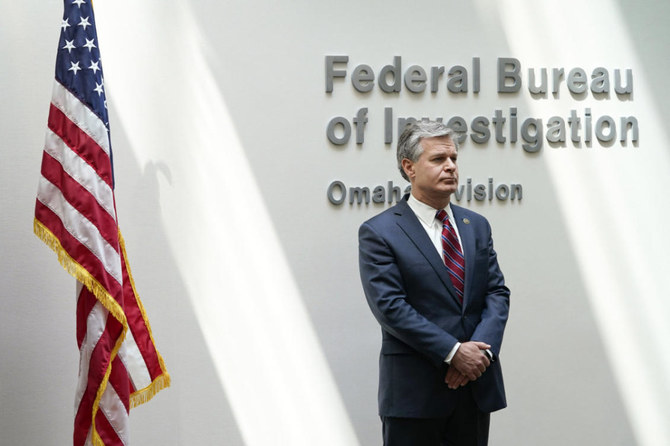
FBI Director Christopher Wray waits to speak at a news conference on Aug. 10, 2022, in Omaha, Nebraska. (AP Photo/Charlie Neibergall)
Short Url
Updated 12 August 2022
Follow

FBI sought nuclear documents in search of Trump’s home: report

  • Supporters of President Donald Trump have been using violent rhetoric in the wake of his agency’s search of his Mar-a-Lago home
  • Trump is being investigated by the US Justice Department for potential mishandling of classified information

OMAHA, Nebraska: US federal agents were looking for documents relating to nuclear weapons when they raided former President Donald Trump’s home in Florida this week, the Washington Post reported.
It was not clear if such documents were recovered at the former president’s Mar-a-Lago resort in Palm Beach, the Post said.
The US Justice Department asked a judge on Thursday to make public the warrant that authorized the FBI search of Mar-a-Lago, after Trump, a Republican, portrayed it as political retribution.
The request means the public could soon learn more about what investigators were looking for during the unprecedented search of a former president’s home.
The search was part of an investigation into whether Trump illegally removed records from the White House as he left office in January 2021, some of which the Justice Department believes are classified.

Earlier, the director of the FBI had strong words for supporters of former President Donald Trump who have been using violent rhetoric in the wake of his agency’s search of Trump’s Mar-a-Lago home.
Christopher Wray, who was appointed as the agency’s director in 2017 by Trump, called threats circulating online against federal agents and the Justice Department “deplorable and dangerous.”
“I’m always concerned about threats to law enforcement,” Wray said. “Violence against law enforcement is not the answer, no matter who you’re upset with.”
Wray made the remarks following a news conference during a long-planned visit to the agency’s field office in Omaha, Nebraska, where he discussed the FBI’s focus on cybersecurity. He declined to answer questions about the hours-long search Monday by FBI agents of Trump’s Palm Beach, Florida resort.
It has been easy to find the threats and a call to arms in those corners of the Internet favored by right-wing extremists since Trump himself announced the search of his Florida home. Reactions included the ubiquitous “Lock and load” and calls for federal agents and even US Attorney General Merrick Garland to be assassinated.
On Gab — a social media site popular with white supremacists and antisemites — one poster going by the name of Stephen said he was awaiting “the call” to mount an armed revolution.
“All it takes is one call. And millions will arm up and take back this country. It will be over in less than 2 weeks,” the post said.
Another Gab poster implored others: “Lets get this started! This unelected, illegitimate regime crossed the line with their GESTAPO raid! It is long past time the lib socialist filth were cleansed from American society!“


Bangladesh halts controversial relocation of Rohingya refugees to remote island

Updated 29 December 2025
Follow

Bangladesh halts controversial relocation of Rohingya refugees to remote island

  • Administration of ousted PM Sheikh Hasina spent about $350m on the project
  • Rohingya refuse to move to island and 10,000 have fled, top refugee official says

DHAKA: When Bangladesh launched a multi-million-dollar project to relocate Rohingya refugees to a remote island, it promised a better life. Five years on, the controversial plan has stalled, as authorities find it is unsustainable and refugees flee back to overcrowded mainland camps.

The Bhasan Char island emerged naturally from river sediments some 20 years ago. It lies in the Bay of Bengal, over 60 km from Bangladesh’s mainland.

Never inhabited, the 40 sq. km area was developed to accommodate 100,000 Rohingya refugees from the cramped camps of the coastal Cox’s Bazar district.

Relocation to the island started in early December 2020, despite protests from the UN and humanitarian organizations, which warned that it was vulnerable to cyclones and flooding, and that its isolation restricted access to emergency services.

Over 1,600 people were then moved to Bhasan Char by the Bangladesh Navy, followed by another 1,800 the same month. During 25 such transfers, more than 38,000 refugees were resettled on the island by October 2024.

The relocation project was spearheaded by the government of former Prime Minister Sheikh Hasina, who was ousted last year. The new administration has since suspended it indefinitely.

“The Bangladesh government will not conduct any further relocation of the Rohingya to Bhasan Char island. The main reason is that the country’s present government considers the project not viable,” Mizanur Rahman, refugee relief and repatriation commissioner in Cox’s Bazar, told Arab News on Sunday.

The government’s decision was prompted by data from UN agencies, which showed that operations on Bhasan Char involved 30 percent higher costs compared with the mainland camps in Cox’s Bazar, Rahman said.

“On the other hand, the Rohingya are not voluntarily coming forward for relocation to the island. Many of those previously relocated have fled ... Around 29,000 are currently living on the island, while about 10,000 have returned to Cox’s Bazar on their own.”

A mostly Muslim ethnic minority, the Rohingya have lived for centuries in Myanmar’s western Rakhine state but were stripped of their citizenship in the 1980s and have faced systemic persecution ever since.

In 2017 alone, some 750,000 of them crossed to neighboring Bangladesh, fleeing a deadly crackdown by Myanmar’s military. Today, about 1.3 million of them shelter in 33 camps in the coastal Cox’s Bazar district, making it the world’s largest refugee settlement.

Bhasan Char, where the Bangladeshi government spent an estimated $350 million to construct concrete residential buildings, cyclone shelters, roads, freshwater systems, and other infrastructure, offered better living conditions than the squalid camps.

But there was no regular transport service to the island, its inhabitants were not allowed to travel freely, and livelihood opportunities were few and dependent on aid coming from the mainland.

Rahman said: “Considering all aspects, we can say that Rohingya relocation to Bhasan Char is currently halted. Following the fall of Sheikh Hasina’s regime, only one batch of Rohingya was relocated to the island.

“The relocation was conducted with government funding, but the government is no longer allowing any funds for this purpose.”

“The Bangladeshi government has spent around $350 million on it from its own funds ... It seems the project has not turned out to be successful.”