

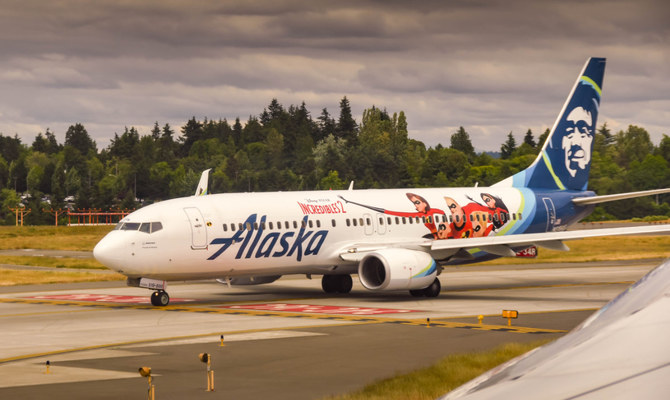

CHICAGO: Two Muslim American passengers filed a lawsuit this week against Alaska Airlines for allegedly kicking them off a flight, saying they were victims of racist discrimination and dissatisfied with the company’s promise to investigate the humiliation they faced.
Abobakkr Dirar and Mohamed Elamin, American citizens of Sudanese heritage, were seated in the first-class section of Flight #304 waiting for departure from Seattle to San Francisco on Feb. 17, 2020, when they were removed from the airplane, allegedly for speaking and texting in Arabic.
While they waited for takeoff, they spoke to each other and texted friends in their native language. Another passenger who overheard them speaking Arabic and saw some of their texts became “alarmed” and complained to a flight attendant, according to the lawsuit that was filed in the Western District of the State of Washington.
Dirar and Elamin were immediately escorted off the plane with the excuse of having “ticketing issues” by uniformed law enforcement personnel. Once off the flight, the two men spoke with an FBI agent called to the scene who copied and translated their text messages, later determining that they “posed no threat,” according to the lawsuit.
Although the other passengers eventually departed on the flight, Dirar and Elamin were rebooked hours later in downgraded economy class seats, and prohibited from flying together. They were each booked on separate flights.
After they complained, they were told that Alaska Airlines would investigate, but after two years of no action, Dirar and Elamin decided on Aug. 2 this year to take their complaint to a Federal Court alleging civil rights violations.
“Through its actions, Defendant (Alaska Airlines Inc.) essentially weaponized Islamophobic, racist, and xenophobic fears by using Plaintiffs as human props in an admittedly unjustified, unnecessary, and self-serving display of discriminatory security theater,” the lawsuit explains.
“By the time Plaintiffs finally reached their destination, they were too humiliated and traumatized by Defendant’s actions to enjoy their trip. Their trauma was exacerbated by knowing that such public mistreatment would give credence to Islamophobic, racist, and xenophobic beliefs which have plagued the Muslim community in the United States for decades. The emotional distress Plaintiffs suffered continues to impact them to this day, and they are retraumatized each time they consider booking a flight.”
The lawsuit further alleges: “As a result of Defendant’s discriminatory abuse on February 17, 2020, Plaintiffs have felt immense pressure to take precautions in travel which non-Arabic/Middle Eastern travelers do not have to consider and which no traveler should ever have to take.”
The precautions include actions “specifically designed to conceal and downplay their identity and avoid similar discriminatory abuse in air travel, (and) include: avoiding air travel whenever possible and, thereby, enduring long distance road trips and suffering the physical discomfort, inconvenience, loss of time, and added financial costs associated with such trips.”
They also claim that they now are forced to arrive “at the airport hours earlier than customary to account for delays from potential repeat discriminatory abuse; avoiding use of their cell phones and keeping them powered off in airports and on airplanes whenever possible; and avoiding speaking in their native Arabic in airports and on airplanes as much as possible.”
Alaska Airlines released a statement after the lawsuit was filed, stating: “Alaska Airlines strictly prohibits unlawful discrimination. We take such complaints very seriously. Our greatest responsibility is to ensure that our flight operations are safe, every day.”
The 25-page lawsuit was filed by attorneys Luis Segura and Lena F. Masri who work with CAIR, the Council on American Islamic Relations.
Segura and Masri allege in the lawsuit that after the two individuals were removed from the plane, employees were instructed to remove all the “tanks” from its toilets, and they also discussed bringing in a K-9 unit to check the aircraft.
All this occurred even though Port of Seattle Police Officer Andrew Neisinger “spoke with an unnamed Alaska Airlines manager” who reported that the incident was “a misunderstanding between passengers,” that “everything was fine,” “there was no threat of any kind,” and that “police were no longer needed.”
The lawsuit demands that Alaska Airlines provide “racial and religious sensitivity training to all employees,” prevent further discrimination against other passengers based on “their religion, race, color, ethnicity, alienage or national origin,” and award the two plaintiffs unspecified financial and punitive damages to be determined by a court trial, in addition to attorney fees.
The incidents of Arab and Muslim Americans being escorted off flights, especially since the Sept. 11, 2001, terrorist attacks, have been quite common, Arab and Muslim American organizations have reported.
Five incidents occurred in the weeks after Sept. 11, 2001, in which Muslims were told they had to leave their seats and exit aircraft.
In March 2016, an Arab American family was forced off a United Airlines flight after the mother, wearing a hijab, asked for a strap to secure a booster seat for her child. Instead, the family was told to leave the plane.
The following month in April 2016, a UC Berkley researcher was removed from a flight after other passengers complained when he spoke in Arabic.
The American Arab Anti-Discrimination Committee reported that similar incidents have occurred on other airlines including Allegiant, Spirit, Delta, JetBlue, American Airlines and Southwest Airlines.


