

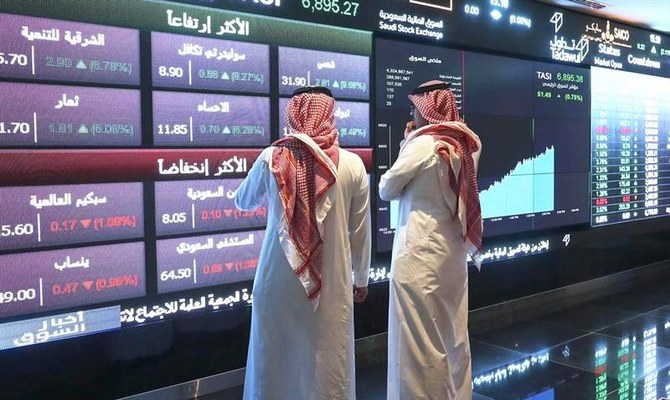
Saudi stocks end flat on US-China tensions: Closing bell

In its closing bell on Thursday, the Tadawul All Share Index ended at 12,291 points, while the parallel market, Nomu, gained 0.36 percent to reach 21,837 points.
Short Url
Updated 04 August 2022
Follow

Saudi stocks end flat on US-China tensions: Closing bell

RIYADH: Saudi Arabia’s benchmark index ended flat in the week’s final session, as oil prices declined and investors scramble to assess the impact on the market caused by tensions between the US and China over House Speaker Nancy Pelosi’s visit to Taiwan.

In its closing bell on Thursday, the Tadawul All Share Index ended at 12,291 points, while the parallel market, Nomu, gained 0.36 percent to reach 21,837 points.

In energy trading, Brent crude dropped to $96.67 a barrel, while West Texas Intermediate fell to $91.03 as of 3:10 p.m. Saudi time.

Naseej International Trading Co. led the gainers with a 9.58 percent gain, followed by the Red Sea International Co. which gained 9.07 percent.

In the fallers list, Saudi Industrial Investment Group slipped 4.99 percent, after its profits for the first half declined by 36 percent to SR519 million ($138.4 million).

The Saudi National Bank dropped 0.56 percent, while the Kingdom’s largest valued bank, Al Rajhi, added 0.23 percent.

Riyad Bank gained 2.47 percent, after its first-half profit rose 10 percent to SR3.2 billion.

The National Industrialization Co. fell 0.84 percent, after reporting a profit decline of 11 percent in the first half of 2022 to SR606 million.

The Saudi Steel Pipe Co. gained 1.53 percent, after it recorded profits of SR26 million in the first half of the year, compared with losses of SR16.7 million in the same period of 2021.

The Kingdom’s oil giant Saudi Aramco ended the day with a 0.38 percent decline.


Experts clash over effect of war on oil supply

Updated 19 sec ago
Follow

Experts clash over effect of war on oil supply

  • International energy chief dismisses crisis fears * But Qatari minister warns exports could halt ‘in weeks’

BRUSSELS: International Energy Agency chief Fatih Birol on Friday dismissed fears of a global oil crisis, and said there was “plenty of oil in the market.”
But he was contradicted by Qatar’s Energy Minister Saad Al-Kaabi, who said Gulf oil producers could halt exports within weeks because of the US-Israel-Iran war, sending crude prices to $150 a barrel.

The war on Iran and Tehran’s retaliatory attacks across the Gulf have already sent crude prices soaring by about 20 percent, fanning fears of a fresh spike in inflation that could hit the global economy. Shipping through the critical Strait of Hormuz has all but dried up.
US President Donald Trump has pledged to protect ships passing through and promised further action to “reduce pressure on oil,” but prices have remained elevated. Brent crude, the global benchmark, was up 2.77 percent on Friday to nearly $88 a barrel.

However, Birol said: “There is plenty of oil, we have no oil shortage. There is a huge surplus in the market. We are facing a temporary disruption, a logistical disruption.”

Nevertheless, Al-Kaabi insisted there would be pressure on oil supplies “in two to three weeks” if tankers were unable to pass through the Strait.

“Everybody that has ​not called for force majeure we expect ⁠will do so in the next ​few days that this continues. All exporters in ​the Gulf region will have to call force majeure,” he said. “Everybody's energy price is going to go higher. There will be shortages of ​some products and there will be a chain reaction of factories that cannot supply.”

Qatar halted its liquefied natural gas production on March 2, as Iranian retaliation for US and Israeli strikes continued to target Gulf countries.