


EDMONTON, Canada: Pope Francis began a historic visit to Canada on Sunday to apologize to Indigenous peoples for abuses by missionaries at residential schools, a key step in the Catholic Church’s efforts to reconcile with Native communities and help them heal from generations of trauma.
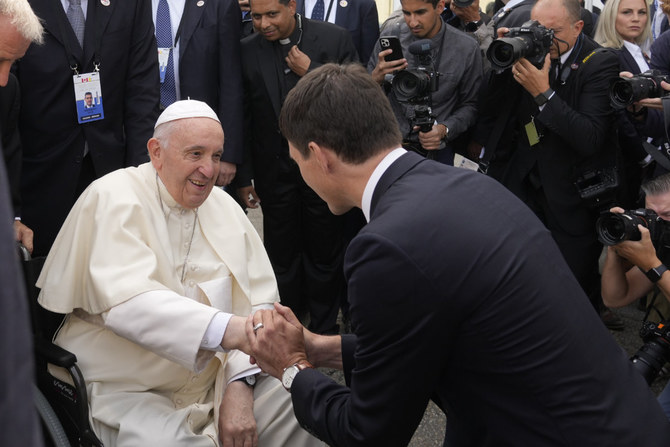
Francis kissed the hand of a residential school survivor as he was greeted at the Edmonton, Alberta, airport by Indigenous representatives, Canadian Prime Minister Justin Trudeau and Mary Simon, an Inuk who is Canada’s first Indigenous governor general.
The gesture set the tone of what Francis has said is a “penitential pilgrimage” to atone for the role of Catholic missionaries in the forced assimilation of generations of Native children — a visit that has stirred mixed emotions across Canada as survivors and their families cope with the trauma of their losses and receive a long-sought papal apology.
Francis had no official events scheduled Sunday, giving him time to rest before his meeting Monday with survivors near the site of a former residential school in Maskwacis, where he is expected to pray at a cemetery and apologize.
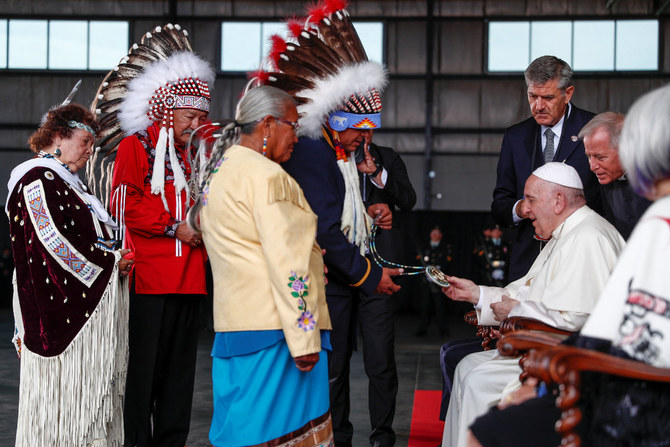
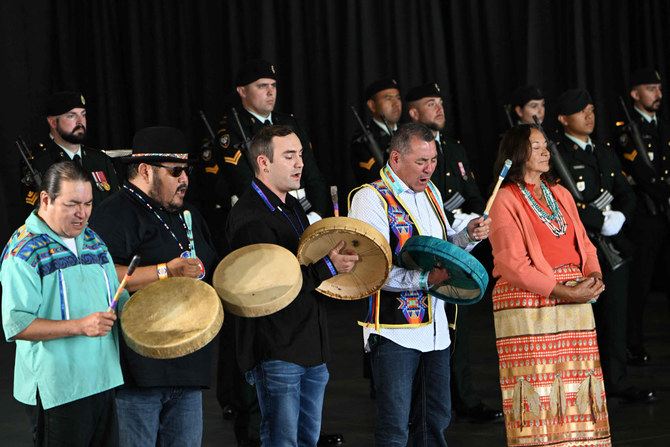
Francis exited the back of his plane with the help of an ambulift, given his strained knee ligaments have forced him to use a wheelchair. The simple welcome ceremony took place in airport hangar, where Indigenous drums and chanting broke the silence. As Trudeau and Simon sat beside Francis, a succession of Indigenous leaders and elders greeted the pope and exchanged gifts. At one point, Francis kissed the hand of residential school survivor Elder Alma Desjarlais of the Frog Lake First Nations as she was introduced to him.
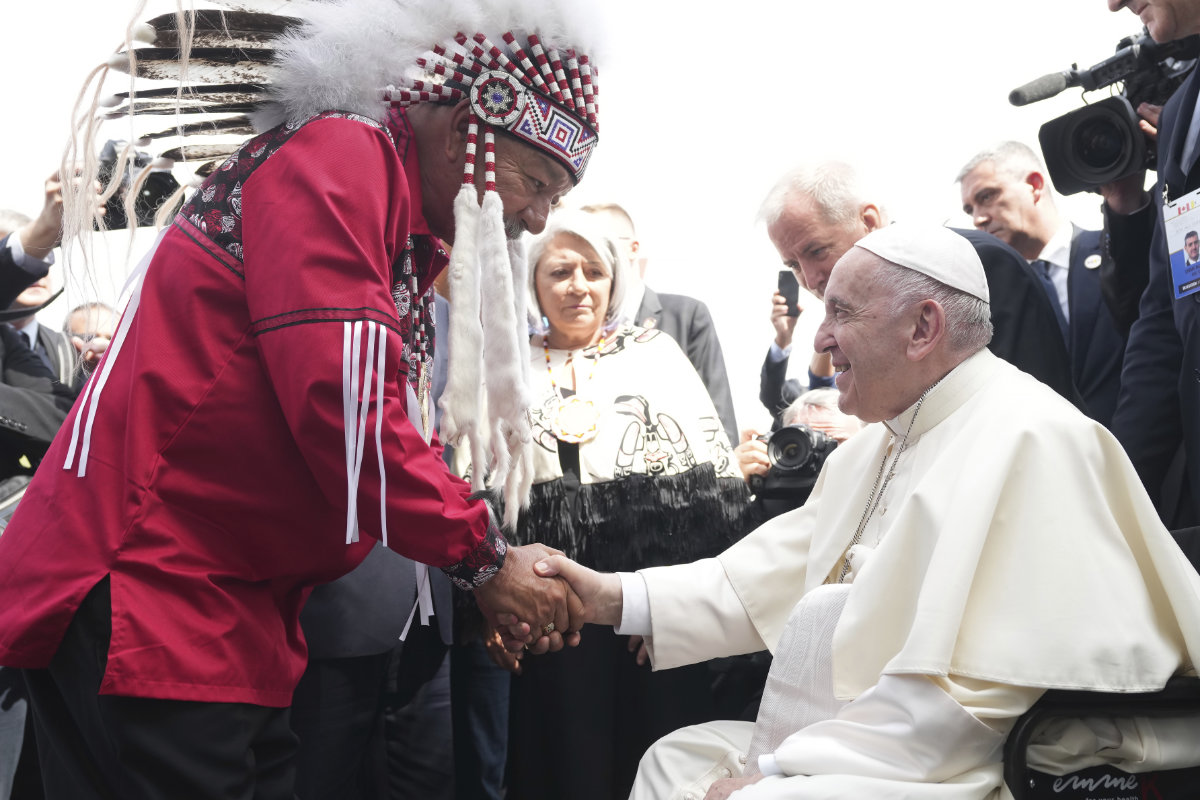
Pope Francis is greeted by George Arcand, Grand Chief of the Confederacy of Treaty Six First Nations, as he arrives in Edmonton, Alberta, Canada, on July 24, 2022. (The Canadian Press via AP)
“Right now, many of our people are skeptical and they are hurt,” said Grand Chief George Arcand Jr. of the Confederacy of Treaty Six First Nations, who greeted the pope. Yet he expressed hope that with the papal apology, “We could begin our journey of healing .. and change the way things have been for our people for many, many years.”
Indigenous groups are seeking more than just words, though, as they press for access to church archives to learn the fate of children who never returned home from the residential schools. They also want justice for the abusers, financial reparations and the return of Indigenous artifacts held by the Vatican Museums.
Assembly of First Nations National Chief RoseAnne Archibald, one of the country’s most prominent Indigenous leaders, said several members of her family attended residential schools, including a sister who died at one in Ontario. She described it as “an institution of assimilation and genocide.”
During her fight to Alberta, “I was just so overcome with emotion and there were different times on the plane where I really had to stop myself from breaking into a deep sob,” she said. “I realized that I am an intergenerational trauma survivor and there are so many people like me.”
Francis’ week-long trip — which will take him to Edmonton; Quebec City and finally Iqaluit, Nunavut, in the far north — follows meetings he held in the spring at the Vatican with delegations from the First Nations, Metis and Inuit. Those meetings culminated with a historic April 1 apology for the “deplorable” abuses committed by some Catholic missionaries in residential schools.
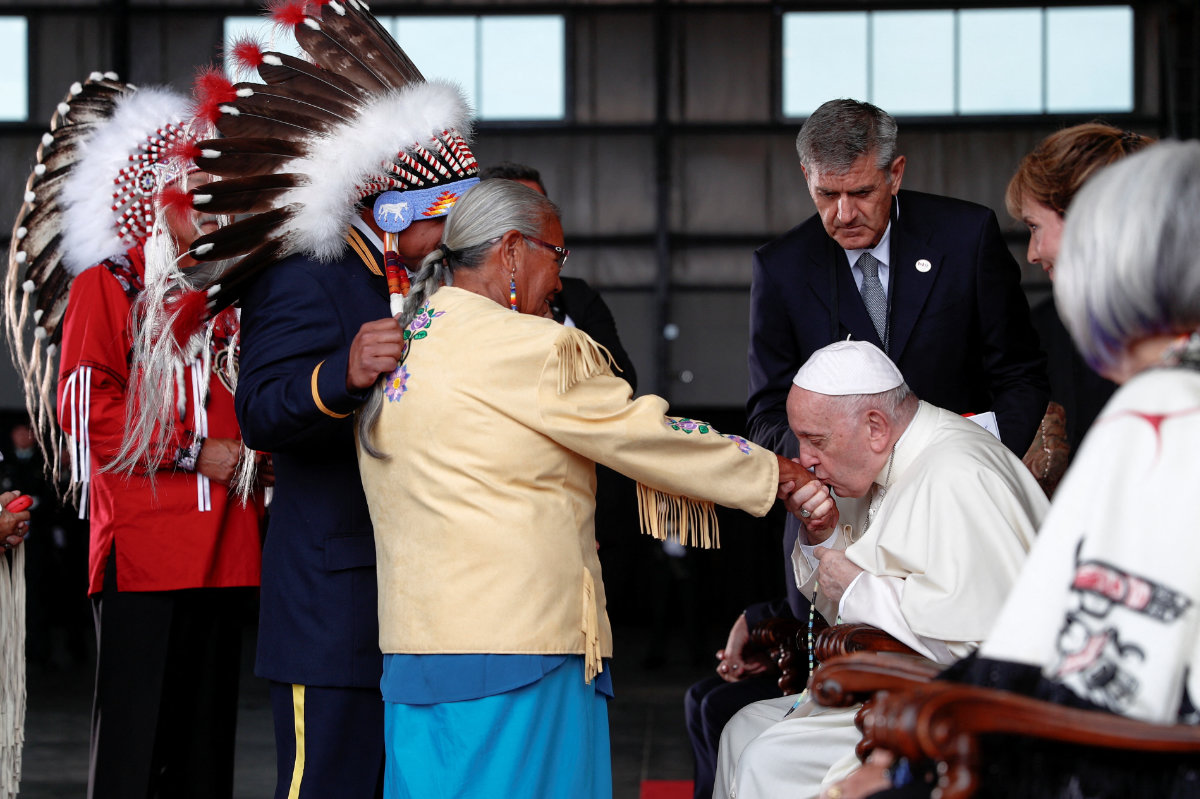
Pope Francis is welcomed by representatives of Indigenous communities upon his arrival at Edmonton International Airport in Alberta, Canada on July 24, 2022. (REUTERS/Guglielmo Mangiapane)
The Canadian government has admitted that physical and sexual abuse were rampant in the state-funded Christian schools that operated from the 19th century to the 1970s. Some 150,000 Indigenous children were taken from their families and forced to attend in an effort to isolate them from the influence of their homes, Native languages and cultures and assimilate them into Canada’s Christian society.
Then-Prime Minister Stephen Harper issued a formal apology over the residential schools in 2008. As part of a lawsuit settlement involving the government, churches and approximately 90,000 surviving students, Canada paid reparations that amounted to billions of dollars being transferred to Indigenous communities. Canada’s Catholic Church says its dioceses and religious orders have provided more than $50 million in cash and in-kind contributions, and hope to add $30 million more over the next five years.
Canada’s Truth and Reconciliation Commission in 2015 had called for a papal apology to be delivered on Canadian soil, but it was only after the 2021 discovery of the possible remains of around 200 children at the former Kamloops residential school in British Columbia that the Vatican mobilized to comply with the request.
“I honestly believe that if it wasn’t for the discovery ... and all the spotlight that was placed on the Oblates or the Catholic Church as well, I don’t think any of this would have happened,” said Raymond Frogner, head archivist at the National Center for Truth and Reconciliation.
Frogner just returned from Rome where he spent five days at the headquarters of the Missionary Oblates of Mary Immaculate, which operated 48 of the 139 Christian-run residential schools, the most of any Catholic order. After the graves were discovered, the Oblates finally offered “complete transparency and accountability” and allowed him into its headquarters to research the names of alleged sex abusers from a single school in the western Canadian province of Saskatchewan, he said.
The Inuit community, for its part, is seeking Vatican assistance to extradite a single Oblate priest, the Rev. Joannes Rivoire, who ministered to Inuit communities until he left in the 1990s and returned to France. Canadian authorities issued an arrest warrant for him in 1998 on accusations of several counts of sexual abuse, but it has never been served.
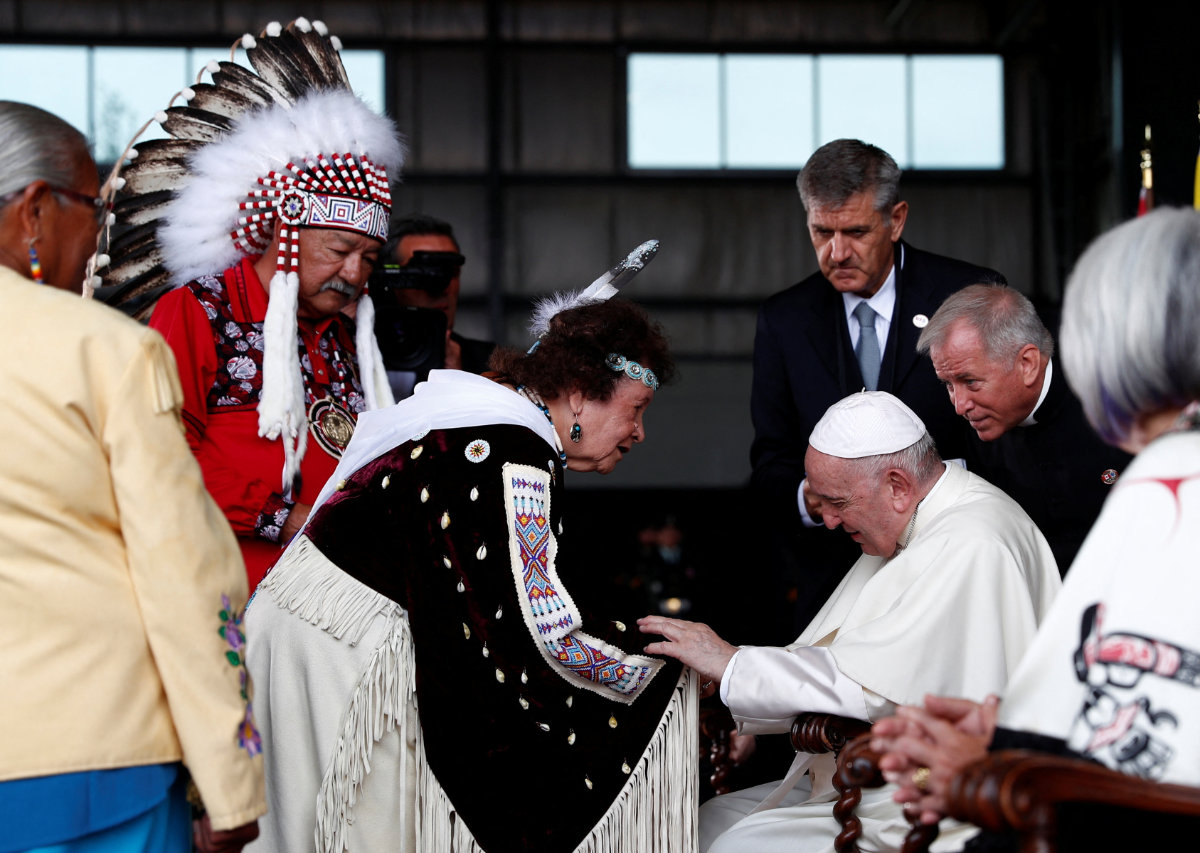
Pope Francis is welcomed by representatives of Indigenous communities upon his arrival at Edmonton International Airport in Alberta, Canada on July 24, 2022. (REUTERS/Guglielmo Mangiapane)
Inuit leader Natan Obed personally asked Francis for the Vatican’s help in extraditing Rivoire, telling The Associated Press in March that it was one specific thing the Vatican could do to bring healing to his many victims.
Asked about the request, Vatican spokesman Matteo Bruni said last week that he had no information on the case.
At a news conference Saturday in Edmonton, organizers said they will do all they can to enable school survivors to attend the papal events, particularly for the Maskwacis apology and the Tuesday gathering at Lac Ste. Anne, long a popular pilgrimage site for Indigenous Catholics.
Both are in rural areas, and organizers are arranging shuttle transport from various park-and-ride lots. They noted that many survivors are now elderly and frail and may need accessible vehicle transport, diabetic-friendly snacks and other services.
The Rev. Cristino Bouvette, national liturgical coordinator for the papal visit, who is partly of Indigenous heritage, said he hopes the visit is healing for those who “have borne a wound, a cross that they have suffered with, in some cases for generations.”
Bouvette, a priest in the Diocese of Calgary, said the papal liturgical events will have strong Indigenous representation — including prominent roles for Indigenous clergy and the use of Native languages, music and motifs on liturgical vestments.
Bouvette said he’s doing this work in honor of his “kokum,” the Cree word for grandmother, who spent 12 years at a residential school in Edmonton. She “could have probably never imagined those many years later that her grandson would be involved in this work.”


