

UK government introduces legal reforms to protect journalists and free speech

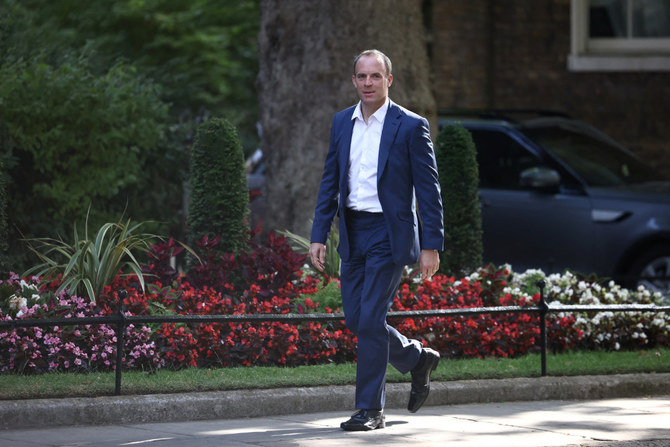
British Deputy PM Dominic Raab, seen outside Downing Street in London on July 19, 2022, is proposing that courts be granted new powers to protect journalists from being muzzled by the rich. (REUTERS)
Short Url
Updated 21 July 2022
Follow

UK government introduces legal reforms to protect journalists and free speech

  • Courts will have the power to decide whether a case has been brought by a wealthy claimant in an attempt to silence criticism or discourage investigations and should be thrown out immediately
  • Such cases, dubbed Strategic Litigation Against Public Participation, are expensive to defend, designed to intimidate and have been employed by Russian oligarchs to target the media

LONDON: The UK government announced on Wednesday a proposal that would grant courts in England and Wales the authority to dismiss cases involving so-called Strategic Litigation Against Public Participation (SLAPP).

According to the government website, SLAPPs are lawsuits intended to censor, intimidate, and silence reporters and publishers by burdening them with the cost of a legal defense until they abandon their criticism.

The proposals, which were set out by Deputy Prime Minister Dominic Raab, include “a new mechanism to allow courts to throw out baseless claims quicker, and a cap on costs to prevent the mega-rich, such as Russian oligarchs, from using expensive litigation as a weapon to silence their critics.”

Courts would be granted new powers designed to protect free speech by employing a three-stage test that would firstly assess whether the case involves journalistic activity that is in the public interest; for example an investigation into financial misconduct by a company or individual. It would then examine whether there is evidence of abuse of process, and finally consider whether the case has any realistic prospect of success.

Anyone targeted by a suspected SLAPP would be able to apply to the court to consider it for early dismissal.

The plans to crack down on SLAPPs were announced in March after the UK government was accused of not doing enough to protect journalists and media organizations from Russian oligarchs close to President Vladimir Putin, who have repeatedly used expensive litigation in UK courts to silence criticisms and discourage investigations into their affairs.

“We won’t let those bankrolling Putin exploit the UK’s legal jurisdiction to muzzle their critics,” Raab said. “So today I’m announcing reforms to uphold freedom of speech, end the abuse of our justice system, and defend those who bravely shine a light on corruption.”

Michelle Stanistreet, general secretary of the National Union of Journalists, said the reforms represent “a significant step in tackling the deployment of SLAPPs and other forms of ‘lawfare’ designed to stymie journalistic investigations.

“Abuse of the law by the sly and mighty, who deeply resent the legitimate work of the media in calling them to account, is a scourge which must be eradicated.”

Dawn Alford, executive director of the Society of Editors, also welcomed the proposals and said a mechanism that will “allow the courts to throw out meritless cases more quickly and a cap on costs are essential protections that should deter the wealthy from using the threat of expensive litigation to silence their critics, and should allow journalists and others the ability to fulfill their roles as the public’s watchdog without bullying or intimidation.”


Paris exhibition marks 200 years of Le Figaro and the enduring power of the press

Updated 17 January 2026
Follow

Paris exhibition marks 200 years of Le Figaro and the enduring power of the press

  • The exhibition celebrated the bicentennial of Le Figaro, offering visitors a rare opportunity to step inside the newspaper’s vast historical archive

PARIS: One of France’s most influential newspapers marked a major milestone this month with a landmark exhibition beneath the soaring glass nave of the Grand Palais, tracing two centuries of journalism, literature and political debate.
Titled 1826–2026: 200 years of freedom, the exhibition celebrated the bicentennial of Le Figaro, offering visitors a rare opportunity to step inside the newspaper’s vast historical archive. Held over three days in mid-January, the free exhibition drew large crowds eager to explore how the title has both chronicled and shaped modern French history.
More than 300 original items were displayed, including historic front pages, photographs, illustrations and handwritten manuscripts. Together, they charted Le Figaro’s evolution from a 19th-century satirical publication into a leading national daily, reflecting eras of revolution, war, cultural change and technological disruption.
The exhibition unfolded across a series of thematic spaces, guiding visitors through defining moments in the paper’s past — from its literary golden age to its role in political debate and its transition into the digital era. Particular attention was paid to the newspaper’s long association with prominent writers and intellectuals, underscoring the close relationship between journalism and cultural life in France.
Beyond the displays, the program extended into live journalism. Public editorial meetings, panel discussions and film screenings invited audiences to engage directly with editors, writers and media figures, turning the exhibition into a forum for debate about the future of the press and freedom of expression.
Hosted at the Grand Palais, the setting itself reinforced the exhibition’s ambition: to place journalism firmly within the country’s cultural heritage. While the exhibition has now concluded, the bicentennial celebrations continue through special publications and broadcasts, reaffirming Le Figaro’s place in France’s public life — and the enduring relevance of a free and questioning press in an age of rapid change.