
TABUK: In line with its ReWild Arabia mission, the Prince Mohammed bin Salman Royal Reserve in Tabuk has reintroduced the Asian houbara bustard after an absence of more than 35 years, marking a renewed, science-based effort to conserve the species.
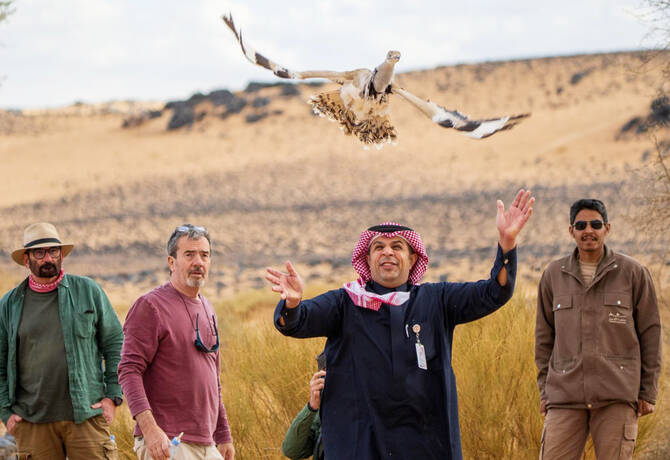
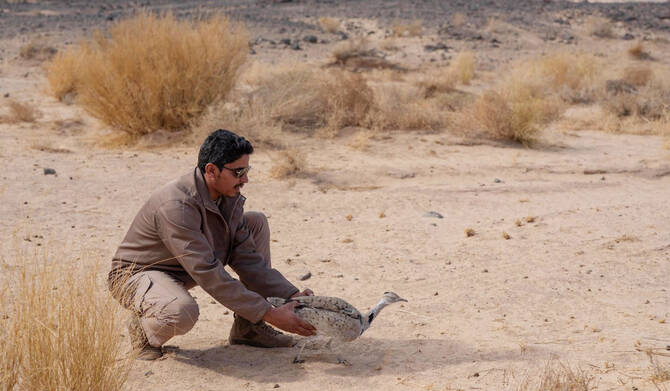
A total of 20 Asian houbara have been released within the reserve as part of a collaboration between the royal reserve, the National Center for Wildlife and the Prince Mohammed bin Salman Houbara Conservation Foundation. The initiative will establish viable wild populations across the Kingdom, the Saudi Press Agency said in a new report.
Historically, both migratory and resident Asian houbara ranged from Egypt to China. In Saudi Arabia, the species once bred widely, with migratory populations wintering across much of the Arabian Peninsula.

A total of 20 Asian houbara have been released within Prince Mohammed bin Salman Royal Reserve in Tabuk. (SPA)
Today, the Asian houbara is classified by the IUCN as Critically Endangered. Resident wild populations no longer exist in the Kingdom, and migratory birds are now only occasionally observed along the Kingdom’s northern and eastern borders.
In an interview with the Saudi Press Agency, Olivier Combreau, CEO of the foundation, said the release represents an important opportunity to advance rewilding science in the Kingdom. “Working with our partners, this initiative allows us to test rewilding techniques and generate critical data to inform future release strategies.”
He added that 10 birds have been fitted with satellite tracking devices, providing essential insights into survival rates, movement patterns, habitat use and threats. “These findings will guide future releases and support long-term population recovery in Saudi Arabia and the wider region,” he said.

A total of 20 Asian houbara have been released within Prince Mohammed bin Salman Royal Reserve in Tabuk. (SPA)
The reserve’s long-term marine and terrestrial management framework supports large-scale habitat restoration across 24,500 sq. km, alongside ranger programs and community engagement designed to support rewinding initiatives.
The Asian houbara holds cultural significance as a traditional quarry in Arabian falconry, which was recognized by UNESCO as Intangible Cultural Heritage of Humanity in 2021. Habitat loss, unsustainable hunting and poaching from the mid-20th century onward led to sharp population declines, the SPA noted.
In response, the late Prince Saud bin Faisal established the Kingdom’s first houbara breeding and research center in Taif in 1985, pioneering captive propagation efforts.

A total of 20 Asian houbara have been released within Prince Mohammed bin Salman Royal Reserve in Tabuk. (SPA)
Despite decades of breeding programs, reestablishing self-sustaining wild populations has remained a key challenge.
Andrew Zaloumis, CEO of the Prince Mohammed bin Salman Royal Reserve, told the SPA that the next phase of conservation must focus on survival in the wild.
“The cultural and historical significance of Arabian falconry and the Asian houbara has driven more than four decades of rigorous scientific research into breeding. While houbara are now bred in significant numbers, the key conservation frontier is achieving the survival rates needed to establish self-sustaining wild populations.
“Through our collaboration with the Prince Mohammed bin Salman Houbara Conservation Foundation, we are committed to restoring viable wild populations within the reserve and across the Kingdom,” he said.
The Asian houbara is the 13th species reintroduced to the Prince Mohammed bin Salman Royal Reserve as part of its rewilding program, which will return 23 native species to their historical ranges.
One of eight royal reserves, the Prince Mohammed bin Salman Royal Reserve stretches from the Harrat lava fields to the Red Sea coast.
It connects NEOM, Red Sea Global and AlUla, and is home to PIF’s Wadi Al-Disah project and Red Sea Global’s Destination AMAALA.
The reserve encompasses 15 distinct ecosystems. Despite covering just 1 percent of the Kingdom’s terrestrial area and 1.8 percent of its marine area, it hosts more than 50 percent of Saudi Arabia’s recorded species, making it among the most biodiverse protected areas in the Middle East.