

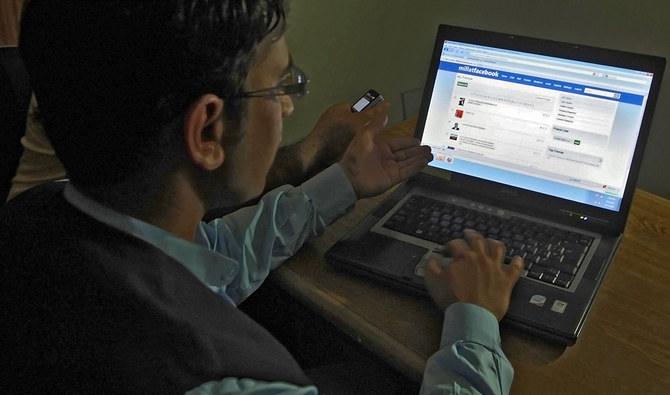

ISLAMABAD: The Pakistani government has decided to crack down on social media users involved in "harassment" and "blackmailing" of citizens as well as promotion of "immoral content and obscene videos," the country's interior minister said on Friday, vowing to strengthen the cybercrime laws to curb these practices.
The development comes as Pakistani authorities attempt to neutralize social media narratives critical of the government and the country's powerful military establishment through amendments in existing laws, but all their efforts have proven to be futile so far.
In 2016, the then Pakistan Muslim League-Nawaz (PML-N) government enacted the Pakistan Electronic Crimes Act (PECA) to check crime on social media and other internet platforms. The successive Pakistan Tehreek-e-Insaf (PTI) government also tried to make the law more stringent through amendments, but it had to back off in the wake of backlash from journalists and digital rights activists.
While the government says such online practices are “unacceptable,” digital rights activists see it as an attempt to stifle dissent.
“The defamation of citizens through character assassination and insulting material on the social media is totally unacceptable,” Pakistan's Interior Minister Rana Sanaullah said in a statement, after presiding over a high-level meeting on "harassment" and "blackmailing" of the citizens and uploading of "obscene videos" on social media.
The interior minister has directed the Federal Investigation Agency (FIA) director-general for “immediate action” against those involved in such crimes.
“The presence of immoral and insulting content on social media and its promotion could spread anarchy in the society,” Sanaullah said. He urged people to lodge their complaints regarding social media harassment and character assassination with the FIA.
The Ministry of Interior has also decided to constitute a working group to introduce necessary amendments in PECA to make the law more stringent and effective. “The working group will look into the legislation and administrative actions required to stop harassment, character assassination and uploading of insulting material on social media,” it said.
A spokesperson for the interior ministry told Arab News the working group would be made public as soon as it was notified and that it would submit its recommendations to the ministry after consultation with all stakeholders.
Digital rights activists, however, say successive governments in Pakistan have used PECA to persecute political opponents and stifle free speech and press through this “draconian and notorious” law.
Usama Khilji, director of 'Bolo Bhi' digital rights advocacy group, said there was no need to bring more changes to the law as “it would end up undermining the freedom of speech and freedom of press that is enshrined in our constitution.”
“Cyber stalking and online harassment are already punishable offences in PECA,” he said. “Uploading and promotion of child pornography and morphing of photos and videos on social media platforms are also included in PECA.”
Khilji said political parties make “short-sighted plans” to curb dissent after coming into power, however, the civil society must resist any such move.
Nighat Dad, executive-director of Digital Rights Foundation, said all political parties in Pakistan, whether they were in power or opposition, tried to suppress the dissenting voices through PECA.
“The Islamabad High Court has already struck down section 20 of PECA relating to criminal defamation by terming it unconstitutional,” she told Arab News. “But it seems like the government wants to bring it back now through another amendment.”
Dad said the government should focus on strengthening the criminal justice system and implementation of existing laws to provide justice to public instead of trying to make PECA more stringent. “The right to freedom of speech and freedom of expression must be protected as long as it doesn’t hurt anybody physically offline,” she said. “People have every right to criticize public representatives and hold them accountable, so this right must be protected both in online spaces and offline.”


